
The factory above us.
Microgravity Manufacturing

How can you make something in a place where gravity is optional?
Last week marked the thirteenth test flight of SpaceX's ‘Starship’, a (hopefully) fully reusable spacecraft the size of a medium haul airliner. It should be able to carry a hundred tons to low Earth orbit when combined with the aptly-named ‘Superheavy’ reusable booster. Put together they're an air-rending flying skyscraper burning five thousand tons of liquid methane and oxygen at a pace that would drain an Olympic swimming pool in a minute… and they're not alone.
For example take SpaceX's Falcon 9 reusable booster, which at about six hundred safe landings has miraculously made re-usable spaceflight boring. But there's more! Blue Origin’s vast New Glenn booster successfully landed itself after a launch on an Atlantic ocean droneship in November last year, and was reused a couple of months ago. China achieved its first booster landing & recovery last month with a Long March 10B rocket, and these events combined do more than make headlines.
They confirm a pattern.

Competition is a wonderful thing, and as more and more new entrants enter the re-usable booster club (yes, even stalwart Europe eventually) we can expect the door of heaven to open a crack. The advent of fully rapidly reusable rockets like Starship could kick it down completely.
Most of humanity hasn't quite come to terms with what this means. The democratisation of access to the Great Upstairs is coming, and that won't just mean cheap satellite Internet. Eventually it'll mean people living and working in the orbital economy: Entire townships over our head, growing in number with our aspirations. In low orbit initially, nearer to Earth than you might be to your capital city. Hunkering close to the lights of home, clustering by the fireside, their backs to the night.
But slowly at first and then with great haste, like a dandelion seed detonation in the dusk, those lights will spread into the black.
And when they do, which they will given time, they'll need to do two things: Build stuff that can't be supplied to them at the pointy end of a giant rocket, and justify their journey to the Far Above by creating things inaccessible on Earth.

When push comes to zero-g shove, that'll mean setting up factories in space.
What challenges can we expect, and will we discover impossible gems?
Oh, yes. We will!
1: Consider Kroll.
Zero-g manufacturing isn't a panacea for all production ills. In fact, for many industrial techniques the lack of gravity is bloody inconvenient!
I can think of no better example of this than the Kroll process; the industrial method to refine commercially pure titanium from its oxide ores.
In titanium processing the primary challenge is separating it from its oxide, because titanium loves itself a bit of oxygen on the side, the filthy ‘ore. In the Kroll process separating the two is first achieved by reacting the ore with chlorine, which strips the oxygen and latches onto the titanium, making titanium tetrachloride (TiCl4).
Chlorine, presumably, is a much saucier wench than oxygen, metallurgically speaking. Who knows? I don't understand it, but maybe I'm just not Metal enough.
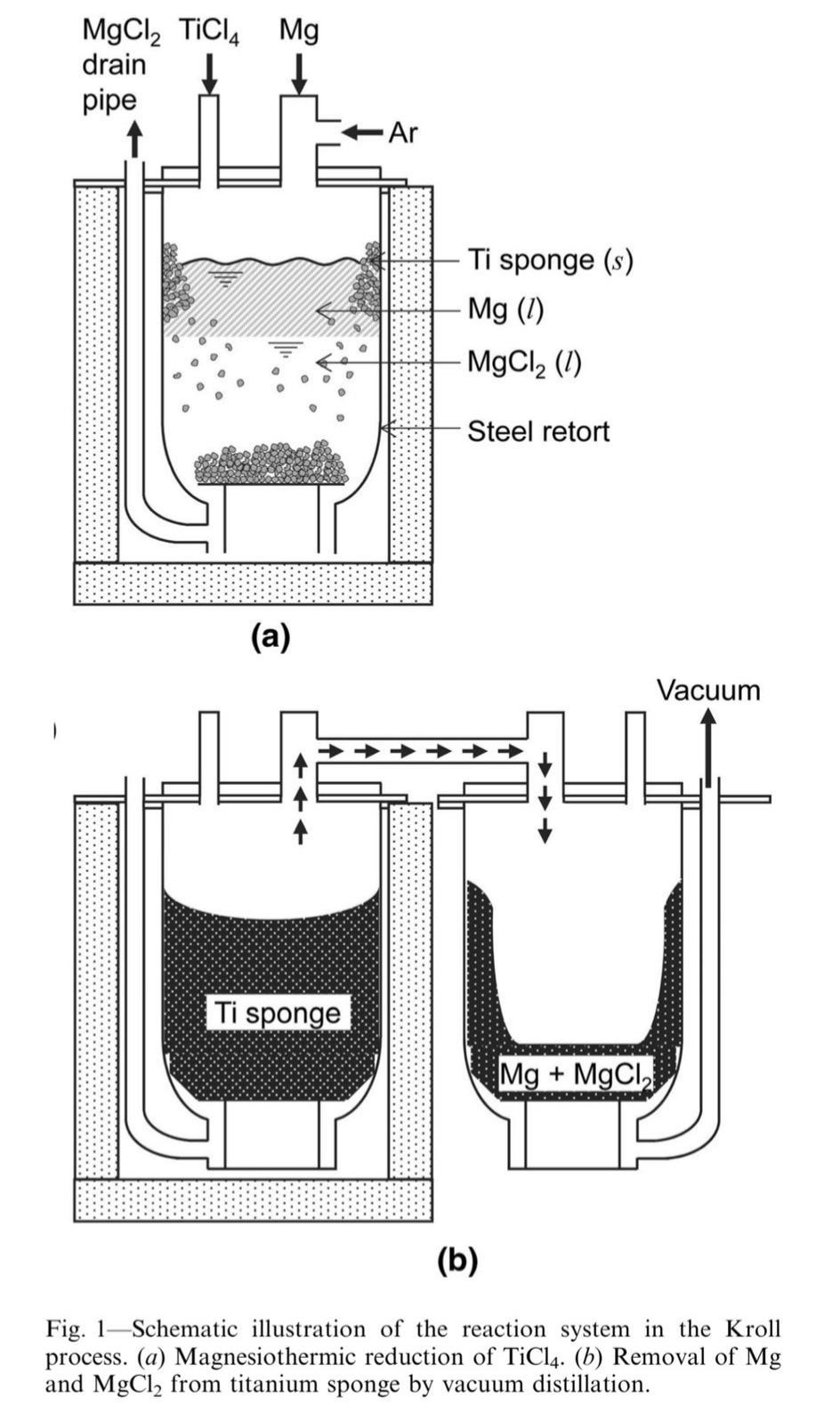
Anyway, that still leaves us the problem of separating the chlorine from titanium tetrachloride, and to do that we need to complete the metallurgical love triangle by blasting TiCl4 into an 800 degree Celsius reactor filled with molten magnesium, where the TiCl4 vapourises into a gas on contact. Chlorine, tempestuous mistress that it is, leaves the titanium and bonds with magnesium, forming magnesium chloride (MgCl2) and leaving pure titanium as a solid froth on the choppy surface of a magnesium sea. Result!
At this point you might be wondering what this has to do with zero gravity manufacturing. Sit tight, for all will be revealed…
The solid magnesium chloride is very dense, and sinks to the bottom of the reactor, out of the way. The lightweight titanium metal froth floats to the surface, the TiCl4 (due to its lower boiling point) stays a gas above it and the whole reactor stays animated by convection, with the choppy surface of the magnesium as the primary interface for the reaction to continue. The reaction only slows down when enough titanium has formed to block the surface.
The key factor here is the invisible employee that makes it all work: Gravity. It drives convection, allows density-based separation, manages thermal gradients and maintains an ordered reaction interface. Without gravity (even artificial ‘gravity’ produced by spinning) it simply wouldn't work.
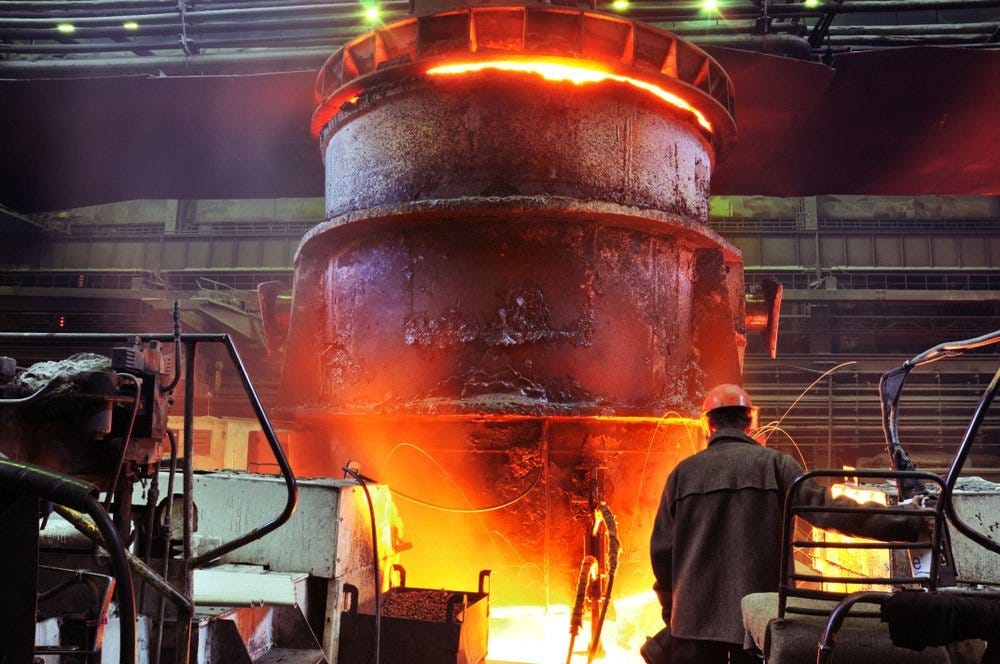
This doesn’t apply just to the Kroll process: In microgravity even electrolysis is a challenge as any bubbles that form can't just float to the surface, and choose instead to stick around and reduce efficiency. This is a particular pain if you're electrolysing water for oxygen and hydrogen, which you'd think would be a fundamental process in space settlements.
And it doesn't stop there: Even something as simple as welding behaves differently in microgravity, as surface tension draws the weld bead into an inconvenient sphere. Weld depth penetration becomes hard to control and porosity from trapped bubbles increases, reducing strength.
In a future microgravity fabrication facility you could see a lowered reliance on traditional techniques like arc welding and a greater use of methods that are less dominated by gravity and convection: For example, pressure-driven friction welding and near-net-shape hot isostatic pressing might become widely used out of basic necessity.
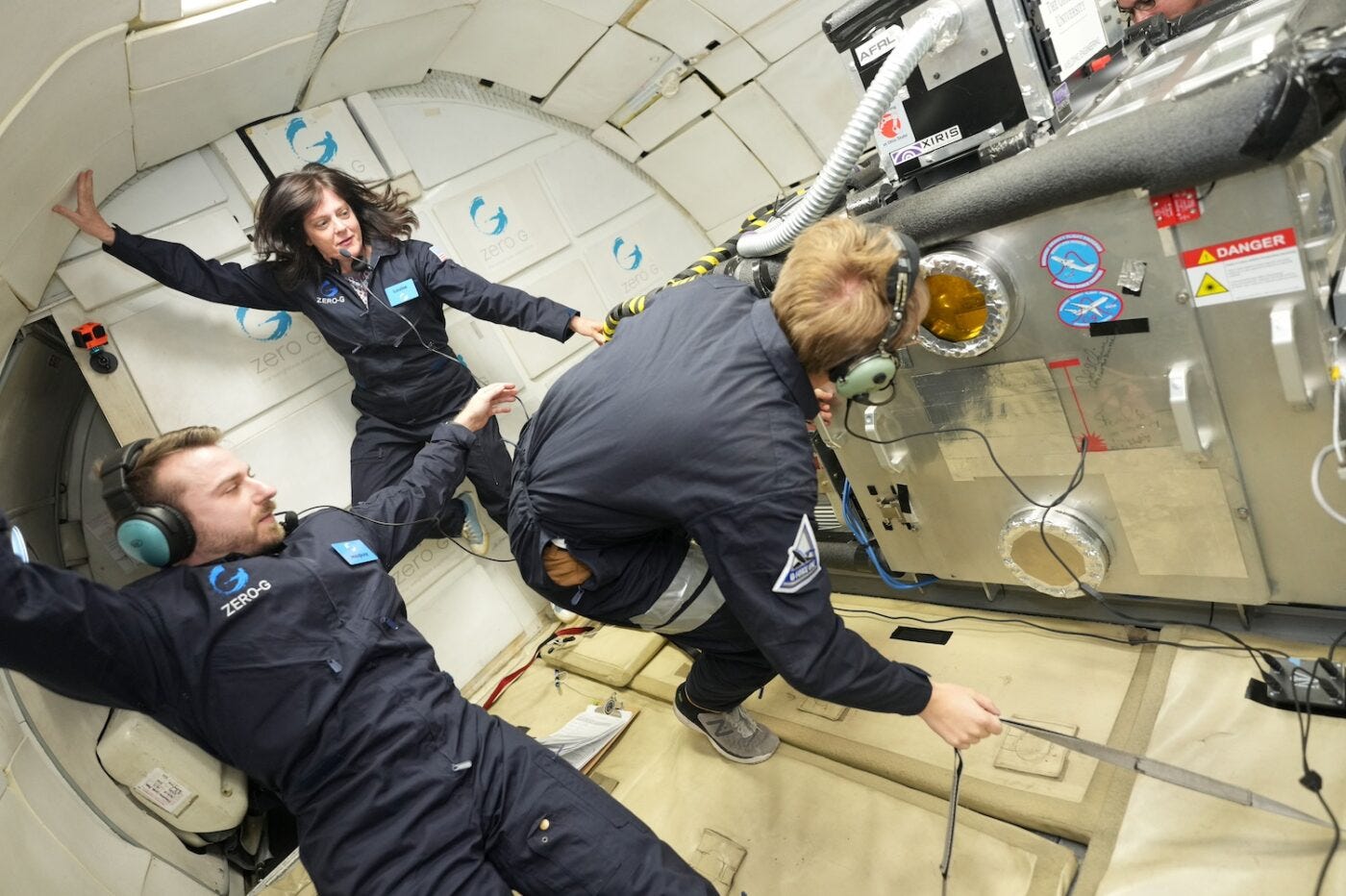
And it's not just fluidic processes that become a pain where gravity's invisible hand is absent. Even humble metal cutting operations need careful consideration, unless you want a face full of swarf and coolant oil every time you try to mill or lathe anything. Powerful vacuum removal systems or high pressure gas coolant would be advisable.
But it's not all bad: Some 3D printing techniques work quite well, high purity systems can benefit from containerless processing, and complex crystal growth can run unimpeded by the dread hand of gravitation.
In fact there are a few niches that only work in microgravity.
2: Of Crystals & Computation.
Our world is not wireless, whatever your smartphone thinks.
Fibre optic cables are the information arteries of our civilization: Unseen, unsung and unappreciated, they carry our techno economy on their sinuous backs, transmitting the bulk of the world's data. This is given particular salience now, as Russian ships skulk off the unguarded Irish coast, where most of Europe's trans-Atlantic data traffic makes landfall.
All it would take is a couple of anchors in the wrong place. All very deniable…
But what are fibre optics, how do you manufacture them and what has this got to do with space and zero-g?
Let's start with the basics. A fibre optic wire is basically a strand of extruded glass the thickness of a human hair that you can bounce light signals through. They were invented in the fifties for medical endoscopy, allowing surgeons to look inside patients in minimally-invasive surgeries, but its potential was quickly realised for telecommunications.
Light frequencies are far higher than the electricity in copper wires, allowing enormously increased data bandwidth for fibre optic cables. This is further enhanced by the ability to transmit multiple colours simultaneously, and in a form resistant to electromagnetic interference.
And that's why my streaming TV is provided by a fibre optic line into my house, instead of being beamed down by satellite.
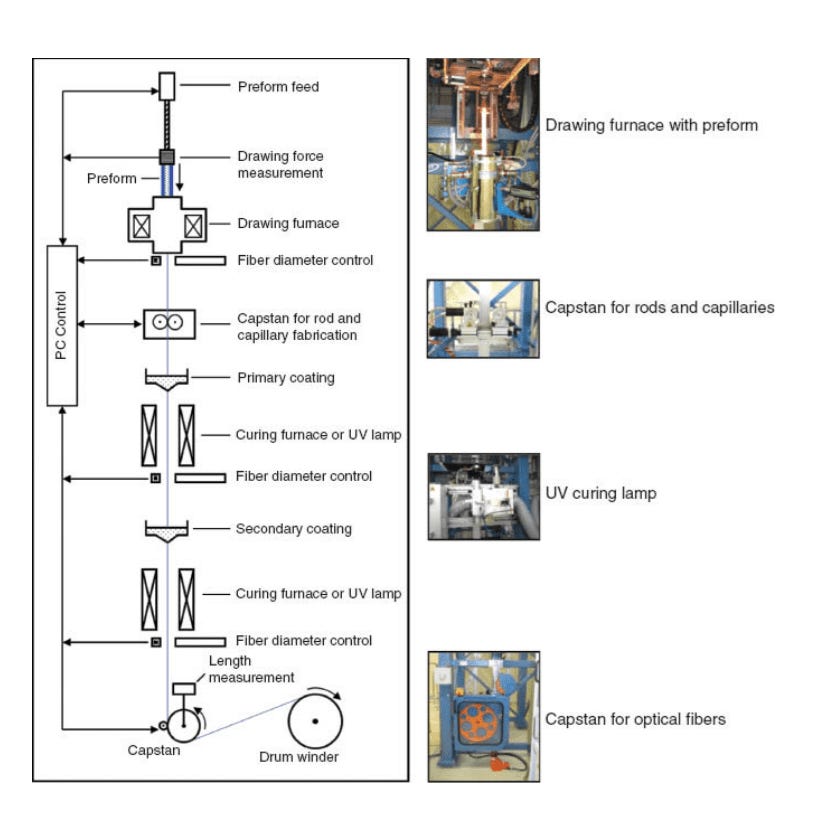
To make it, a super-pure cylindrical ‘preform’ (typically plastic or silica glass) is created with chemical vapour deposition around a rotating rod, forming the required structure. This preform is aligned vertically over a drawing furnace where the base of it is melted and a thin strand is extruded under gravity from the base, with its diameter governed by a hole in the drawing furnace. The drawn fibre, stretching and aligning its molecules to the fibre direction as it is drawn, is then coated and reeled in a continuous process.
So, once again gravity is a production tool, in which case what’s the advantage of zero-g?
The advantage is that it enables use of specialist fluoride gas-based glass such as ZBLAN. This is a glass alloy of zirconium, barium, lanthanum, sodium and aluminium fluoride. Usefully, it's transparent over a much wider range of frequencies than conventional silica glass, extending into the infrared for example. This exotic material can therefore transmit more than ten times the data for a given amount of cable, with minimal losses over long distances.
So it's a metal-glass magician, yet it's not everywhere. What's the catch?
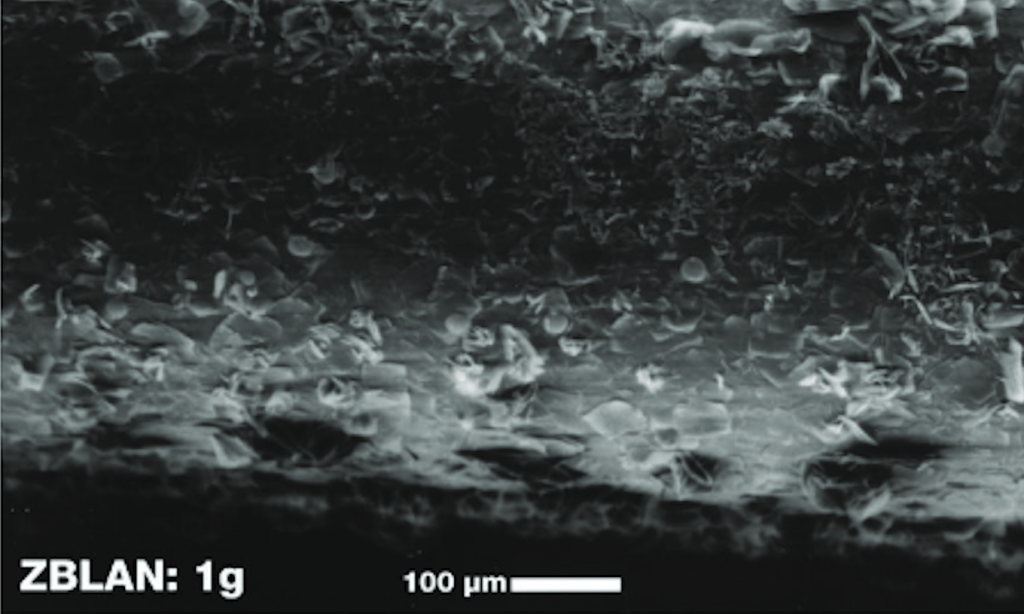

The catch is that it's bloody hard to make. The different components of ZBLAN all have different crystallisation temperatures, and the alloy resists forming a glass. Gravity is a particular bugbear, as crystallisation control of ZBLAN is so delicate that convection and density-driven discontinuities cause micro-crystals to appear throughout the ZBLAN strand, scattering light and defeating the purpose.
But slow down crystallisation in micro-gravity and it's possible to defeat this, which has been demonstrated on the International Space Station through the Flawless Space Fibers mission. Multiple kilometres of nearly flawless ZBLAN have been produced through a miniature zero-g extrusion system up there: A prototype for a nascent industry that could boost global communications, quantum computing and medical lasers & diagnostics.
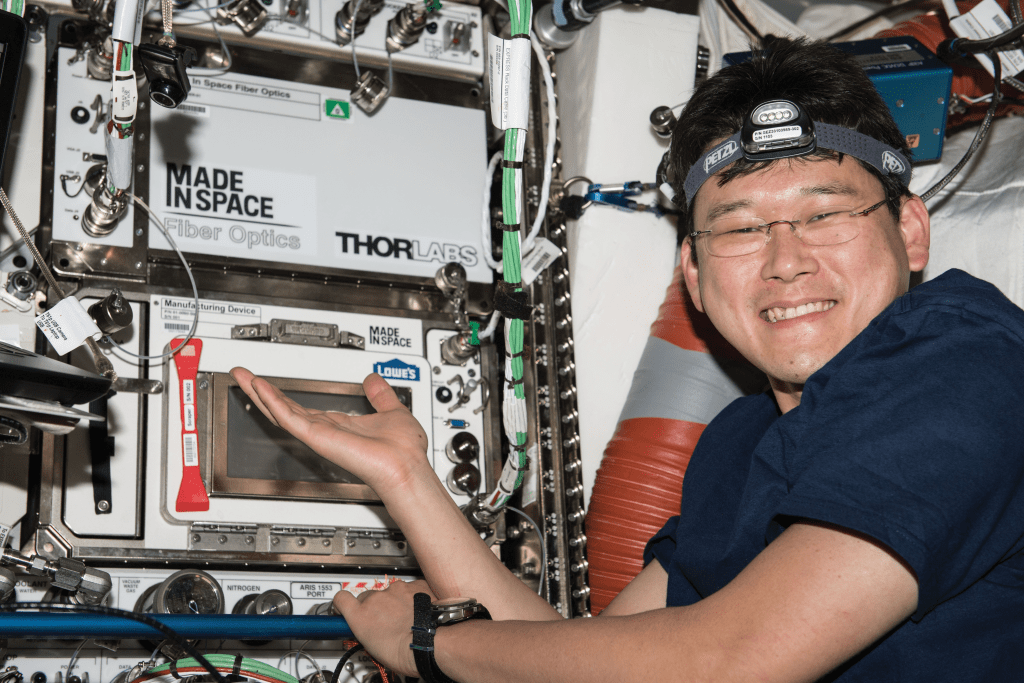
The arteries of the world, unclogged from space?
Maybe. Stranger things have happened…
3: Drugs from space: The re-entry factory!
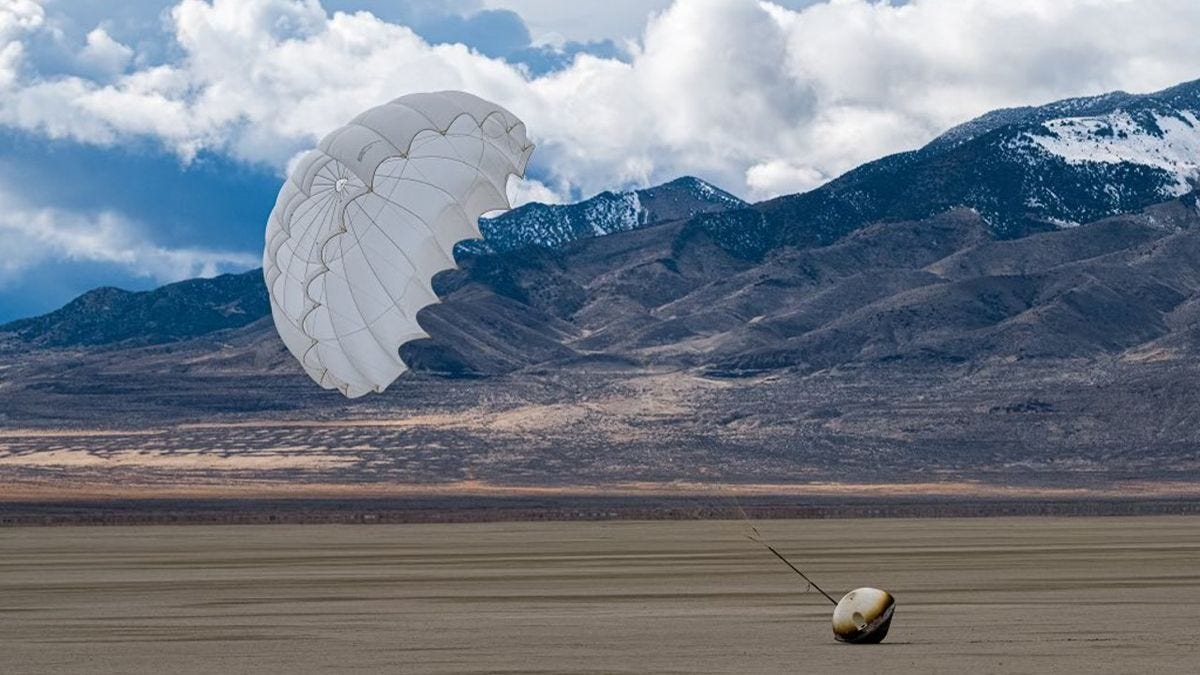
On the 21st of February, 2024, in the clear skies of a Utah afternoon, a new star fell to Earth. It was a prototype re-entry vehicle owned by the US startup Varda and it contained temperature controlled pharmaceutical reactors, filled with the HIV/ AIDS drug Ritonavir.
Why?
