
Surviving re-entry!
Dumping Icarus

Last week a gigantic shark-finned shape the size of a Boeing 737 dropped out of space on a fast-track to the Indian ocean. It fell with gentle ballistic grace, like a thrown knife through an empty room, but about a hundred kilometres up it hit a wall.
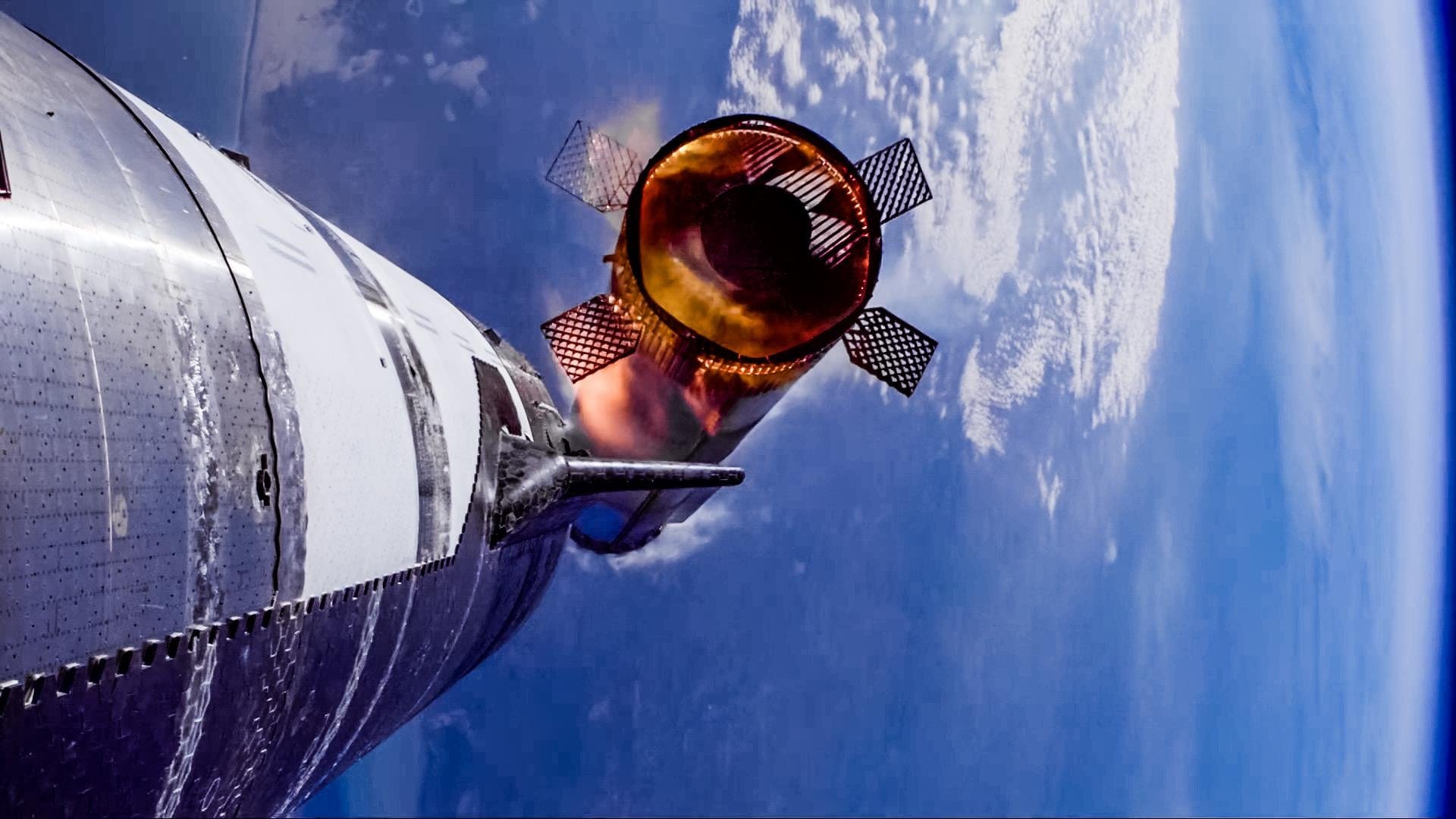
Elon Musk's spectacular ‘Starship’ is a design straight out of schlock science-fiction but exactly right for its intended purpose, which is to shed the kinetic energy of a seventeen thousand miles per hour descent without disintegrating or rendering itself into a smoky crater, or a turbulent splash. Its final graceful rocket powered hover at a precise location over the waves is an act of engineering ballet, performed by dancing skyscrapers.

But the real drama starts a little under a hundred kilometres up where the atmosphere changes from a ghost to a wisp, which for something like Starship is about the same as slamming into a brick wall, twenty-five leagues above the sea.
When something like Starship chooses to return to Earth's embrace it can be doing anything up to 17,000 mph, and that's a lot of haste. At this kind of speed (about 25 times the local speed of sound) the airflow over the spacecraft doesn't function as you'd expect as Starship is moving too damned fast for air to ‘get out of the way’ in the normal fashion. Instead a series of violent shockwaves form around the vehicle, which redirect the path of the air passing through them, at the expense of rapid compression and the generation of a certain amount of heat.
A lot of heat!
At the high hypersonic speeds encountered by descending spaceships like Elon's characterful creation, the shock heating gets to thousands of degrees: Enough to rend the air into an ionised plasma and cut steel. Enough to obliterate almost any material, in fact! It's trial by hellfire…
Do you want to know how to protect yourself from hellfire?
1: The plasma cutter.
Necessity is the mother of invention, but genius can pre-empt it.
Robert Goddard first developed the concept of a heat shield in the late 1920s after observing meteors entering the Earth's atmosphere. This significantly predated World War 2, where the advent of liquid fuelled rocketry and the V2 ballistic missile underlined the point that war really does quicken the blood of invention. As conflict and captured German scientists gave way to the Cold War and the space race in the 50s and 60s, the issue of re-entry heating became salient at last. Aerodynamicist Von Kármán coined the term ‘thermal barrier’, believing that no material known at the time could resist the demands of re-entry from orbital velocities.
As it turned out, Von Kármán was wrong, but it begs a question: If rockets are able to accelerate up through the atmosphere to orbital speeds in the first place, why is decelerating back down such an intractable problem? Aren't the two scenarios just two sides of the same coin?
Not quite.
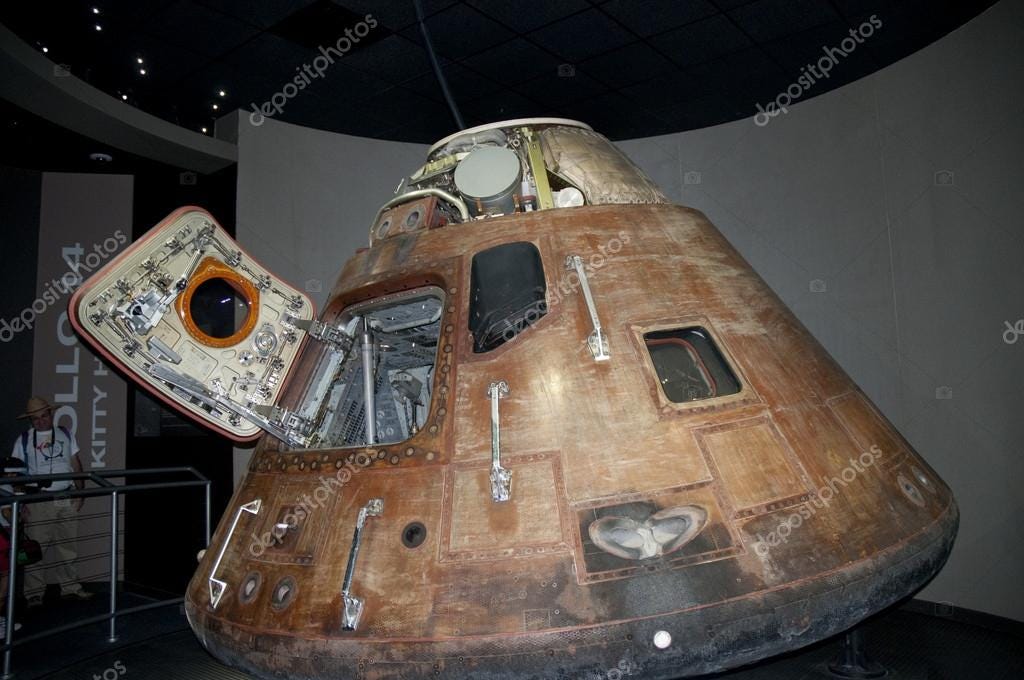
For a start, a skyscraper-sized orbital rocket ascending with misleading speed towards the heavens does most of its acceleration above the air: The big booster stage is mainly concerned with gaining height rather than velocity, while the second (or even third) stage spends most of its time accelerating in the ghostlike realm of the stratosphere and ionosphere, where the atmosphere is as thin as a tax economists’ Christmas party. For example, the most common launch vehicle in the world, the Falcon 9, stages at between 70 and 80 kilometres of altitude at about six times the speed of sound. This is fast, no doubt, but not so fast that thermal protection is a big factor. The vacuum adapted engines of the second stage then accelerate the Dragon spacecraft another two and a half times to reach orbital velocity while the big booster falls back to Earth.
And the re-usable first stage booster gets to fall in a graceful parabola from a relatively low altitude (“only” 70 to 130 kilometres) and so never ends up gaining that much velocity… only twice as fast as a BlackBird spy plane, or six times faster than a handgun bullet. No problem.
The second stage, however, has to return from orbital velocities, which is a little more problematic…
Orbital velocity is 7.8 kilometres a second, or over twenty eight thousand kilometres per hour, or over seventeen thousand miles per hour. Or about twenty-five times faster than that handgun bullet. -Basically it’s really bonkers fast, and the only thing available to slow the spacecraft down is the atmosphere, which starts as a ghostly memory way up high but increases exponentially in thickness from one hundred kilometres altitude as the spacecraft falls.
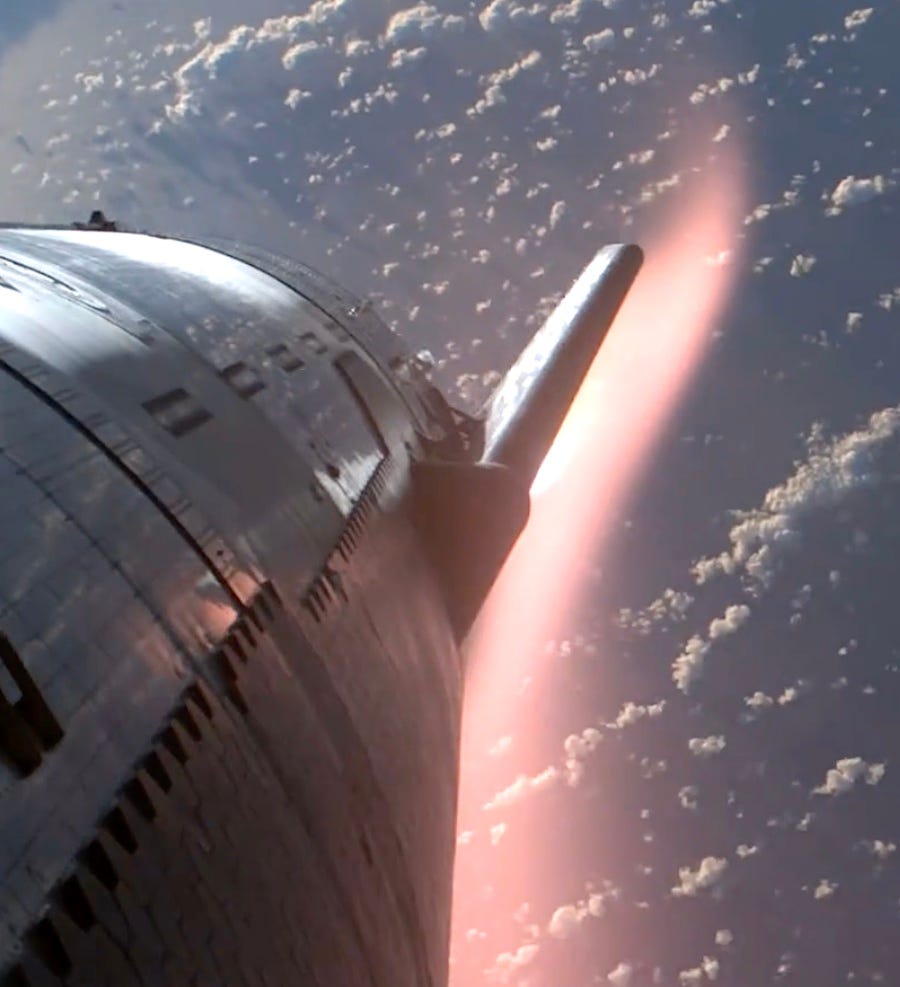
At these velocities, the shockwaves that form around the spacecraft do more than make a loud bang: The heating of air through the shock (or just impact with the hull) is so severe that it hits thousands of degrees and is turned into plasma. Plasma that radiates powerfully, basting the fuselage in lethal heat. What’s more, the sheath of superhot ionised gas is opaque to radio waves, which means that a re-entering spacecraft can be completely shielded from communication from the ground. This was particularly troublesome during the Apollo missions, where a three-minute blackout cut the astronauts off from the ground for the most dangerous part of the mission.
Three minutes as a meteor, and nobody in the world knows if you’ve made it or not. Trust the math buddy, because you’re all on your own.
SpaceX managed to break the blackout curse by bouncing signals from the spaceship upwards, through its orbiting mega-constellation of Starlink satellites, allowing for something the world has never seen before: A live feed of re-entry! This led to some epic-level tooth-grinding with many of the flights, as Starship flight 4 managed to survive re-entry with a control flap almost severed from its body by plasma that had torn away the heatshield and was melting the steel frame.
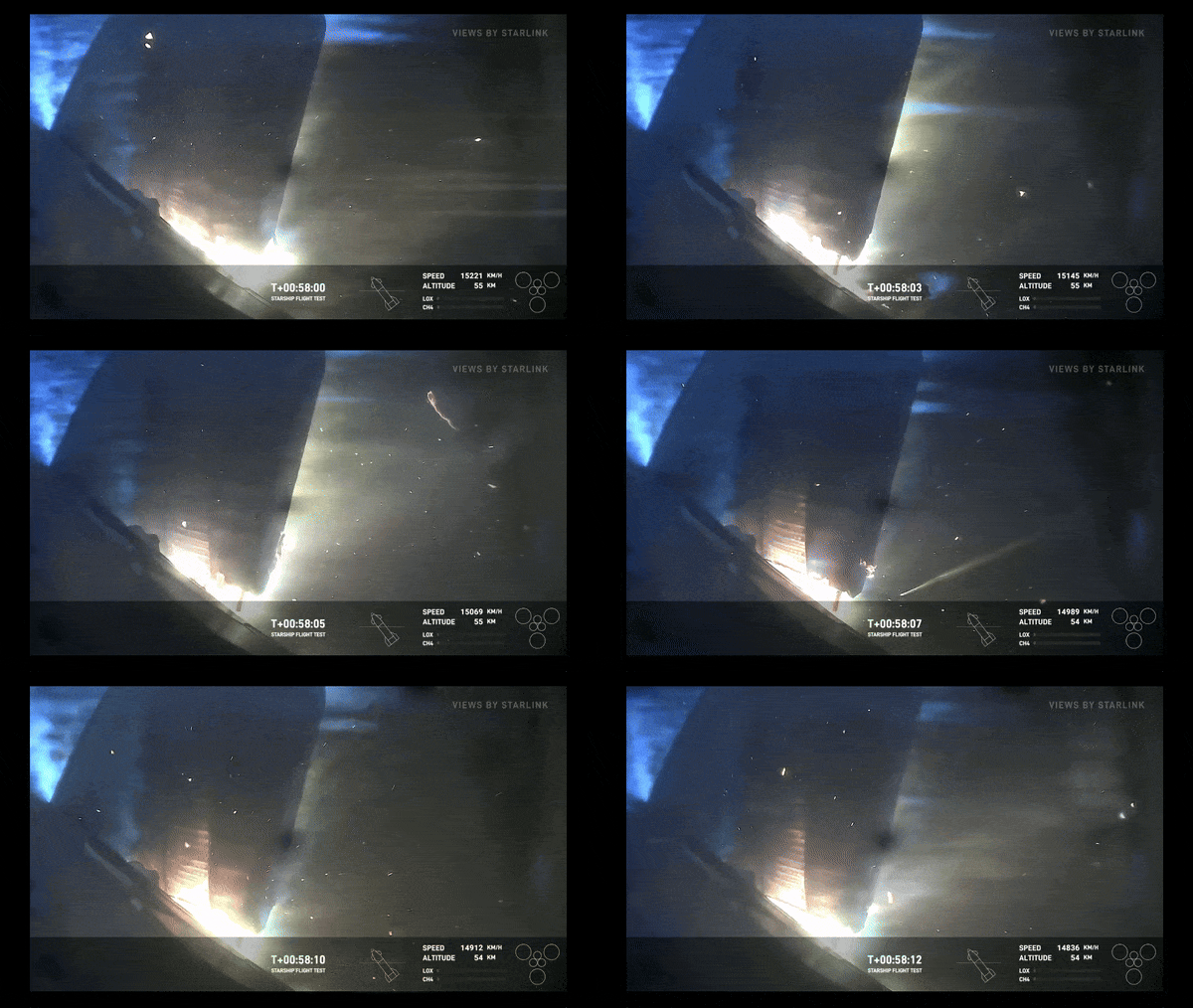
At a high enough velocity, air is pretty damned dangerous!
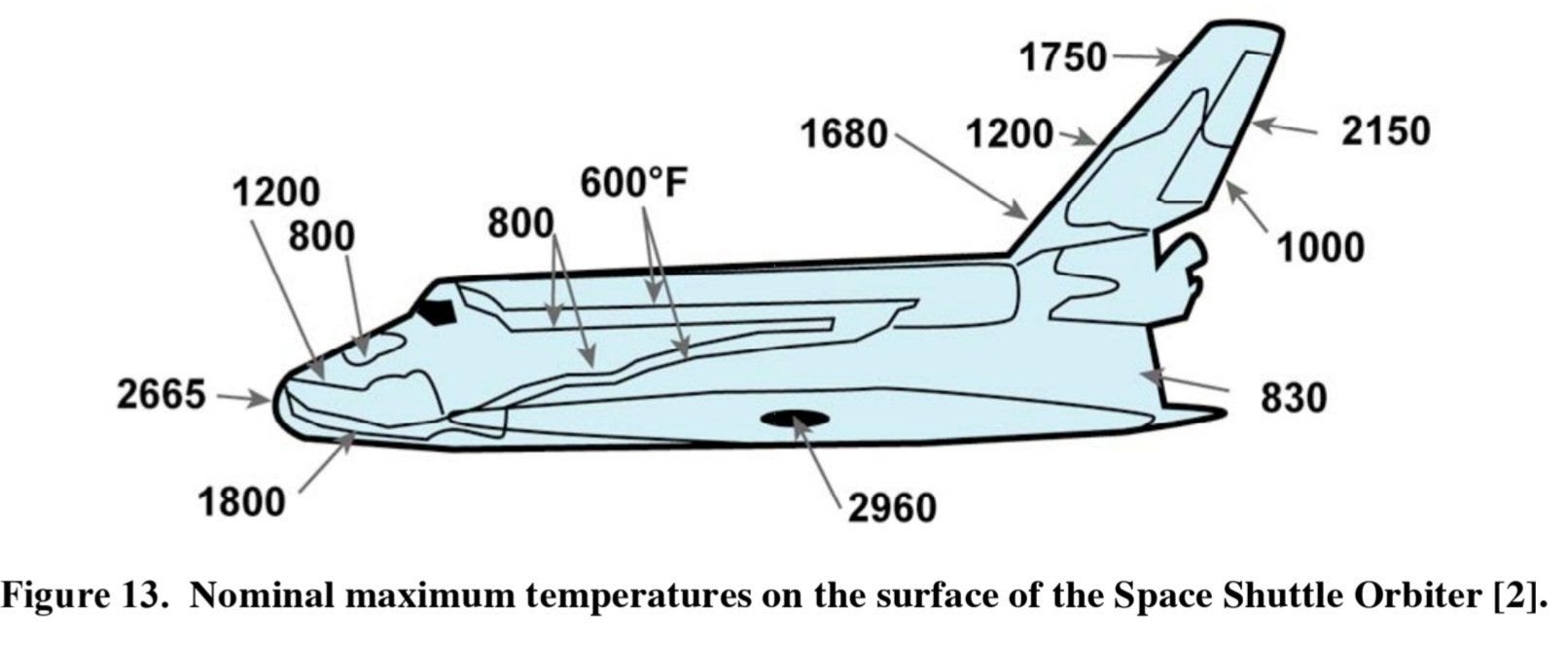
For a more eighties-style example, here’s the max skin temperatures experienced by the Space Shuttle orbiter during re-entry (here written in Fahrenheit), with the most vicious hotspots on its nose and belly, where 2,960F, or 1,627 Celsius is seen. This is a temperature that would melt steel, titanium or even nickel. It’s a temperature rarely seen outside the heart of gas turbine engines, and in those the superalloy blades and nozzles only survive through the application of serious amounts of cooling from highly compressed air: Something the Orbiter didn’t have access to.
And it’s not just about peak temperatures, but also managing energy. An object at orbital velocity has to shed kinetic energy equivalent to 31 million Joules per kilogram… OK, that means nothing to anyone, but it’s about seven and a half times more energy per kg than you’d get by exploding TNT, and it all needs to be dissipated.
Fortunately only about 1%-3% of this gets absorbed into the spacecraft itself (shockwaves knock most of the rest into the air), but that’s still enough to cook the occupants if it’s not managed: Even 1% of kinetic energy retained as heat in the vehicle is sufficient, if evenly spread-around, to raise the temperature of the entire craft by 600 degrees if it was all steel, or 74 degrees if you somehow built an all-water spaceship. Basically it’s lethal either way.
So thermal protection isn’t just about finding high temperature materials, because you also need insulation to keep all that heat away from the astronauts inside, and cooling to make sure that it stays away. This is not straightforward!
So long story short, what are our options?
2: Options, options.
You can divide thermal protection systems into two broad categories: Active & passive. In an active system, some mechanism exists to transport heat energy away from the structure and cool it, whereas in a passive system you just stack up materials that can take the heat and let them soak it up.
There is also a semi-active option, which we’ll start with: Ablators!
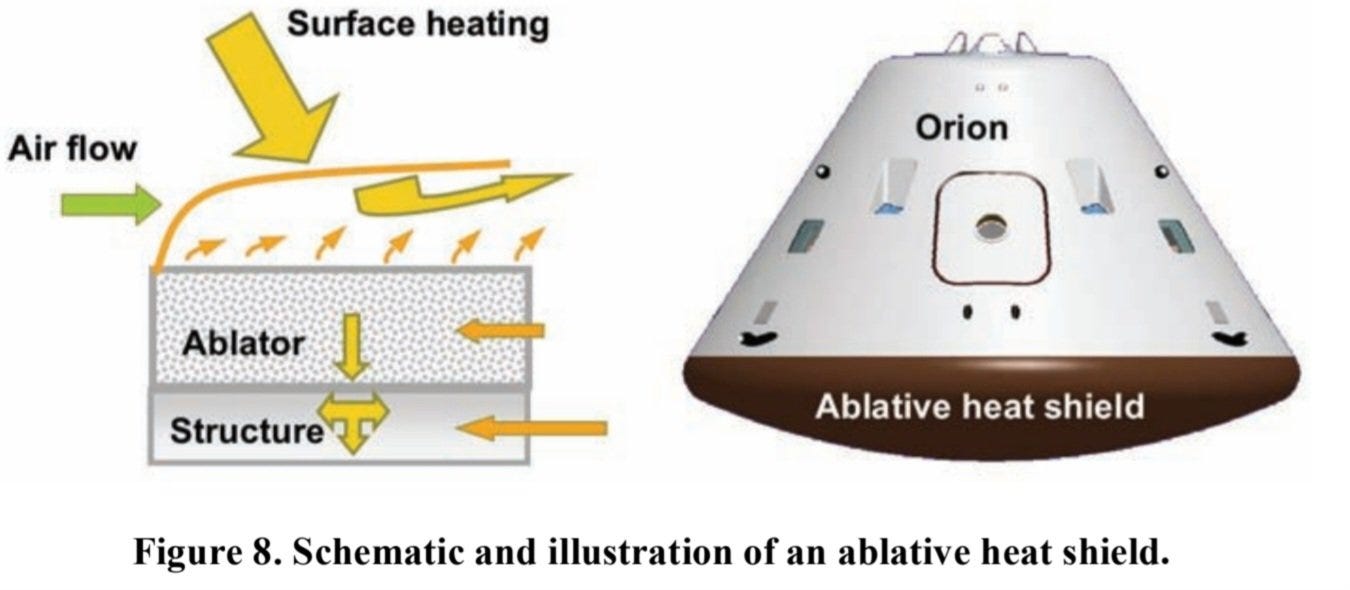
An ablator shield is a one-use disposable heat shield that is charred or chemically altered by the heat of re-entry and outgasses as it does so. In this way it both absorbs heat and also expels it through loss of material as the shield is ablated away. One early example of this is cork. Yes, the wood itself!
Cork is low density and has a cellular structure of closed prisms filled with air, providing superb insulation for the structure beneath. It also forms a char layer as it’s hit by superhot plasma, absorbing the heat in an extra barrier. The char formation creates outgassing, dumping thermal energy into the air as it abrades down. This happens relatively slowly, so aerodynamic geometry isn’t badly affected, and the ease of machining, cheapness and lightness of cork has made it a valuable structural component in many heat shields.
And it’s renewable too, eco-fans! Just plant another tree.
Other more synthetic ablator shields include Avcoat (a honeycomb epoxy which chars and outgasses) that was used in the Apollo program, and PICA (a phenolic resin impregnated carbon ablator) used in the SpaceX Dragon spacecraft as well as the Stardust comet sample return mission. Ablation layers are excellent at dealing with very high heat fluxes (hence their use in the extreme velocity lunar capsules), but are mostly one-shot-&-done, not ideal for reusable spacecraft unless you’re willing to book in plenty of renovation between launches.
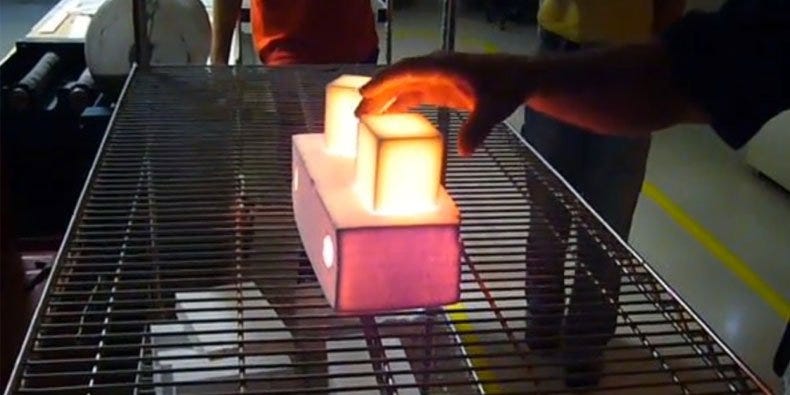
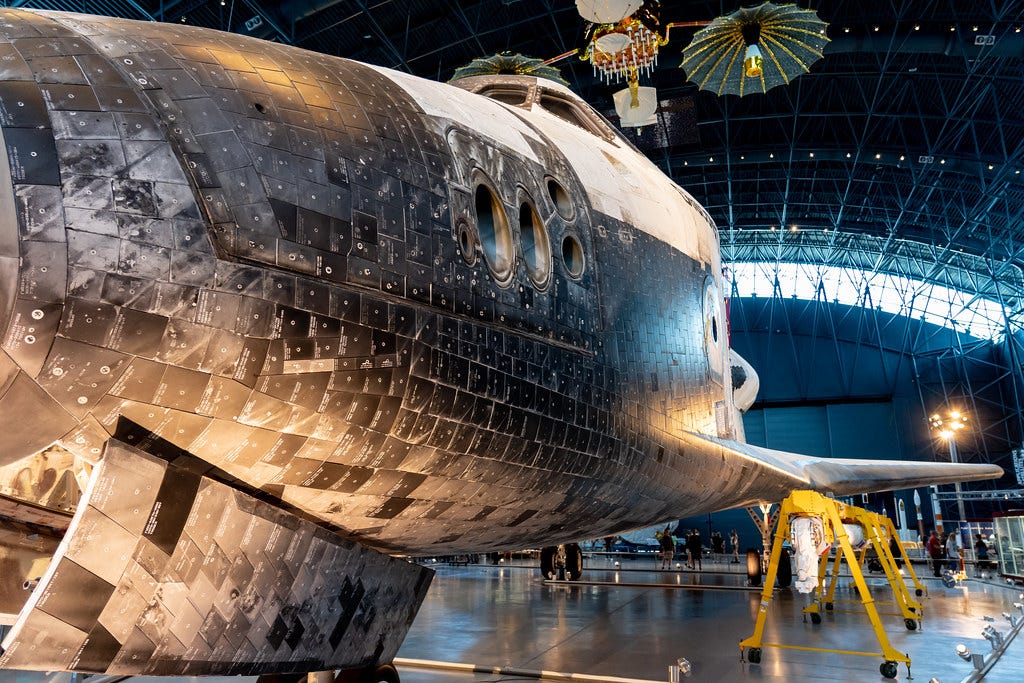
And so we move to our next category: Passive thermal protection through insulating tiles & blankets! These are typically aimed to be reusable, degrading minimally within an individual flight, and so are found on vehicles like the Space Shuttle (LI-900 silica glass fibre tiles) and the SpaceX Starship (a silica-based ceramic tile). They are designed not just for heat resistance but also spectacularly low thermal conductivity. There are videos online of people holding LI-900 tiles at their edges by hand straight after they’ve been sat in a 1,200 Celsius oven. Heat simply isn’t flowing into the person’s skin fast enough to burn them, even though the centre of the tile is white hot!
All this specialization brings drawbacks of course: If you optimize for low thermal conductivity (a LI-900 tile is 94% air) then you lose strength, rendering them fragile. We sadly saw the possible results of that with the Space Shuttle Columbia disaster, which disintegrated during re-entry due to a compromised thermal protection system, though this was a carbon-carbon panel rather than a LI-900 tile. Reinforced carbon-carbon is a carbon composite weave embedded in a graphite matrix, capable of managing temperatures over 2,000 Celsius. They were found on Space Shuttle hotspots such as the underside of the nosecone and wing leading edges.
Likewise, tile loss on early SpaceX Starship vehicles led to dramatic re-entry failures and is something that has been continually optimized as the program has advanced.
The other drawback of reusable tiles or panels, aside from potential fragility, is complex assembly. If you commit to re-usable tiles then you need a lot of them, and you need them to be securely mounted with minimal gaps that plasma could sneak in-between. Starship, for example, has an ablative layer underneath it’s silica composite tiles, thousands of which cover the exposed belly, fins and nose section of the craft. Unlike the Space Shuttle they are standardized, which aids manufacture, inspection and installation, but tiles still add a significant assembly & inspection load to the turn-around of a reusable spaceship.
And they’re kinda fat-looking, so you’ll have no slinky needle points on your cool new spaceship, which immediately loses you 1950s retro-chic points. Whether through ablatives or tiles, making it pointy seems to be a no-go.
And before we dive into the other forms of thermal protection, let’s explore why chonky spaceships might actually be a good thing…
3: Buck Rogers was wrong!
We’ll start with some counter-intuitive design quirks. For one, why are space rockets and orbital capsules so damned… blocky?
We naturally assume that something designed to go really, really fast will have a certain retro sci-fi aesthetic. In short, we want it to be pointy! Fast cars are pointy, missiles are pointy, speed skaters aren’t exactly spherical, so why are the front ends of space rockets so blunt?
The answer lies in heat protection: Early attempts at hypersonic rockets were indeed pointy, on the basis that this would reduce drag and therefore heat loading… except it transpired that a slim ‘n’ sporty physique was a death sentence in the hypersonic realm. It’s just one of the counter-intuitive design quirks that dominate re-entry vehicles.
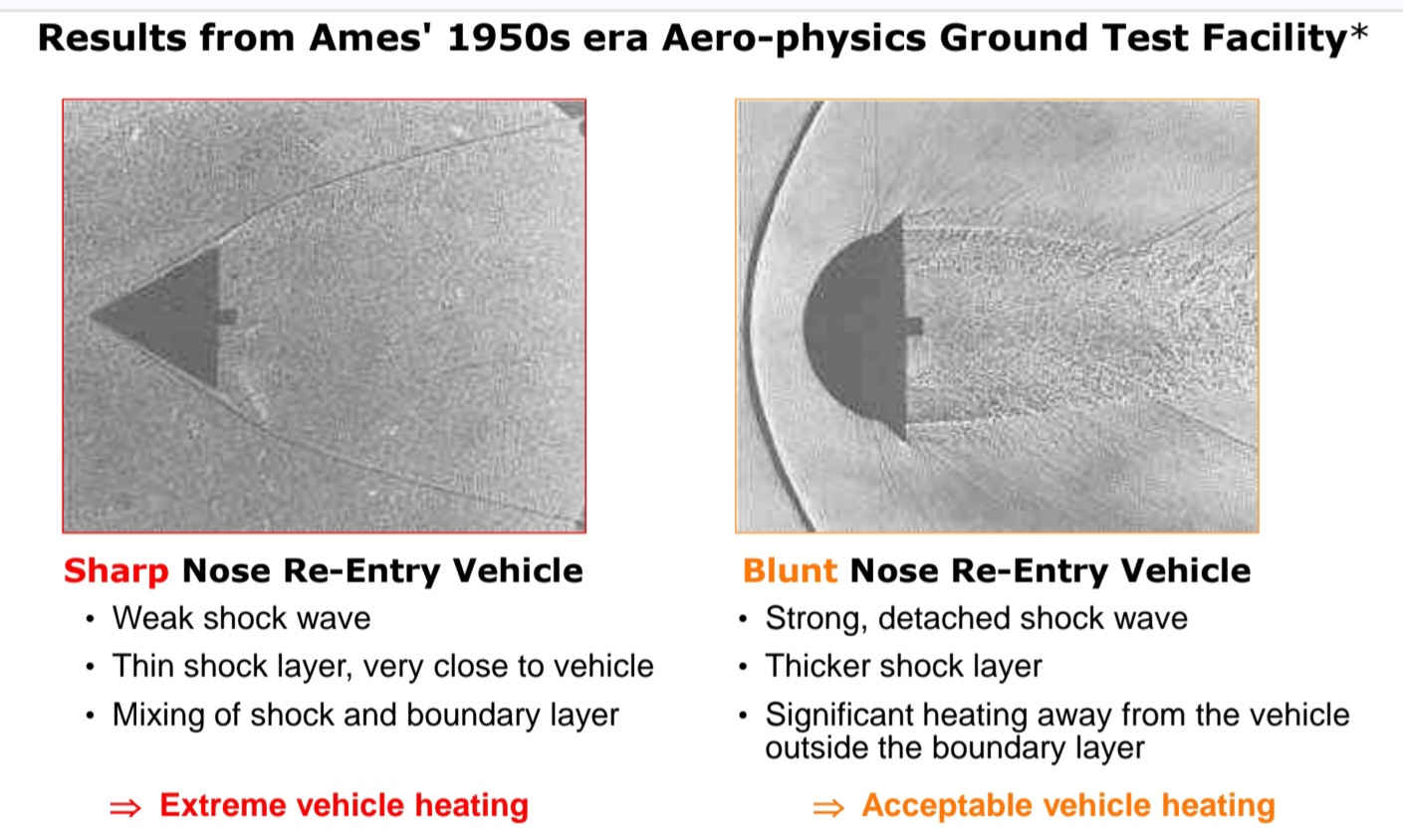
You see, the heating effect from air at such insane speeds doesn’t stem from skin friction but mostly from shock wave formation, as mentioned earlier. The hot, radiating plasma shocks are like an oven heating element, so it’s best to keep them at a respectable distance. Sadly, a skinny frame swept back below the shock angle means that the apex of the shock is in contact with the leading edge, with inevitable results: Melty, disintegrating death.
By contrast, make the leading edge of a spacecraft blunt and the shocks that form will stand proud of the surface as they curve around the spacecraft, keeping a handy distance between your skin and the inferno. The design feature is further enhanced by the extra internal volume afforded by fat, blunt leading edges: Make it chonky and you can fit extra stuff inside it such as heat ablative material, insulation and cooling systems. Good luck doing that on a needle!
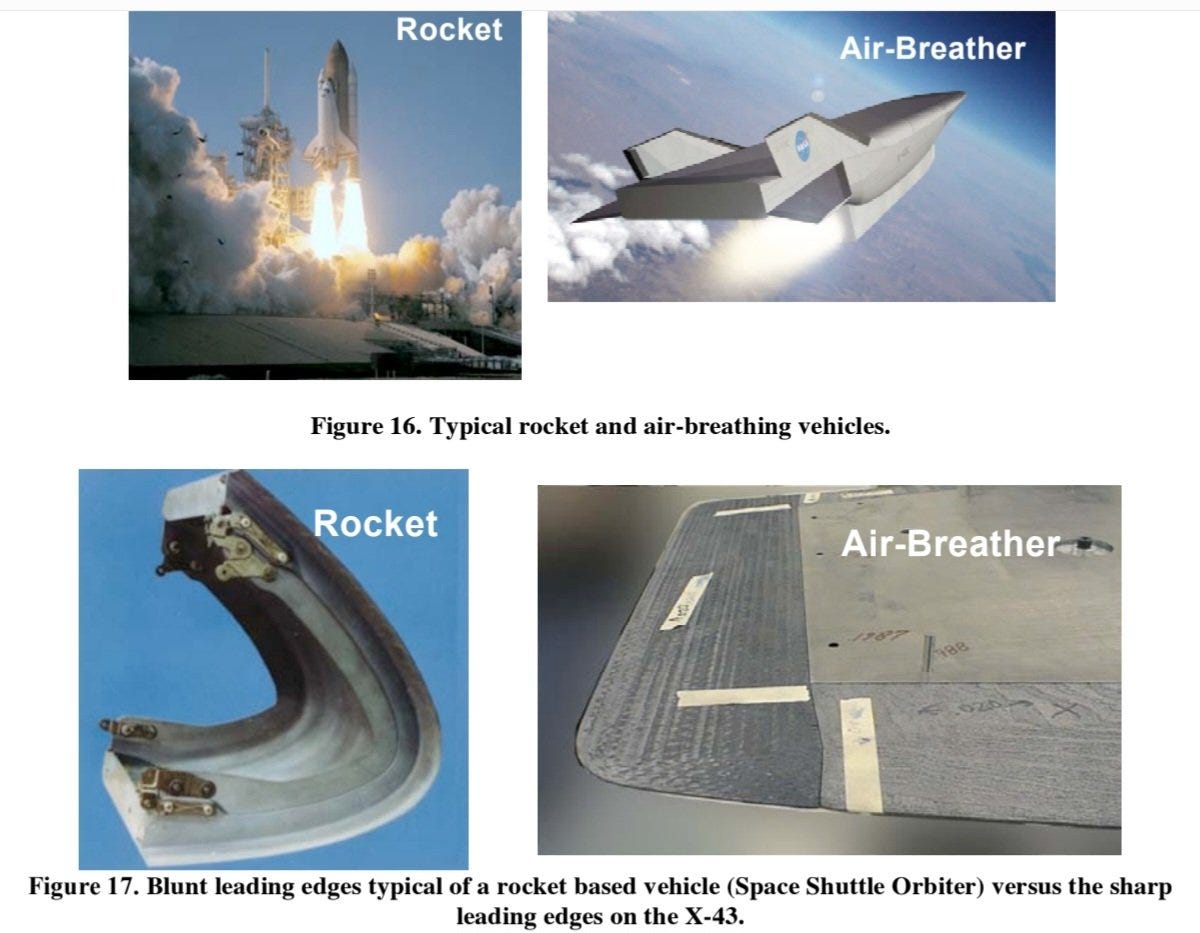
This actually becomes a big quandary in the design of air-breathing hypersonic cruise aircraft, since unlike a fat spaceship re-entering the atmosphere, a hypersonic jet would need to keep drag as low as possible, meaning slender lines and skinny leading edges. More ballerina than rugby player.
And skinny figures fry when they fly too close to the sun.
So far, so intuitive, but there are quirks in hypersonic aerodynamics that go far beyond a fat rocket, and we’ll go through them, from unpredictable boundary layers, shockwaves that reverse control inputs and air so thin and hot that it stops being air at all.
But first, let’s go through the last couple of thermal protection systems: Hot structures and active cooling…
4: Hot to trot!
You can’t keep out the heat forever.
