
Spooky Superconductor Batteries
Or: How to harness a ghost

There's a ghost in the attic of our energy system.
We store energy in batteries, or reservoirs, or hot salts, or capacitors or… well, we've got lots of options! But what if I said that you could store it in nothing at all?
And what if I said that this was almost lossless, for as long as you like, charges instantly and discharges controllably in an eyeblink? You'd probably want to know how I do it, where I keep this box of demons and whether it's in a haunted U-Haul somewhere.
Well it's not in a haunted U-Haul or a ghostly attic, and it's not a box of demons because it's even weirder than that.
It hides in a torus of twisted superconductors, and stores energy in invisible magnetism. It's a gift in the vacuum, an old wardrobe leading to a petro-state Narnia.
Demons in a box would be easier to explain.
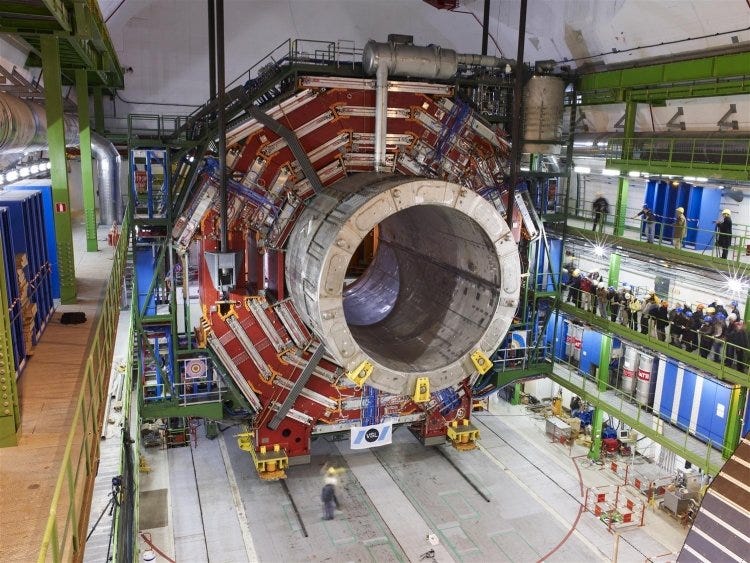
Let's talk about the ungodly machine that controls fusion reactors, stabilizes semiconductor plants, fires up particle accelerators and may one day keep the lights on in the timeless shadows of deep space.
Let's talk about Superconducting Magnetic Energy Storage!
1: Whispers from Upstairs.
When thoughts flow like Quicksilver…
Alchemists have been fascinated by Mercury, or quicksilver, for centuries. The silvery metal that flows as a liquid at room temperature is as fascinating as it is toxic; it's not for nothing that the notions of ‘mad as a hatter’, exist, as milliners in the 18th & 19th century used Mercury nitrate to turn fur into felt… and their nerves into tatters.

But while it never helped anyone find the philosopher's stone, or turn lead into gold, it did feature in something almost as miraculous.
The discovery of superconductivity.
In the year 1911, before world war turned the world upside-down and inside-out, Dutch physicist Heike Kamerlingh Onnes discovered that if you chill Mercury down to 4.2 kelvin, or 4.2 degrees Celsius above absolute zero, its electrical resistance drops to zero. Not just ‘very low’, but nothing whatsoever. It becomes a superconductor.
Almost all substances resist the flow of electricity, and that resistance manifests as heat. Some substances, like plastic or rubber, resist it strongly and are natural insulators. Others like Aluminium or Copper barely resist it at all, and are conductors.
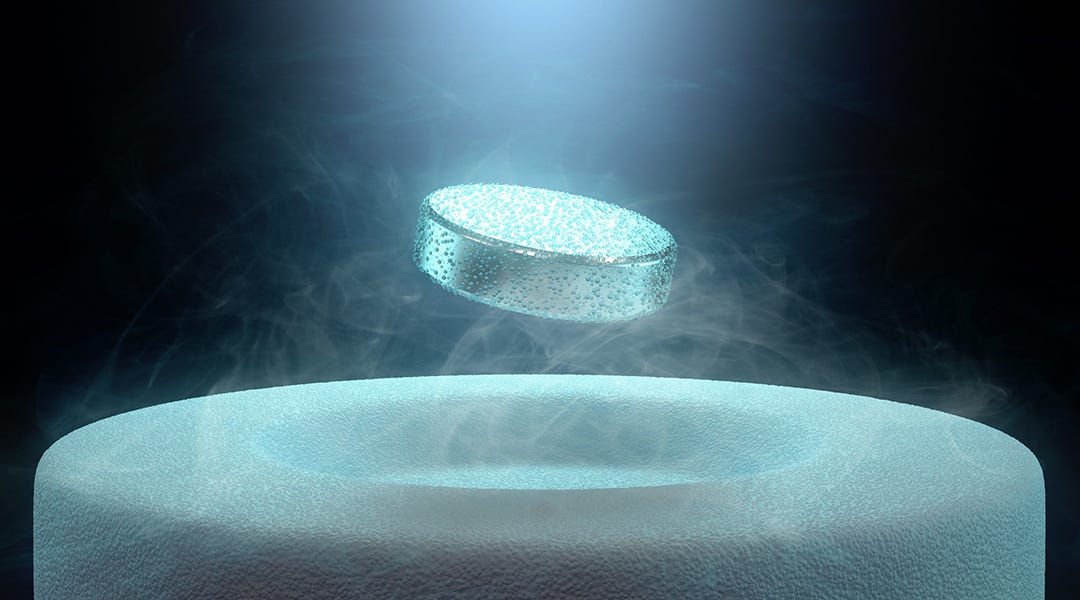
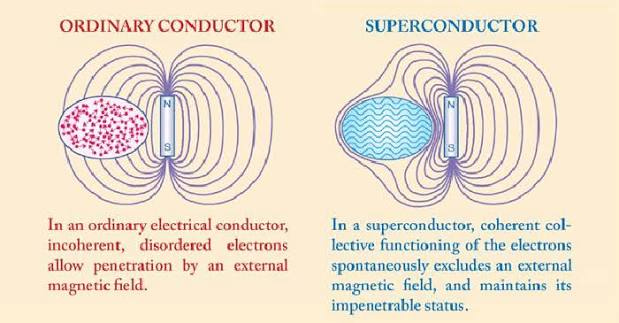
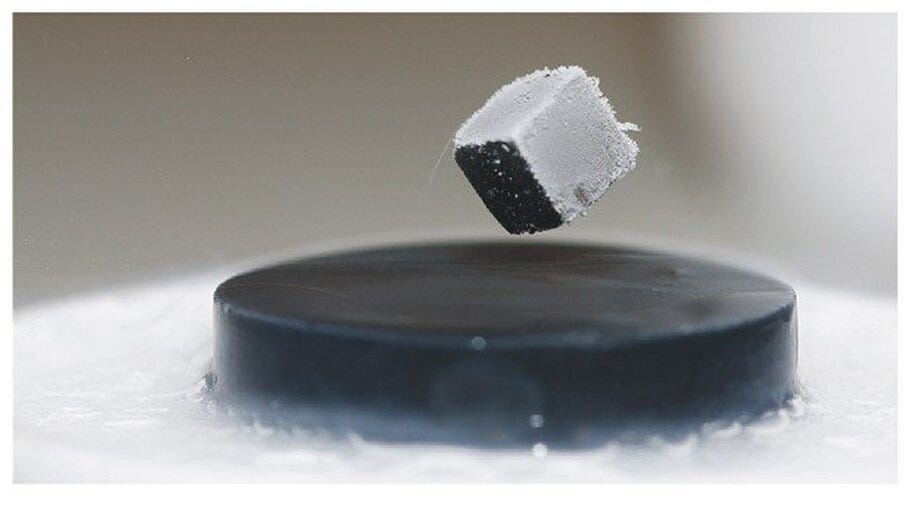
A superconductor is special. Because it has zero resistance, a direct current flow of electrons will just keep travelling on & through it forever with no external application of electrical potential. This leads to interesting phenomena such as the Meissner effect, where a magnetic field impinging on a superconductor sets up electron flows in its surface that effectively repel the magnetic field. This can lead to levitation!
And this interaction of electric current flow with magnetism is the crucial thing when talking about magnetic energy storage.
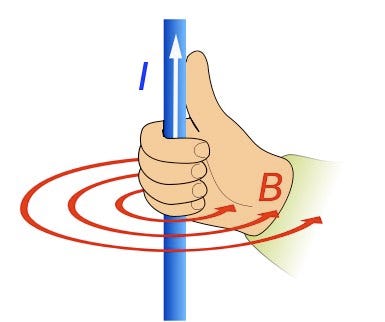
Hold out your right hand in front of you, without dropping this device if possible. Give a cheerful thumbs-up gesture, ignore any weird looks people throw you and check out the direction of your thumb and fingers. If your thumb is the direction of an electrical current then your curled up fingers are the direction of the induced magnetic field this creates.
Now let's think three-dimensionally.
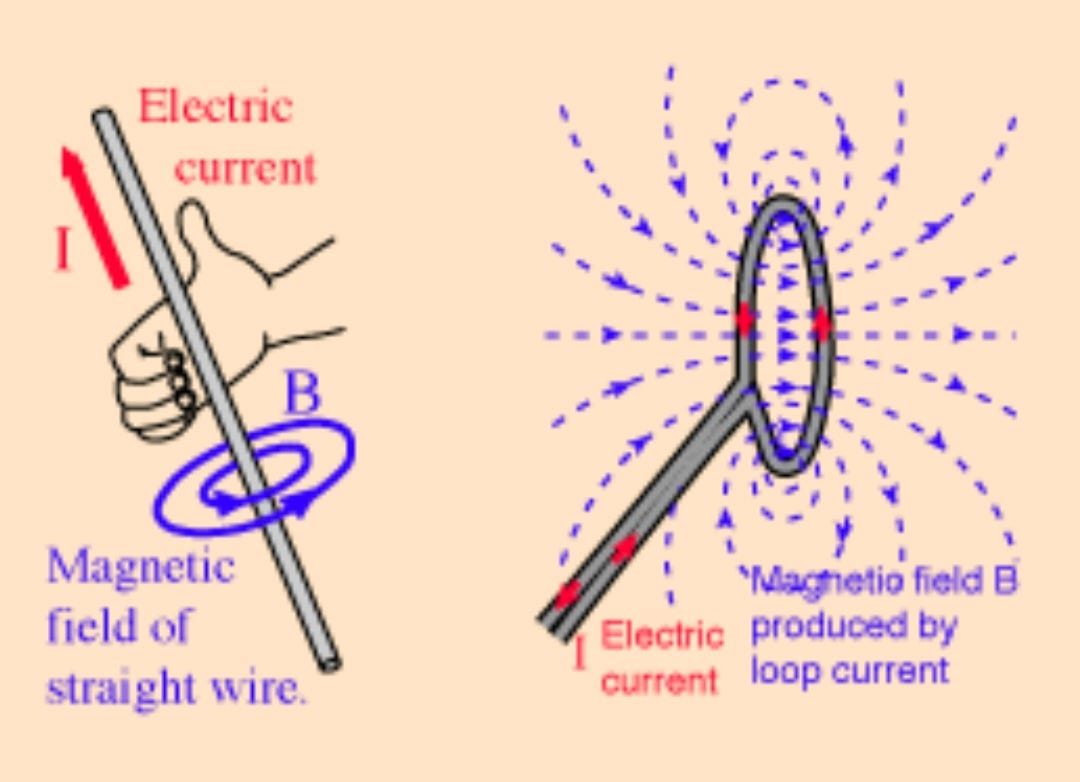
If instead of imagining a straight line current and a circular magnetic field you imagine a circular electrical current that goes round and meets itself again, forming a loop, then your magnetic field becomes a torus. An invisible doughnut with a clear ‘north’ and ‘south’: A dipole magnet.
Now go one step further: Make a toroid out of a whole series of current carrying loops and you'll create a trapped hoop of magnetic field!
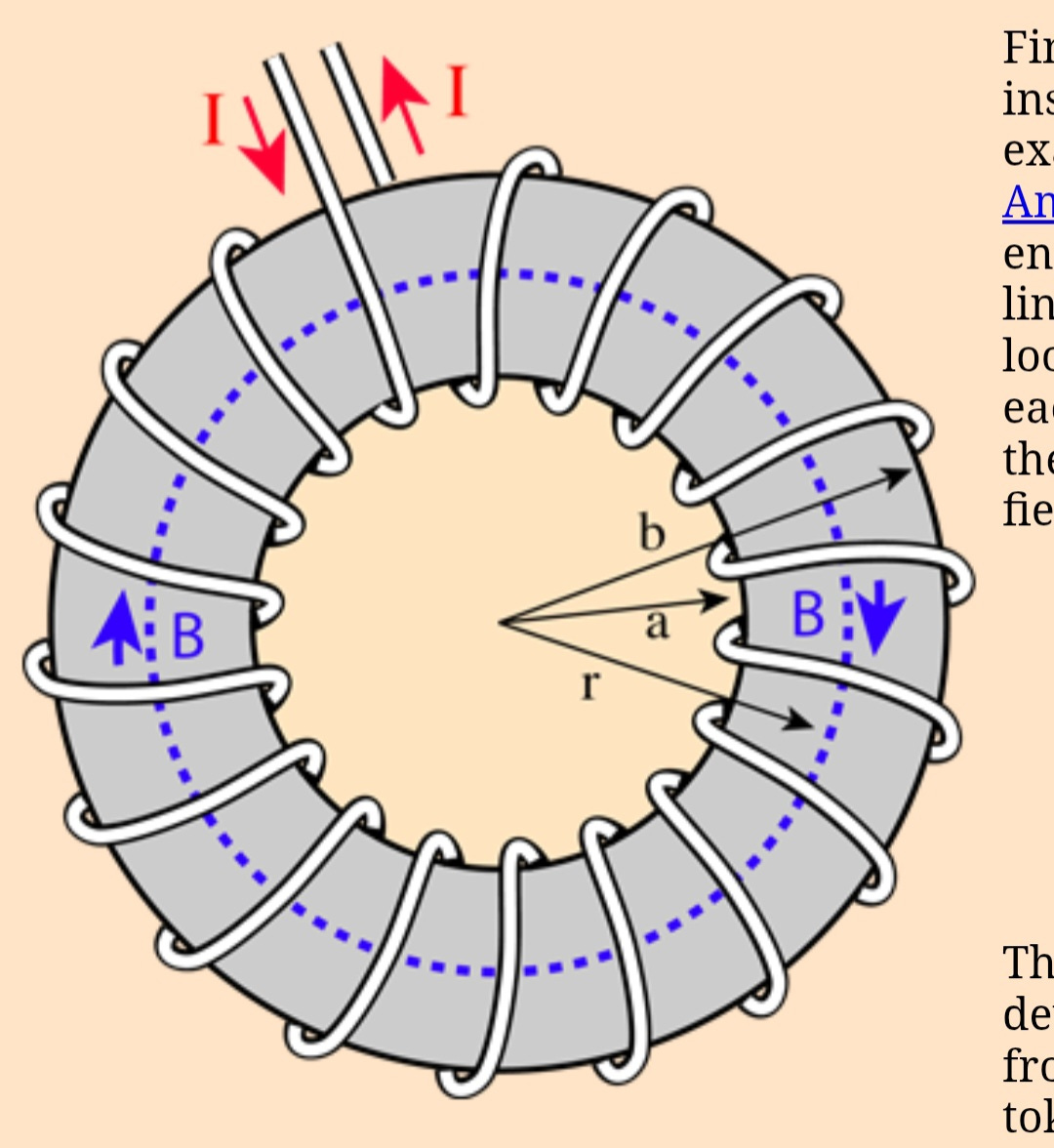
Now if that current around that toroid was travelling in normal wire then resistance would diminish that electrical current to zero within milliseconds and the field would collapse, which is no use to anyone. -But with a superconductor, different rules apply. With zero electrical resistance, a current travelling around an electrical loop will keep on spinning, round and round indefinitely. And the resultant magnetic field will sustain itself forever as well. If you add more current to the loop then it responds by dumping more energy into the strengthening magnetic field, like a battery made of witchcraft.
And if you discharge it? The energy stored in magnetism converts to current for you to use on… whatever. The vacuum locker is opened and what comes out will power whatever you connect it to. Briefly.
The concept for superconducting magnetic energy storage first appeared in the 1960s, and in 1969 the French engineer Maurice Ferrier proposed Superconducting Magnetic Energy Storage (henceforth ‘SMES’) as a means of load-levelling on national electrical grids, to store excess energy during off-peak hours and then discharge into the grid during peak times, allowing power stations to keep an uninterrupted, efficient level output while the magnetic ghost in the machine did the work of load-matching.
Nice idea, but there are major problems in using SMES for grid-scale load levelling, which we’ll get into. Nonetheless the concept was tried: In the year 1980, the Bonneville Power Administration in the United States installed the world’s first operational SMES system for grid stability enhancement. This was an itty-bitty unit, at only 30 MegaJoules of energy retention, or enough to run a household kettle for about an hour, but it was enough to prove the principle and show that SMES systems could be used effectively to dampen power oscillations in transmission lines and therefore improve power quality.
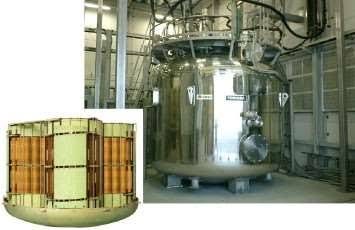
More SMES systems were built worldwide, in small numbers, but at this stage they were all deep cryogenic systems, relying on ultra-cold environments and liquid helium to maintain superconductivity with materials such as niobium-titanium. This changed somewhat in the 1990s with the discovery of high temperature superconductors such as yttrium barium copper oxide (and many others). ‘High temperature’ is a relative term, of course: They still need to be a couple of hundred degrees below zero Celsius, so it’s not exactly toasty, but it’s high enough to put aside the liquid helium and start using much cheaper liquid nitrogen instead.
So: Storing energy with a ghost in a box of ice. A weird way to deliver power quality and dampen oscillations on an electrical grid.
And ‘Power quality’ sounds like a wonky and niche thing to want. After all, your toaster or microwave doesn’t need a super-clean power source, so why on earth would you want superconducting wizardry on your electrical grid? Cool though it is, it doesn’t sound either simple or cheap.
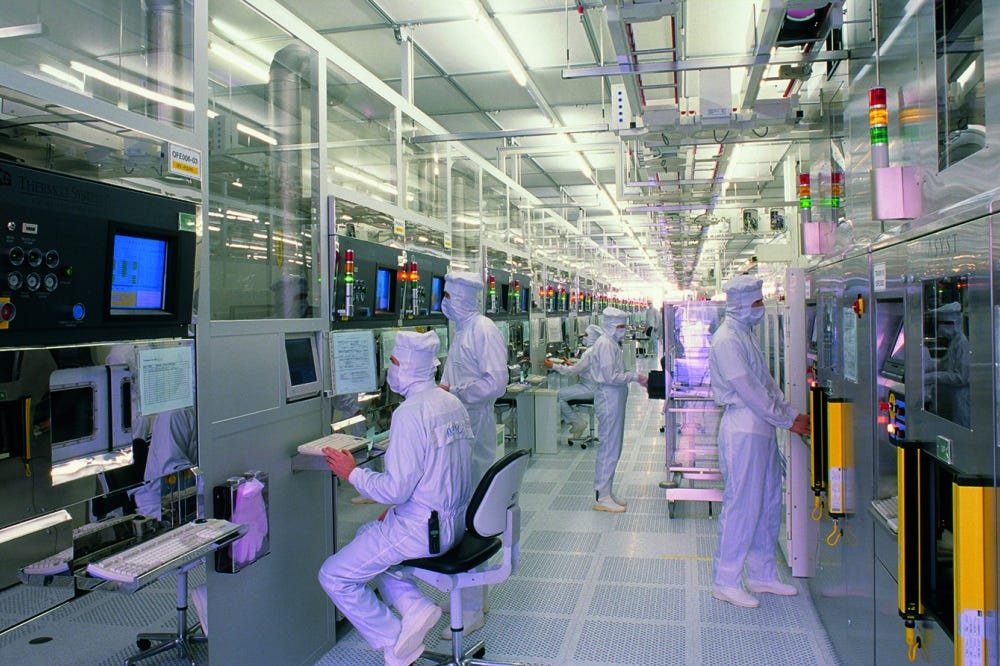
Well, maybe not, but that’s because you’re not running a semiconductor factory or a particle accelerator. There are a number of industrial uses that depend on near-perfect current, and even some weirder uses that new material science could open for the future: Fusion reactors, hypervelocity guns and futuristic bases on the dark side of the moon.
Intrigued? I bet, but first we need to know how these weird Ghostbusters-style containment units actually work, and what they’re good at.
2: The Ghost in The Attic.
It’s the year 2235, and sunlight kisses a solar array, a long-departed lover in the black void of space. But this kiss is not a familiar one, and this sun is not our own.
Alpha Centauri A. It’s just a dot in the sky this far out, barely enough to throw a shadow. There’s no heat in this light, but in the power array surrounding our squat little spaceship, faint stirrings of electricity have awoken something. The machine Mind at its apex stirs, unblinking eyes opening. The star ahead, once unfathomably distant, is now drawing near. The AI considers for a microsecond, and looks upon itself.
SMES systems are strange, no doubt: Superchilled spirits storing energy in the aether could hardly be anything else, but they have strengths as well.
Firstly, a SMES unit is almost lossless. As long as you keep away materials that could generate eddy currents in magnetic fields (such as solder or imperfect connections), your losses during storage are pretty much zero. Current decay in a superconductor can be as low as fractions of a percent per century, which is basically eternal. Practically however, unless your SMES unit is in deep space then you’re going to need to cool it for operation, which will demand a certain amount of power, though you could keep this to a fraction of a percent rated storage per day.
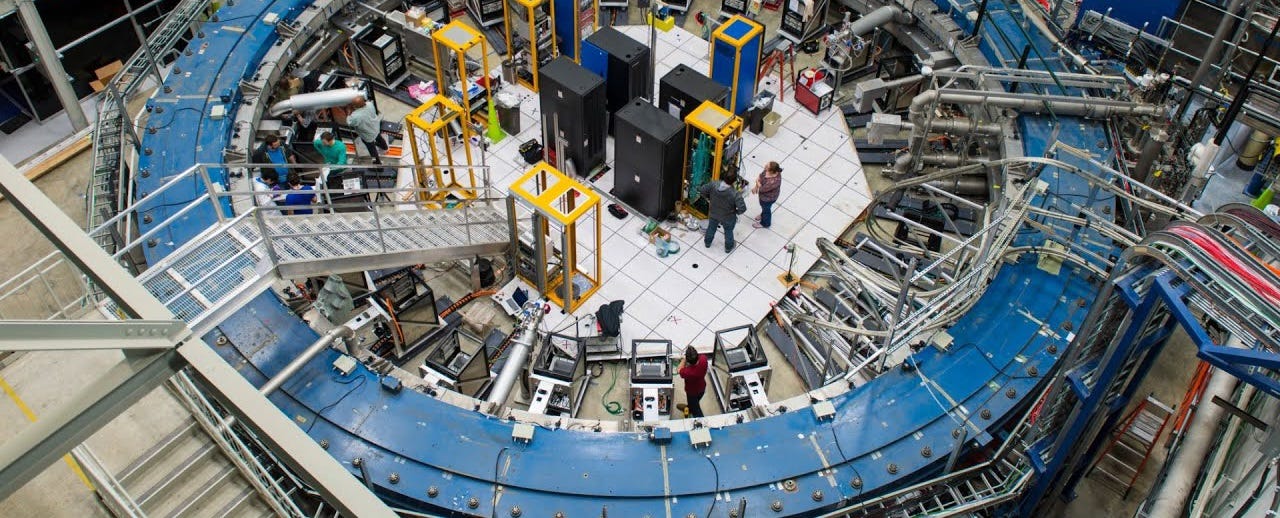
The main sources of losses in a SMES unit are actually pretty generic: The use of inverter/ rectifier systems for charge & discharge will sap about 5% of energy in round-trip inefficiencies, but this is generic to almost any energy storage system and is usually much larger. Overall, SMES can achieve round-trip efficiencies of about 95% and can store for either very long or very short periods, which isn’t bad.
Another thing to think about is power versus energy. SMES systems don’t store that much energy per kilogram (more on that later), so their specific energy isn’t too impressive, but their specific power is enormous. A SMES system can go from standby to full charge or discharge in as little as 5 milliseconds, which is insanely fast. Many megawatts of power can be sucked away or released pretty much instantly, which makes them excellent at controlling very short period fluctuations in electrical systems.
And that, you will learn, makes it a guardian of our future world.
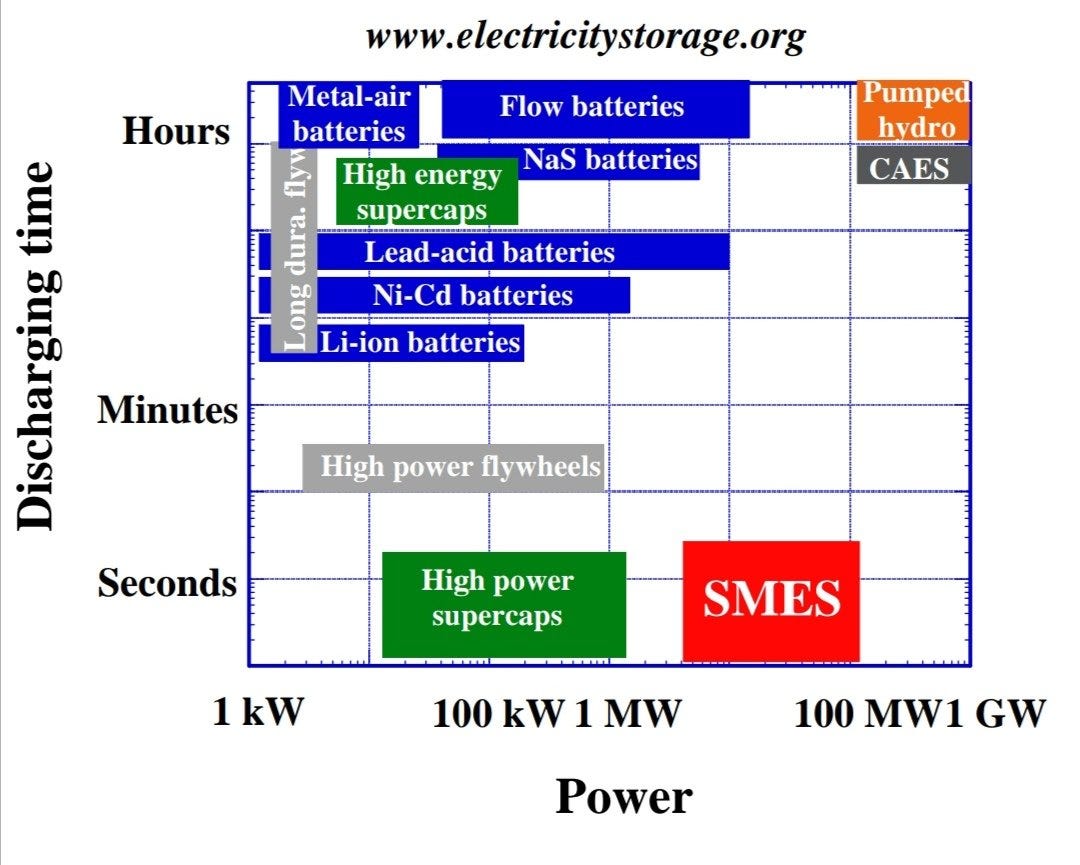
This facility with extreme speed isn’t just useful on electrical grids: SMES systems can be used to control fusion reactors, where high speed plasma instabilities need countering with a high-power, high-speed control system that can react instantly. Superconducting magnetic energy storage does exactly that, which means it can cage a star. Very impressive!
So: High speed, high power, low loss and indefinite storage. Sounds too good to be true. Where do I sign?
Steady on now, because there are some big drawbacks to storing energy in magnetism that we’ll get to shortly. But to understand that, you first need to know how these things are put together...
In principle you need three things for a SMES system: A loop of superconducting material with a support structure that won’t sustain eddy currents, a cryogenic refrigerator and a current inverter/ rectifier unit. There are obviously lots of other bits & pieces, but these are the basic building blocks. You then need to decide if you want to produce a SMES system with a solenoidal coil or a toroidal coil, as shown.
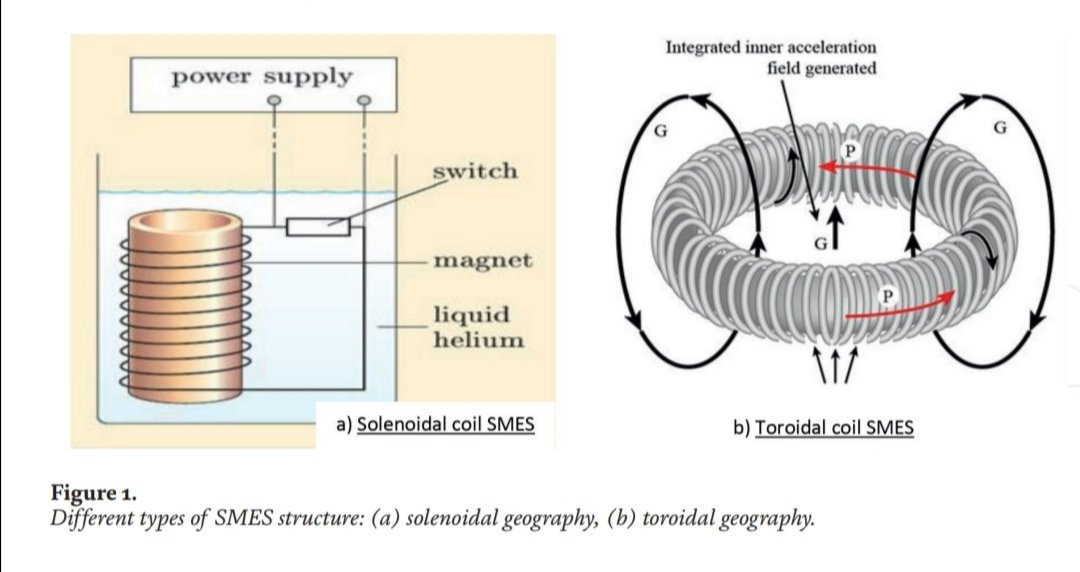
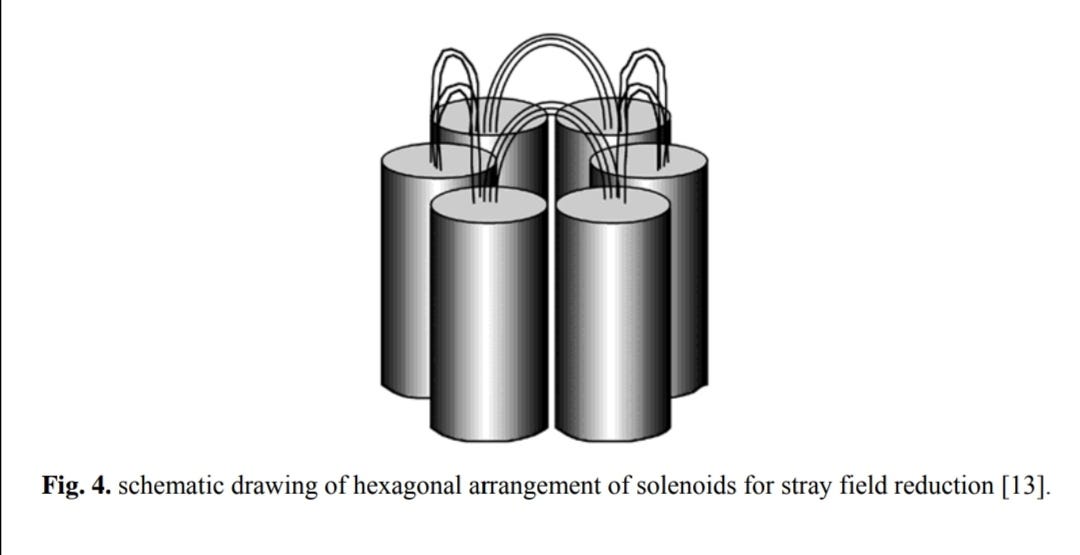
In essence, the solenoid coil is much easier to manufacture than the torus, but the magnetic field isn’t quite so well contained, so you can opt to group them to reduce stray field effects. The solenoid also has a bit more difficulty than the torus at resisting mechanical strain, which is a serious limitation we will get into shortly.
Now at this point you might be shrugging your shoulder and asking “how strong do these magnetic fields need to be? Will I be in trouble if I walk into one holding a heavy wrench?”
Well, yes. Yes you would.
For comparison, a commercial non-research hospital MRI machine, the kind of thing that’s used to look at your spine to see if you’ve wrecked your back slouching over for years, will have a magnetic field of about 1.5 to 3 Tesla. That’s Tesla the magnetic field strength unit, not Tesla the car that’s become weirdly political all of a sudden. For an idea of how strong 1-3 Tesla is, take a look at any number of online videos showing what an MRI machine will do to a ferrous object anywhere nearby, such as this trolley.
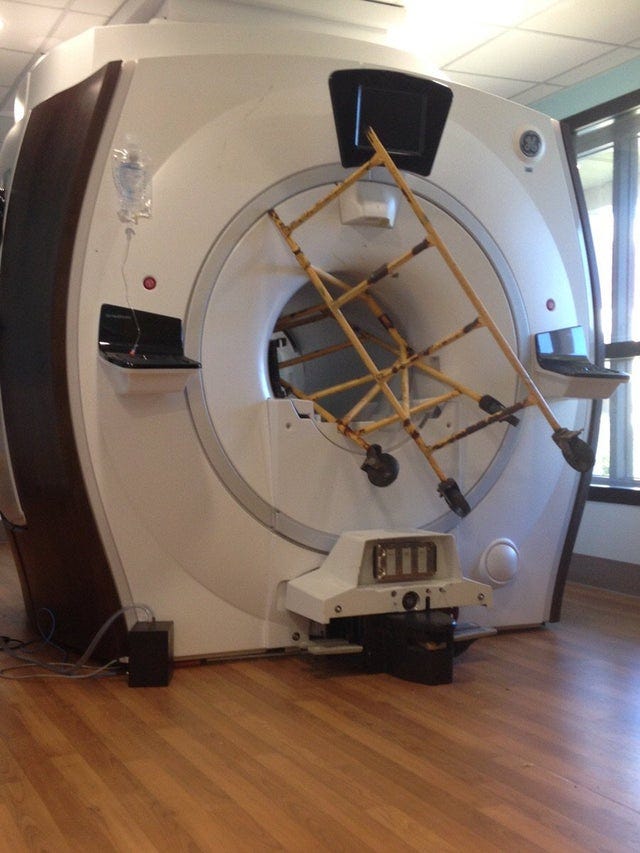
It'll wreck the hell out of it. Strong magnetic fields are serious business. Don’t walk up to one with a wrench in your hand.
OK now what about a SMES system? Well, you’re not putting people or trolleys into it, so the sky is the limit and they can top out at over 20 Tesla, which is just mind-bending.
Even if the ghost in the attic didn’t come with a lethal cryogenic environment, that’s still plenty enough to make you think again about walking into such a thing.
And yet, this awesome silent power is also the chief limitation of a SMES system, because the primary limit on how high you can crank that field isn’t electrical.
It’s structural.
3: Shackling a Demon in a Box.
The solar sail, mirror-finished and substantial as a cloud, a thousand kilometres wide, now splayed out behind the spaceship like a joke of a parachute.
The Brake, a colossal ring of superconductor and graphene, atomically thin, that stretches ten thousand kilometres around its periphery, surrounding the ship and invisibly distant. Vast currents chase each othet endlessly around the chill ring and its magnetic field grasps against the flux of the aether, slowing the ship with a constant, growing tug as it approaches the distant star.
The Vault, deep within the vessel’s belly, looks to have survived the voyage. There are no humans inside, but a cargo of clever machines and precious, precious DNA.
When you start turning up the dial on that magnetic field, you’d think that the result would be silent and subtle. The demon just gets angrier, the ghost gets stronger, but there’s no evidence. The vault of magnetic storage just sits there acquiring energy like a science-fiction MacGuffin, ready to kick a hole in the plot in the third act.
