Rogue Reactor: Building the Atomic Alchemist
Just because we can do a thing...

Energy!
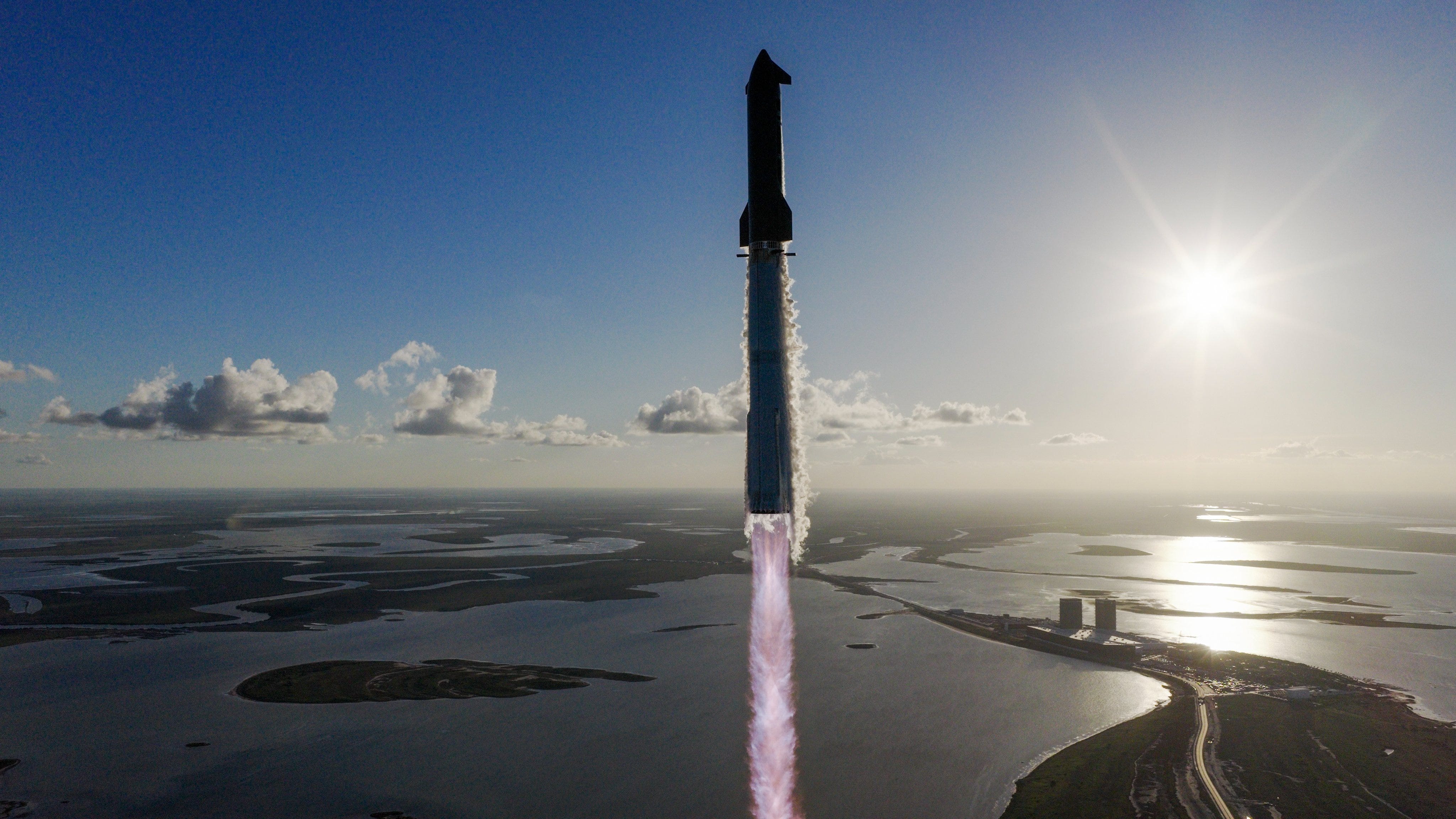
It's the bottleneck of civilization and the passage to prosperity. Lack for it and the simplest things, like winter chill, become existential risks. Swim in enough of it and you can launch cities into the void of space powered by ambition alone.
Sadly the Western world seems to have forgotten this lesson, bound by the straitjacket of energy efficiency and the navel-gazing dream of the circular economy, hoping to one day live off our own green farts.
And then some madman threw a million men into a meat grinder and some of us realised how much of our prosperity was actually underwritten by an autocratic gas station.
So: Energy as prosperity. We might have woken from our dream and remembered that again, but the problem as ever is how to generate enough of it without scorching the sky.
We can bask like sun-worshippers with seas of silicon. We can tilt at wind turbines. We can plumb the Forge Of Hephaestus, charm Poseidon or, my personal favourite, we can rend the atom itself to do our bidding. These are all fine options.
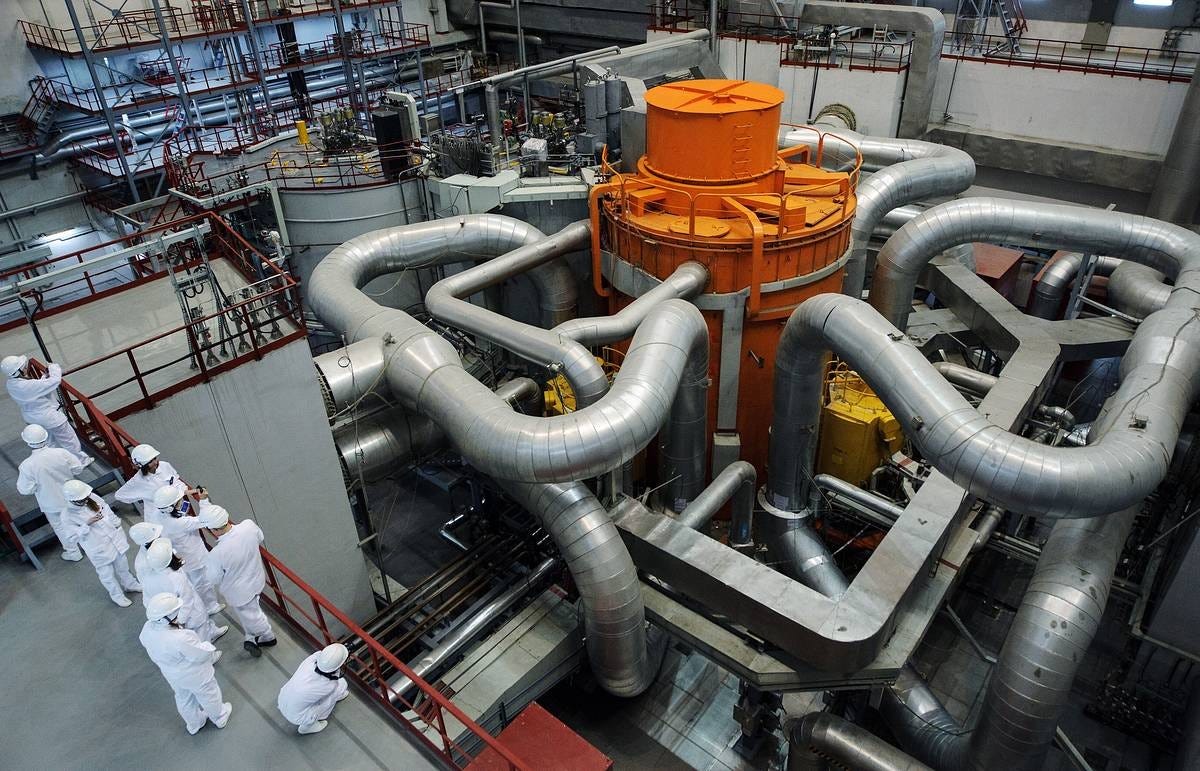
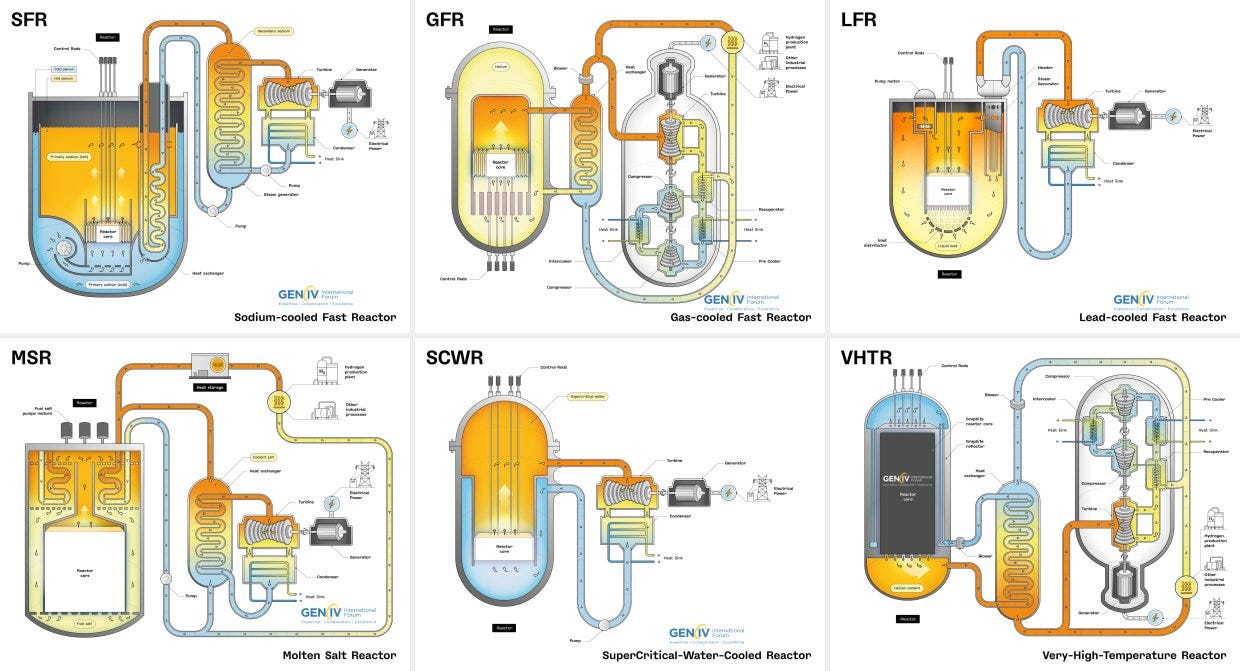
I've written in detail over a couple of the new ‘Gen IV’ nuclear reactor concepts, which boast simplified architecture, passive safety, high temperature output and potentially nuclear waste burning, and you'll find those articles linked in further down. I mostly looked at the near-term GenIV designs that either have prototypes operational or under construction (that's the Very High Temperature Reactor and the Lead-cooled Fast Reactor, by the way). But why not change the rhythm a bit and talk about the one that's furthest from deployment? The really advanced one. The Maverick.
The scary one.
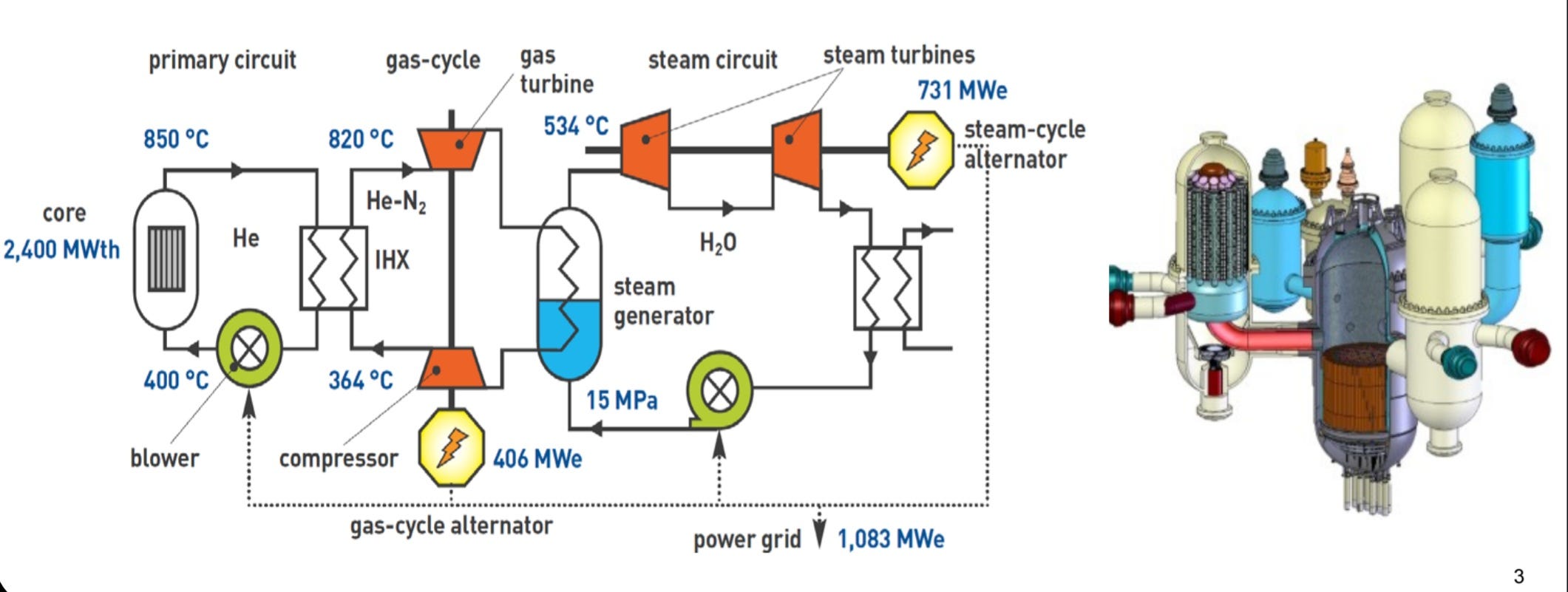
Today we're going to go over the nuclear oddball that is the gas-cooled fast reactor!
Let's dial up the heat…
1: Best of Both Worlds
The ideal energy source would be compact, enormously productive, clean, safe and controllable. Like a Marvel Tesseract but without the tendency to materialise psychotic demigods and big purple people.
Sadly in our world of humble means our energy sources tend to be expensive, bulky and with a sideline in at least one form of toxic byproduct. It's a game of compromise, here in the real world.
They're safe, though, and there's no danger of Thanos rocking up to steal a pressurised water reactor, so that's something. This is just as well as until battery storage technology gets an order of magnitude cheaper, nuclear power is really our only fully scalable & controllable solution to clean power. Sorry, battery-bros!
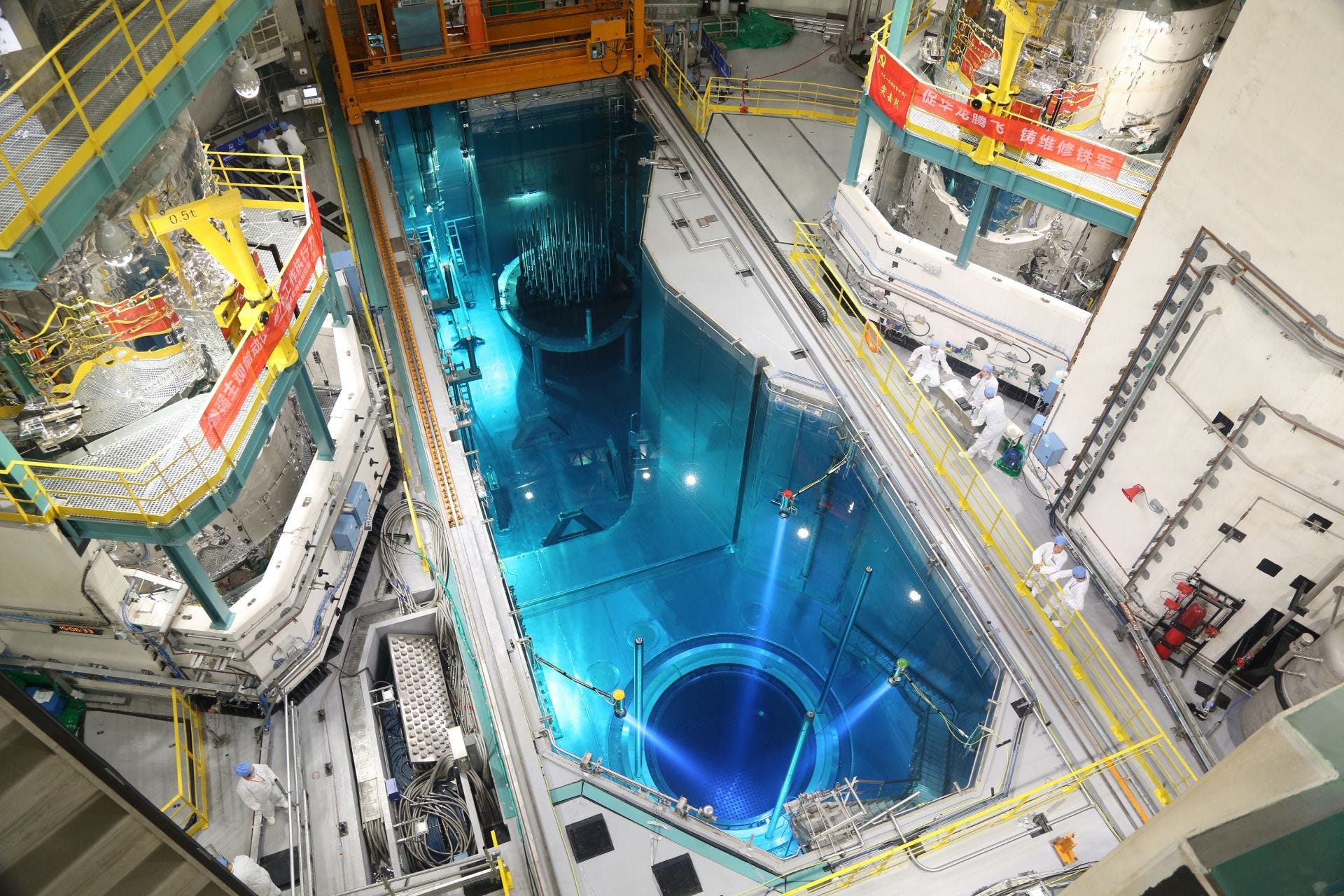
Sadly, the power of the atom is both expensive and has an image problem. The nuclear waste doesn't help either.
The Generation IV, or ‘GenIV’ reactor concepts were created as a future solution to this, making use of robust passive physical safety measures in place of active control and optimising for simpler architecture and manufacturability. They are one potential path out of the atomic cost conundrum. Of these six design concepts, only one is operational in the world today (China's HTR-PM, which is a Very High Temperature Reactor using helium coolant). Another is under construction; Russia's Brest-300 lead cooled fast reactor. The two of these also showcase some of the frequent themes that run through the GenIV concepts: High temperatures, heat export and a fast, fuel-breeding neutron spectrum. A fast spectrum vastly increases the amount of energy attainable from a given quantity of nuclear fuel by transmuting common non-fissile Uranium 238 in the core, and burning up high level nuclear waste into the bargain.
And why high temperatures? Well, it's a reactor's biggest export, and one that is almost never used. Most of the energy generated in a core never becomes electricity but instead gets lost to the atmosphere or water system. This is all usable, however, if you have a big enough consumer of heat nearby.
In Eastern Europe and Russia, some nuclear power plants provide district heating with their cooling systems, exporting waste heat to townships and apartment blocks, and why not? That's energy that would only be lost as entropy otherwise, spun into rising clouds in a turbulent atmosphere, of no use to anyone.
Writing this today, as I walk the dog on a frigid morning, a hard frost crystallising the countryside and my fingers cracking in dry air, I could do with a bit of nuclear heat.
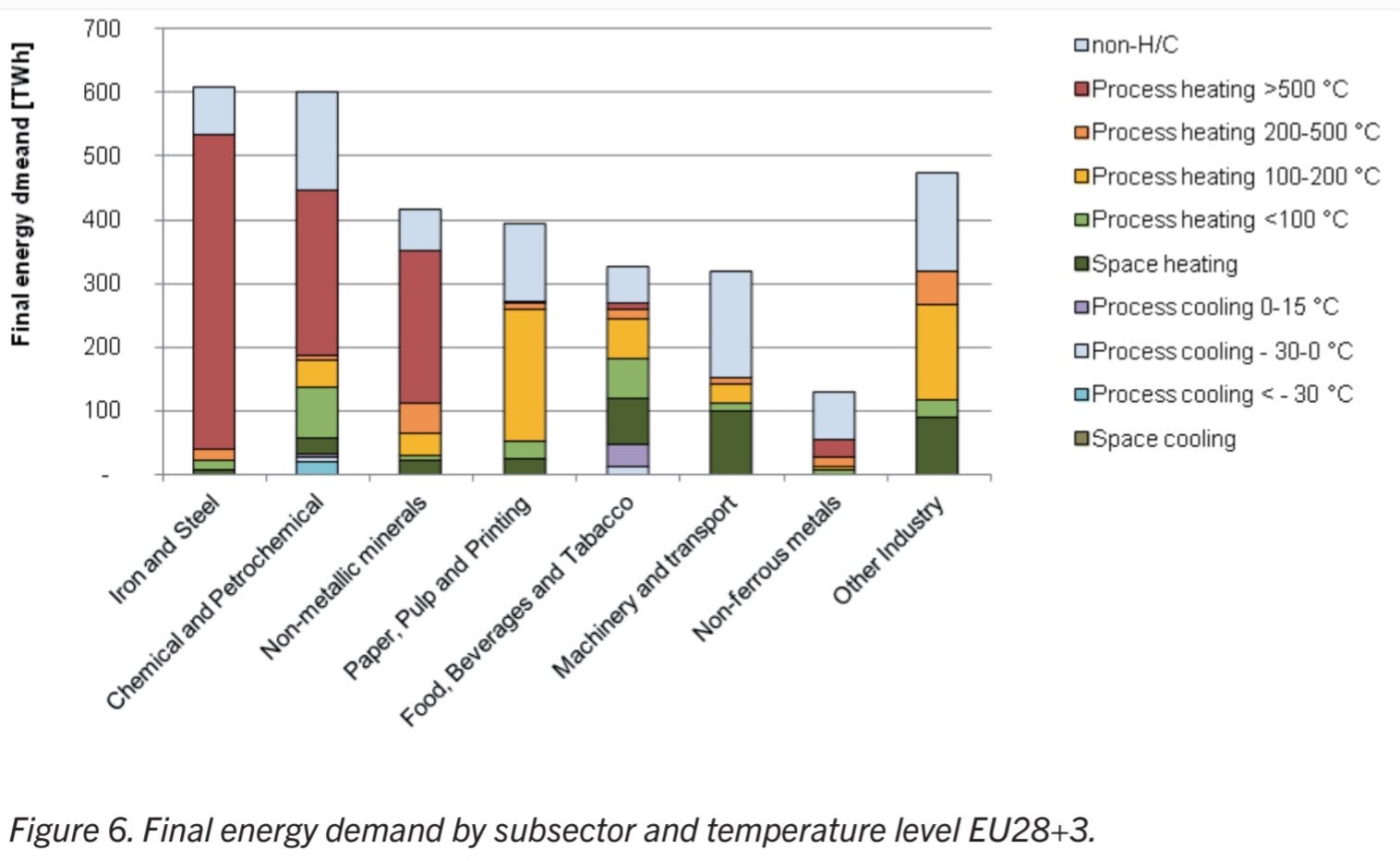
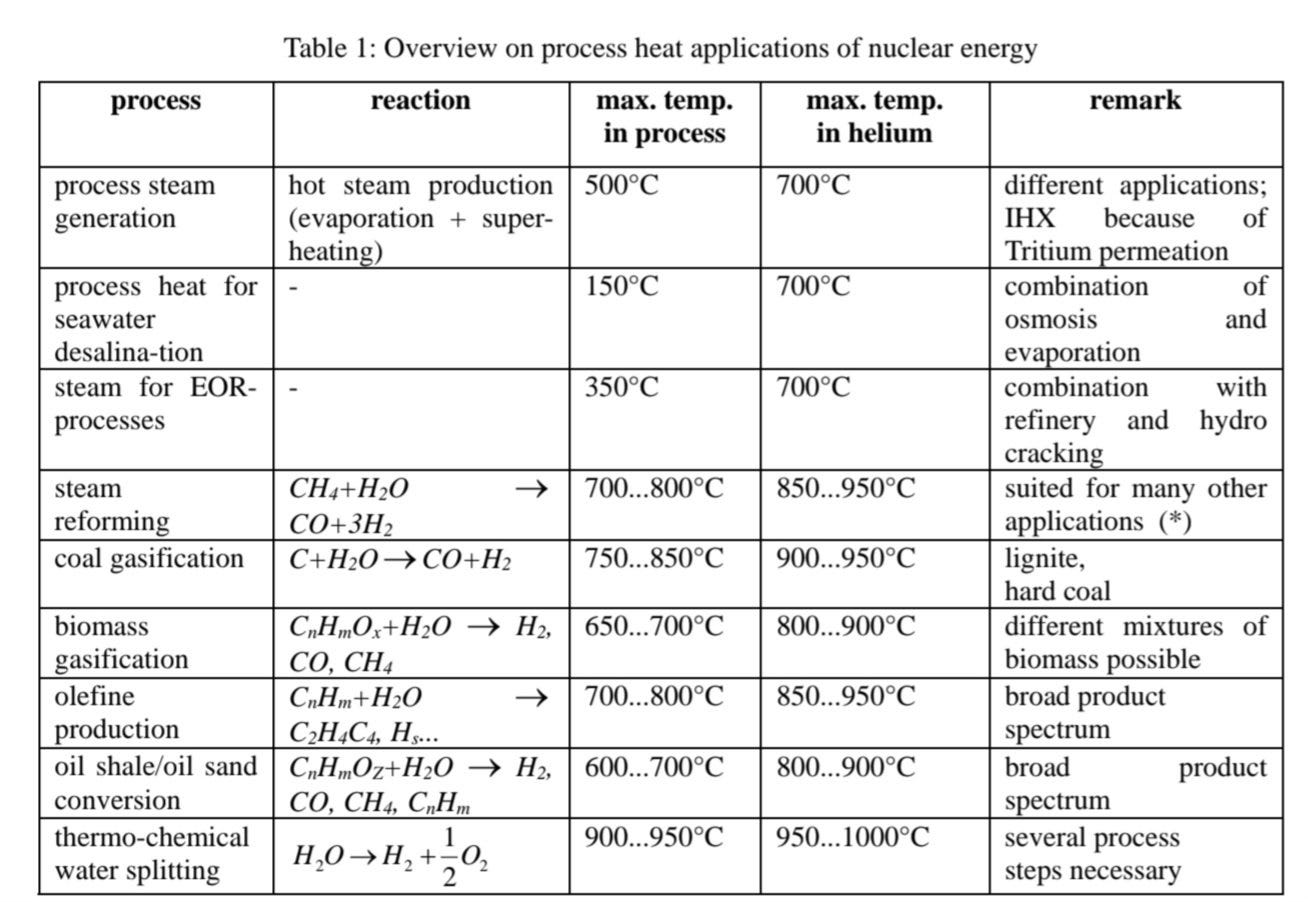
And that's just boring old cooling water from a light water reactor. If you make the export temperature high enough, then it opens up all kinds of industrially useful processes! Chemical industries, paper production, oil refining, brewing, metallurgy, pharmaceuticals… heat export is the big untapped gold mine in every nuclear reactor, the higher the temperature the better.
Crank it up high enough and it even starts to help with the much sung-about and seldom-performed Hydrogen Economy. I'll believe that last one when I see it, frankly.
And so what of our two recent GenIV atom smashers: The Chinese helium cooled hottie and the Russian heart of lead? The Chinese HTR-PM showcases helium coolant and very high primary cycle temperatures (exceeding 800 degrees), but uses single-pass TRISO fuel pellets with a slow neutron spectrum, so it's not as economical with fuel as you'd expect. By contrast, the big Russian will run a U238-transmuting, waste-burning fast reactor, but has to cope with the horrific corrosion challenge of hot lead in its veins.
Can we have the best of both worlds, without the cost? Perhaps.
Enter the Gas-cooled Fast Reactor!
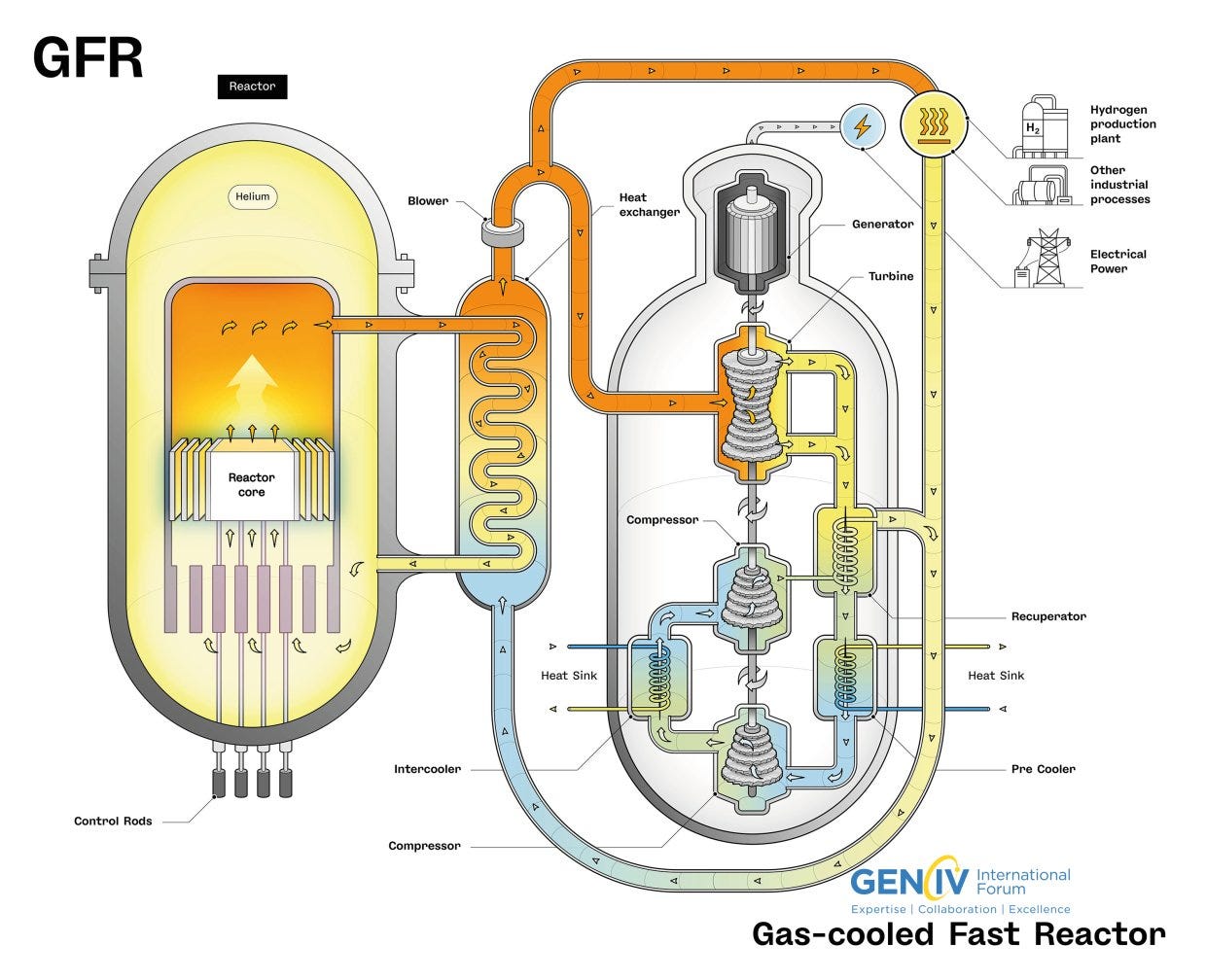
This is the least developed of the GenIV concepts, with the lowest technology readiness level, but it has some unique qualities.
Firstly, the obvious: It's a fast reactor!
That doesn't mean that it runs away with itself. It means that through the magic of atomic alchemy it can breed & burn its own fuel, transmuting non-fissile Uranium 238, which makes up a majority of all Uranium everywhere, into useful fissile plutonium. The details of this, and why it depends on a fast neutron spectrum, can be dealt with in the article linked below, so we won't go over it a second time.
Anyway the upshot of the GFR being a fast reactor is that it can make a small amount of Uranium go a long, long way. Much further than even a normal nuclear reactor would be able to do. That's not necessarily a selling point if you view Uranium as being magically abundant, which it almost is, but it's very useful if you want energy security, or just to be able to burn up nuclear waste and be a better environmental citizen. It's all good.
And as if that wasn't enough, the GFR even uses a more benign coolant than other fast reactors: Not like lead, which erodes & corrodes all in its path. Not like molten sodium, reactive in water and able to radio-activate, necessitating complex coolant loops. No, the GFR uses nice, inert, friendly helium.
Not only does helium not corrode or activate, but it's transparent too! Core refuelling is made immeasurably easier by this fact, compared to vicious, toxic and opaque lead or sodium pools.
And did we mention it runs hot? The other big selling point is temperature!
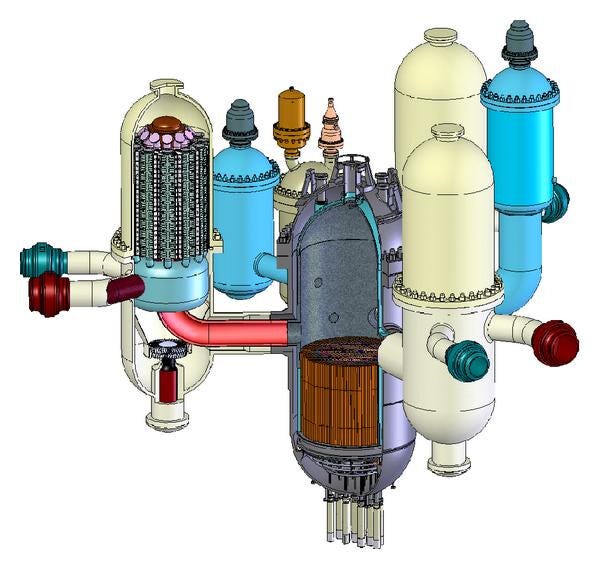
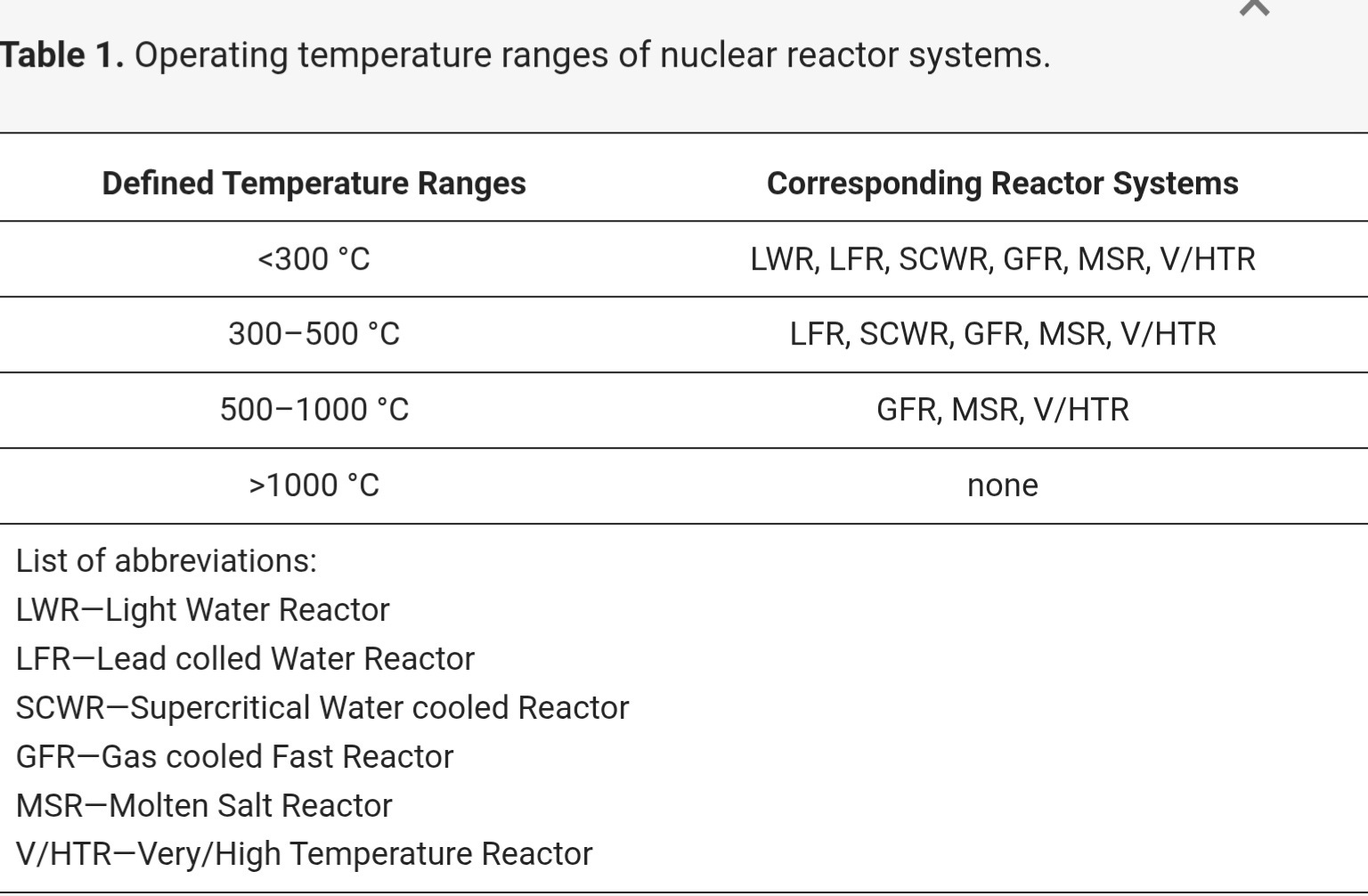
Like the Very High Temperature Reactor, the GFR enables incredible core outlet temperatures, limited largely by metallurgy: 850 Celsius is quite attainable, and higher still could be possible with the right material advances, such as silicon carbide composites for fuel cladding. This super-high core exit temperature is handy if you want to pair it with hydrogen synthesis at industrial scale, which gets significantly easier and less energy intensive at high temperatures. And it's not just about clean hydrogen: Decarbonization of oil refining is also possible at such temperatures, if you fancy a rich seam of irony in your clean powerplants.
But unlike the graphite-moderated VHTR, with a core power density of only about 5 Megawatts per cubic meter, the GFR fast reactor has a core power density twenty times higher, at close to 100 Megawatts per cubic metre! This is comparable to a standard Pressurised Water Reactor (PWR), which matters for compactness, cost effectiveness and modular build potential. The very low power density of the Chinese VHTR, by contrast, renders it absolutely massive, even though the power output of the high temperature core isn't all that impressive. But the GFR combines useful levels of output with small, practical build size. Fantastic!
But this yields a problem.
You see, unlike PWRs with their pressurised water coolant, or sodium fast reactors with their extraordinary molten sodium, or Russia's quirky lead cooled reactors, the GFR needs to achieve this high power density when cooling the core with Helium, one of the thinnest, least substantial gases in nature.
Not only is this challenging on its own, but the combination of a small, potent core with minimal moderation and a wispy, low-density coolant means that the futuristic GFR has a miniscule amount of thermal inertia to hold it in check when something goes wrong.
And that means that, unlike the other Gen IV designs, if you should knock out your cooling after a full power run, you don't have a grace time of hours, days or weeks before intervention.
You have seconds.
2: Miraculous Material
But let's step back a moment. How would a Gas-cooled Fast Reactor work anyway?