Pushing Salt
The story of the machines that bring life to the desert.

This article was first published almost exactly a year and a half ago, as one of the opening articles of this substack. I wrote it on holiday, in the parched land we know as Dubai, looking after an infant who had no idea how strange that city is. A metropolis in a land without fresh water…
Back then, my readership was tiny and so this post, one of the most well-recieved I’ve put out, will be new to many of you. I hope you enjoy it!
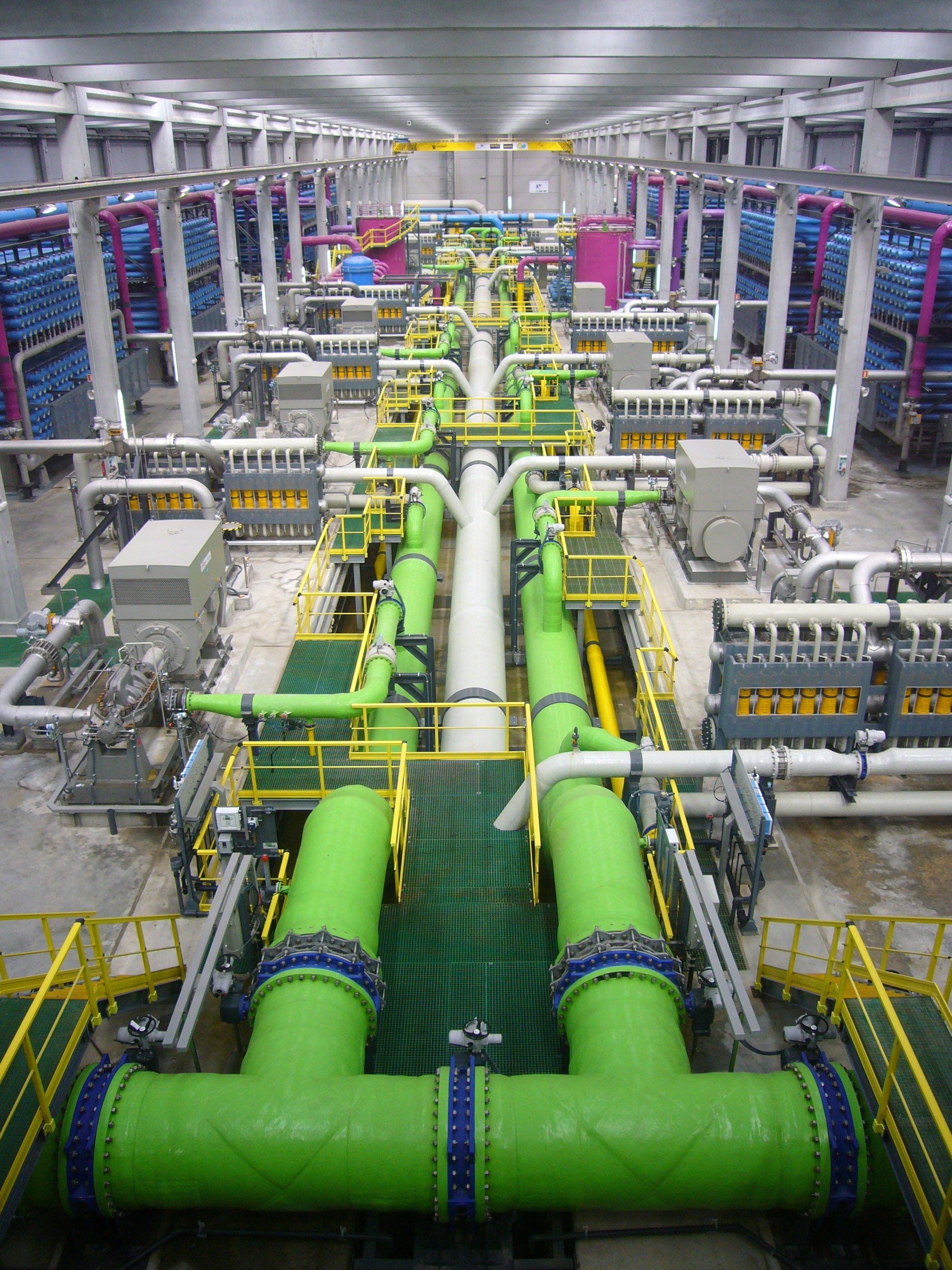
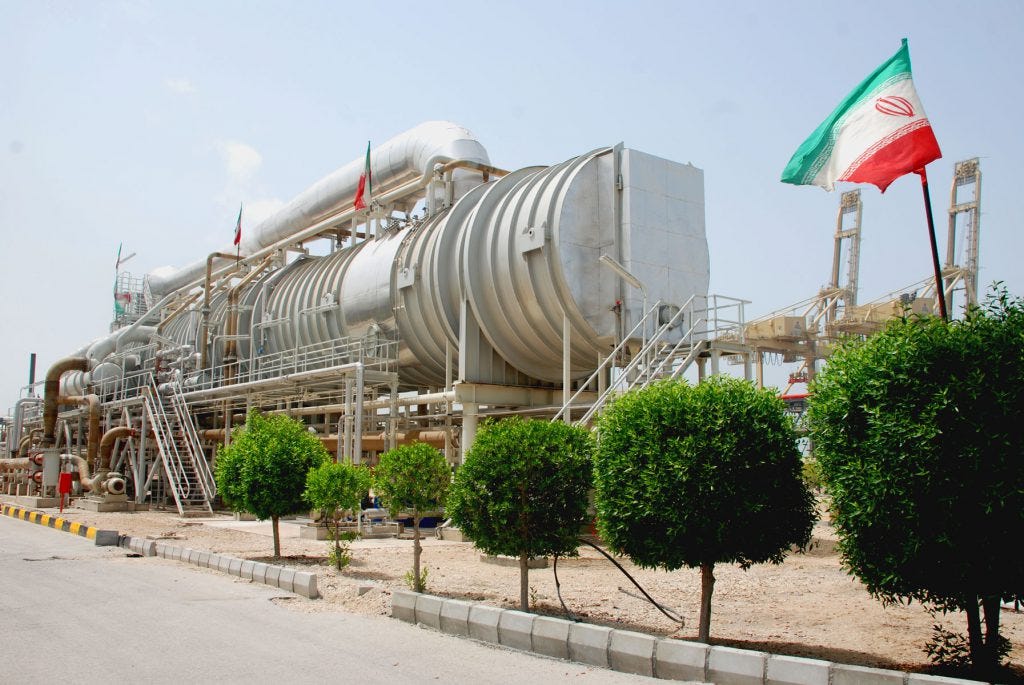
One of the largest desalination plants in the world, Ras Al Khair in Saudi Arabia, outputs over 1 million cubic metres of fresh water a day, powered largely by recycled heat from petrochemical power. It irrigates a desert, while flushing back turquoise-blue brine like a technicolour slick into crystal seas. To put it in human terms, this plant could fill a mid-sized football stadium with fresh drinking water every single day.
In this article we’ll take a journey through the how & why of desalination: The global need for it, complexities of heat recycling, disruptive technologies, how water got so cheap and much, much more.
A dry topic? Not even slightly, this stuff runs deep. Let’s get started…
1: Thirst
Across our world right now, over two billion of us, a quarter of the world’s population, lack access to clean drinking water. Many live in arid areas and others in zones that are not arid at all, but brutally overpopulated. Where rainfall cannot fill your reservoirs high enough, where thirsty mouths in their flocking millions pull your supply and your very crops depend on water from the sky that is not coming, what can you do?
For much of our history the answer was simple: We leave, or die.
Now we have another solution, and it uses the alchemy of energy: If you have enough energy, and it’s cheap enough, you can drink from the very seas themselves. Energy, in short, is life.
This is not a subtle or obscure problem either. Global desalination capacity has quadrupled in the last two decades alone, and with growing urban populations, thronging metropolises in the desert and entire regions like India now in acute water stress as their aquifiers drain, we have come to a head.
From glittering hive cities like Singapore, through the parched realities of the Gulf, the growth of maritime shipping and to entire subcontinents running out of fresh water, the way ahead is clear.
But let’s start at the beginning: How is desalination done, and what are our options?
2: Heat
There are two fundamental approaches to desalination. One is filtration, and we’ll get to that later. The other is distillation.
To distil a liquid, it is first boiled, and the vapour from this boiling is run through a condenser, where a flow of coolant (in this case, usually seawater) forces the vapour to condense and be collected. This only happens when the liquid involved has a vapour phase, and since water boils to a vapour but salt does not (at least not at the same temperature) then your condensed output is pure, fresh water.
Obviously, distillation also allows for segregation by boiling point if there are multiple liquids in a compound, such as with oil refining or, more deliciously, whisky distilling, but for now we’ll concentrate on desalination, which is simpler. The most simple is single-effect distillation, as shown in the next image.
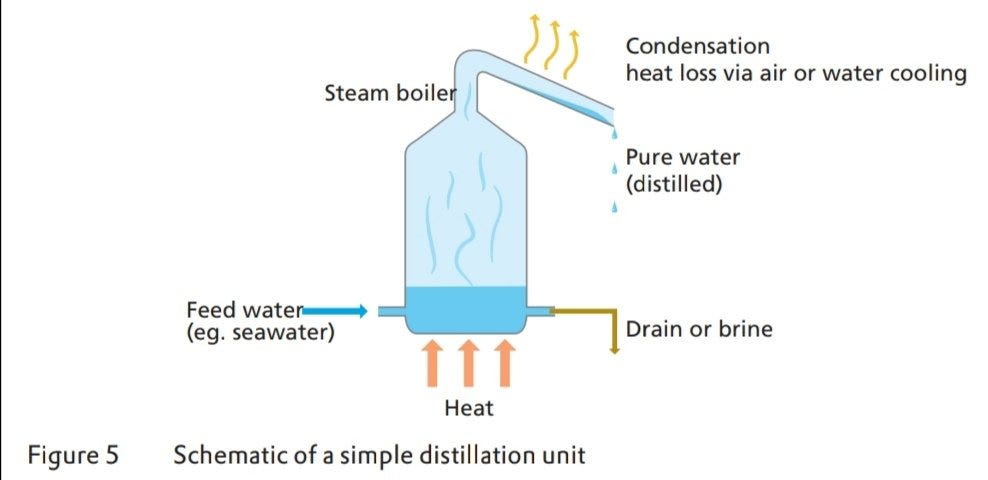
Single effect distillation is simple, time-honoured with a pedigree of millennia, and also very energy intensive: Heating water from a liquid at 25 celsius to a vapour at 100C takes 2,600kJ per kg of water. That’s over two million joules, or an electric kettle running for about 20 minutes: It takes a lot of energy to convince water to become a vapour.
Now anyone watching their electricity meter these days, especially in Europe, will feel a twinge at that. Obviously shelling out a euro for every couple of litres of water in energy costs alone is untenable for large scale desalination, so what are we to do?
The answer is to recycle our waste heat. Remember that the 2,600kJ you fire into a litre of water isn’t lost to the world, just as long as you can reclaim it when it condenses and releases its heat energy back to the surrounding environment. This brings us to multi-effect distillation, or MED, where boiling & condensation occurs in separate tanks, or ‘effects’, and the vapour from one effect passes into the next to recycle its heat as it condenses, before then being claimed as freshwater output. It’s an elegant and simple balance of input & output energies that allows for most of that initial blast of heat energy to be recycled, and thereby massively reduce the energy cost -and financial cost!- of the distillation process.
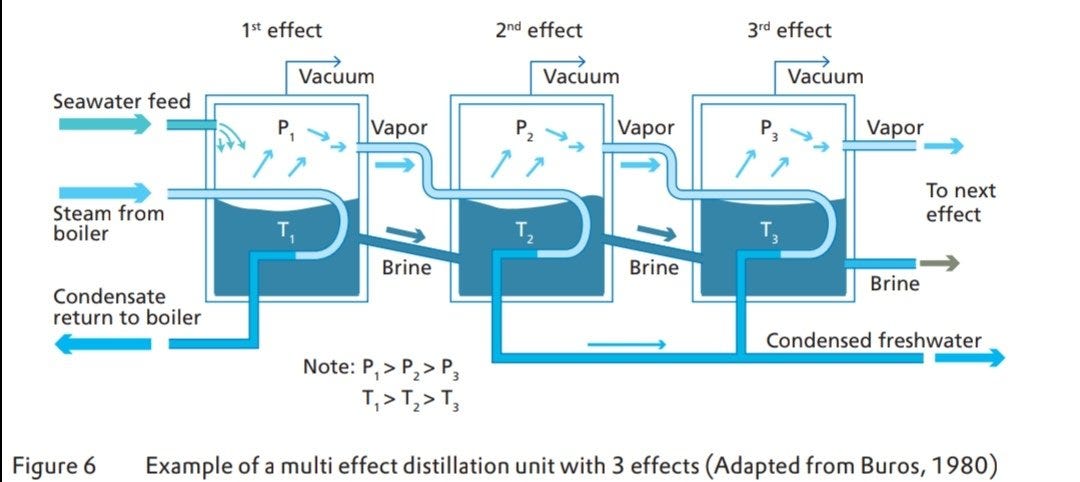
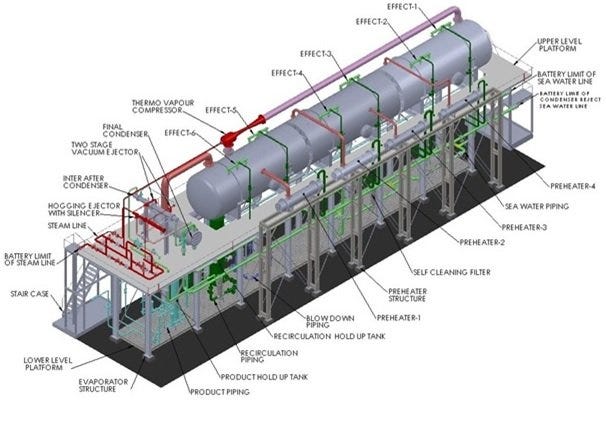
It's not perfect, however. The claimed condensed water can never be cooled all the way down to ambient, and tank walls and pipework will conduct heat away, so some energy is lost at each effect and this needs accounting for by steadily reducing brine levels, or energy addition from boiler steam, or by creating a pressure gradient that reduces the boiling point in each effect: More on that later.
A typical MED plant will have 10 to 20 effects in sequence, and will output 2,000 to 20,000 cubic metres of freshwater daily. The exhausted brine is typically dumped back into the sea.
Nature is not so neat however, and seawater contains a lot of impurities, which will scale up over the submerged condensation tubes over time (because if you boil water it leaves dissolved crud behind and -oh look! A tube to adhere to!-) and this eventually degrades the system so much that a thorough overhaul and cleanout is needed.
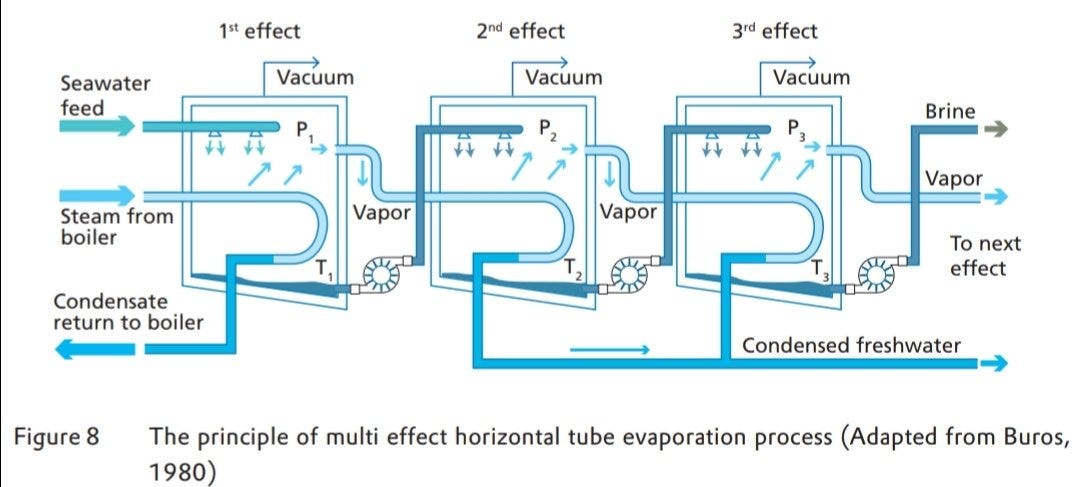
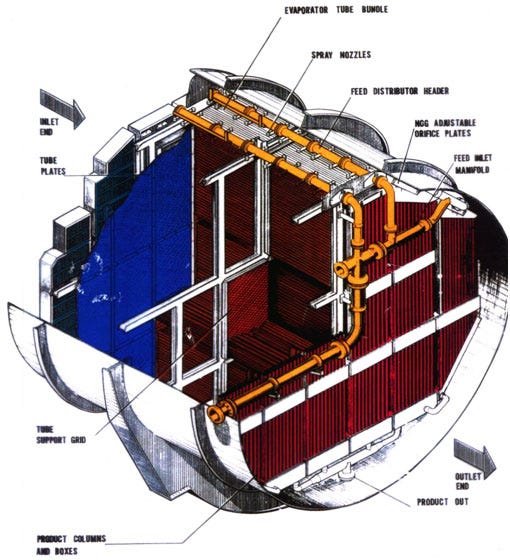
There are ways to reduce this scaling to some extent: If the tubes carrying condensing vapour aren’t directly submerged then the opportunity for scaling in brine is reduced, or at least moved to areas where it will cause fewer problems and will be easier to clean. Vertical & horizontal tube arrangements are shown in which condensation occurs above the brine waterline and spray nozzles are used to introduce the seawater or brine feed. The 3D image shown also gives an idea of what this means in practice; because surface area maximization is important for heat transfer, tube bundles are used to force rapid evaporation: As ever, engineers chase efficiency and complexity is borne from the union.
Or you could take other approaches: Multistage Flash (MSF) takes advantage of the effect of pressure on boiling point: the higher the pressure, the higher the boiling point, and vice-versa in reverse.
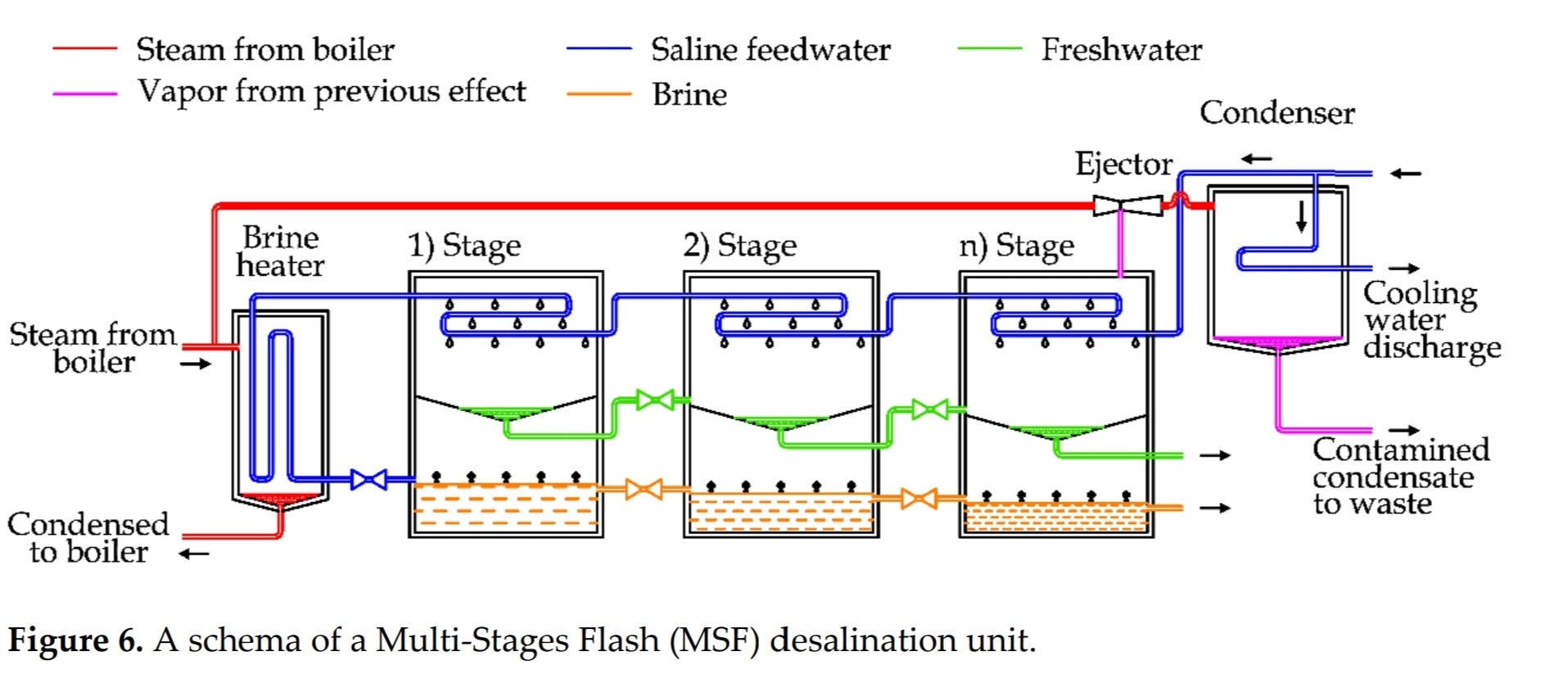
Why does this matter? Because it means that if you balance the pressure ratio just right, and have it going down, stage-by-stage, it can balance out the gradual loss of thermal energy as you move through the system. This pressure ratio can be supplied by tapping some of the boiler high pressure vapour feed (the red line shown) through a convergent ejector, which accelerates the steam and creates a very low static pressure at the throat of the ejector, which is tapped to ‘pull’ on the distillation stages.
As such, as the decreasing level of brine creeps through the system, the gradually lowering temperature is made up for by the reduction in pressure, making the brine ‘flash’ into steam as it moves into each effect, hence the name. The coolant seawater moves contraflow, meanwhile, so it is at it’s coolest in the last, low pressure stage where the boiling point is lowest, and highest in the first stage where pressures and boiling points are higher. Because all of the evaporation happens through pressure a long way away from pipework, it reduces scaling problems too. Bonus!
A perfect balance.
MSF systems are common worldwide, and because they’re popular on ships they outnumber all other forms of thermal desalination, giving suppable drinking water to sailors globally.
But it’s complex. You need to stare at these diagrams for a while before it makes sense, so think how much more complex it is to design one of these beasties, and keep all those thermal and pressure relationships in perfect balance.
Or to start it up, for that matter.
3: Complexity!
We've covered the two mainstays of thermal desalination above, but let's alight briefly on some of the different flavours before we move on to completely different technology. Some of these will have you scratching your head.
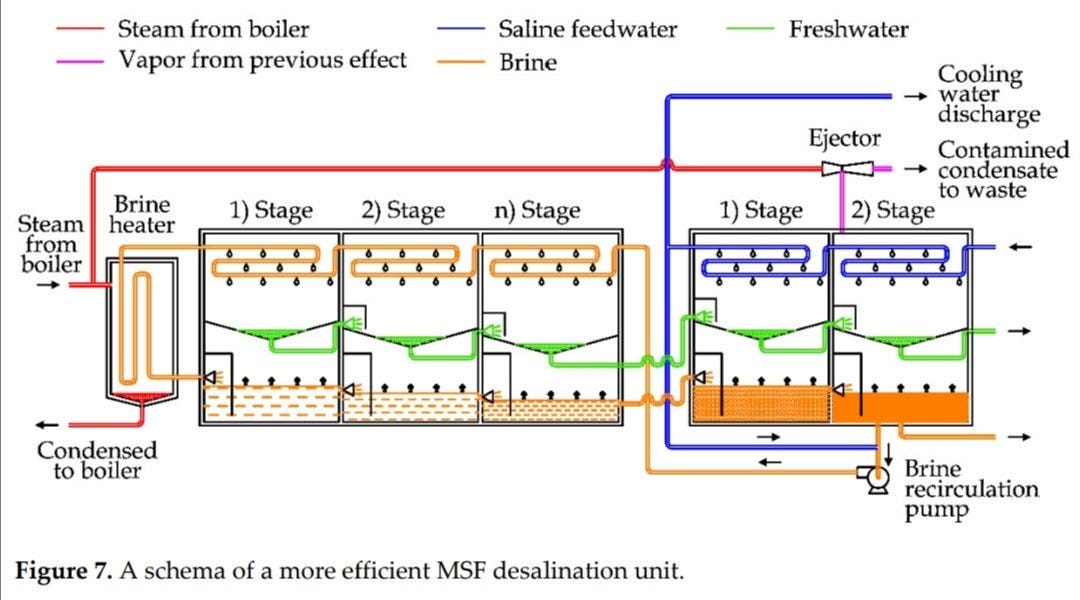
Firstly, here's a normal MSF system but with the condensor stage replaced by two or three heat recovery stages to reclaim lost energy. Note how the coolant seawater and brine pathways change from normal MSF.
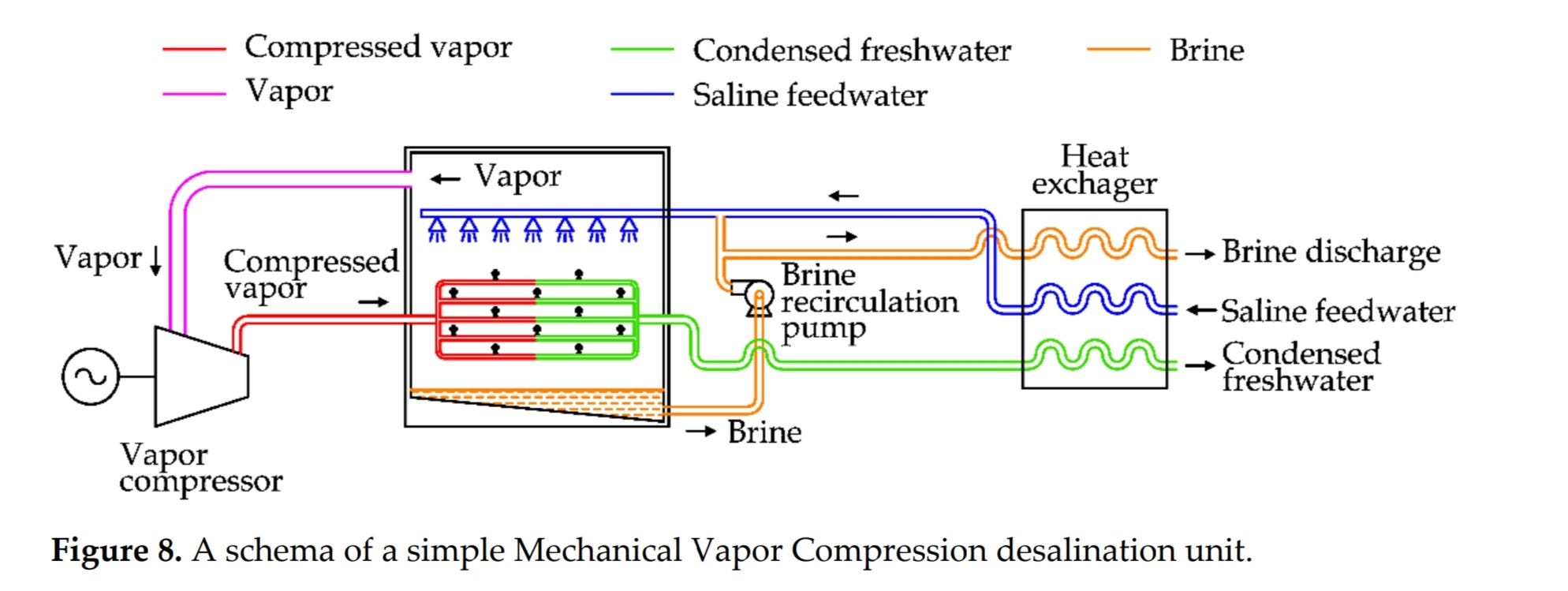
Next, here's Mechanical Vapour Compression (MVC), for when you don't want to use a boiler. Ideal gas laws state that by compressing a vapour, you heat it, so MVC exploits this by using a vapour compressor instead of a boiler.
It's energy efficient and can be kept small, at only 100-3,000 cubic metres a day, but study this closely and you'll realise that there must be a detail missing…
…If it needs water boiled into vapour to run, and needs vapour to start, *how* does it start?
Well obviously a vapour compressor will work with air as well as water vapour, so energy can still be added, albeit at a lower efficiency as condensation won't be going on. Some level of bubbling, ducting or other air separation must then be in-place further down the line to prevent pump damage or air locking behaviour, but logically that has to be common to all thermal desalination systems that condense vapour in tubes.
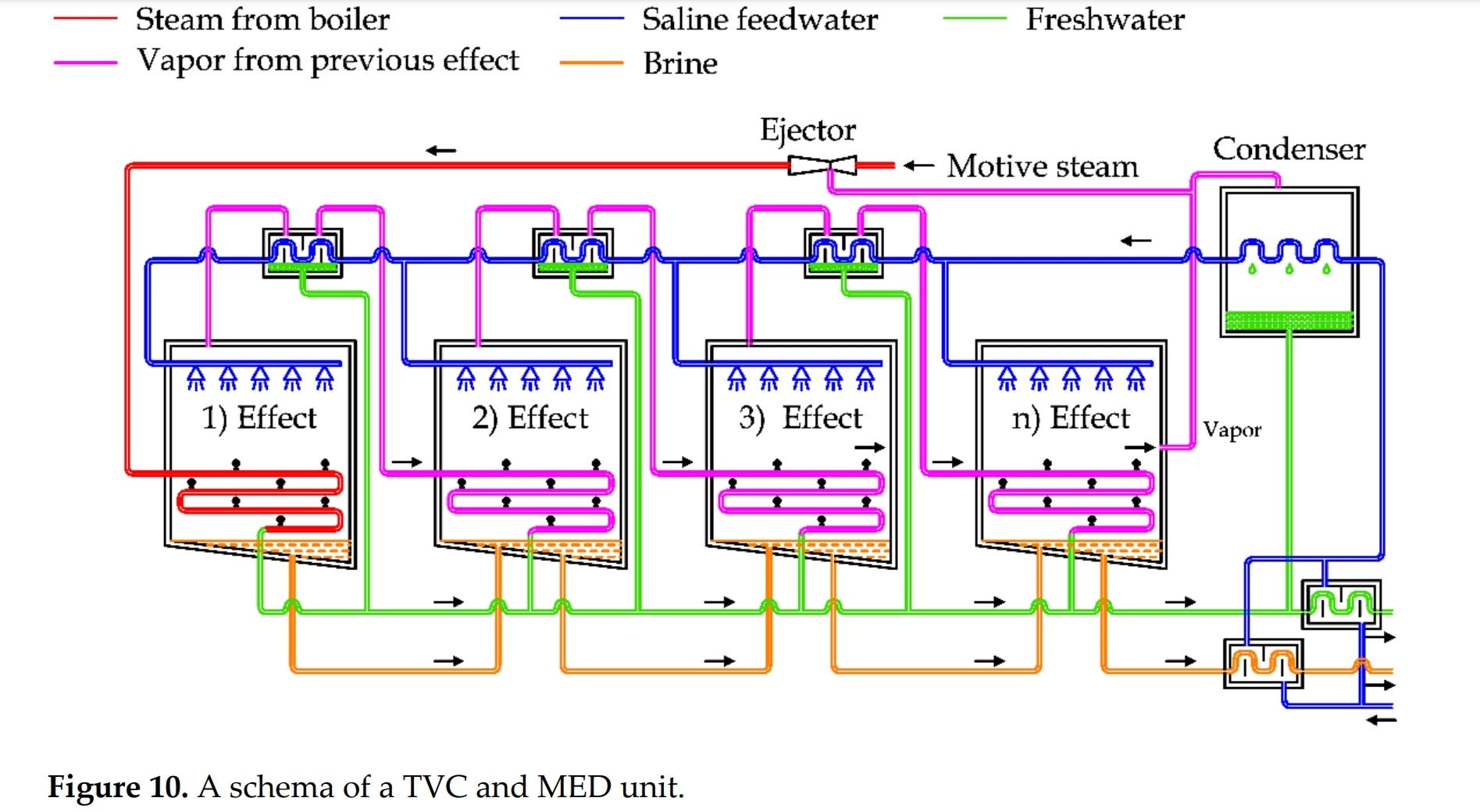
Now for the most complex system diagram of the lot, seen above: You can use thermal means to compress vapour as well as mechanical means, so if you hybridize that and it's steam outlet with the first cell and the condenser of a conventional MED unit, use the steam ejector to set up a vapour pressure gradient and set up heat exchanger/ condensor stages in-between each effect then you get this awesome TVC–MED hybrid that will hurt your brain just to look at.
Let's take a minute to appreciate the levels of insanity an engineer will reach if you just let them run with an idea for long enough…
…That'll do. Now for our final box of tricks: Filtration based desalination!
4: Pushing Salt
It's called Reverse Osmosis, and behind this benign moniker lies, -you'll never guess!- surprising levels of engineering complexity.
We'll start with the basics: You can just filter the salt out!
Pass water through a membrane with a pore size under 1 nanometer (a billionth of a meter, very small indeed) and you'll filter out all the salt, bacteria and viruses, leaving fresh, clean water. Amazing! Except, inevitably, there's a problem to overcome…
If you separate fresh and salty water with such a membrane, fresh water flows towards the salty water to balance the energy potential of the solutions. Nature despises concentration and wants to even things out, and to overcome this you need to apply pressure in the opposite direction.
This is called Osmotic Pressure, and for seawater separated from freshwater this is an unbelievable 27 bar, or 27 atmospheres of pressure!
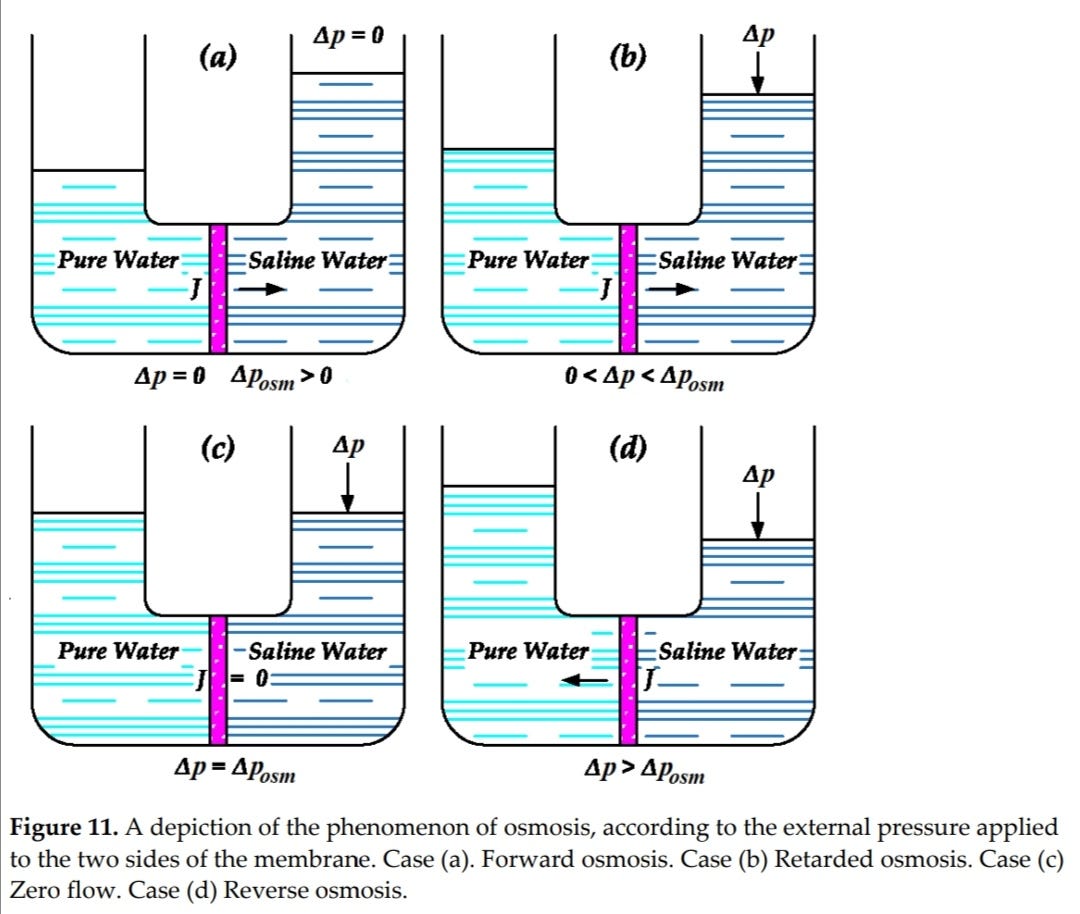
And it gets trickier still because, think about it, if you squuueeeze salty water through an osmotic membrane to create freshwater, then the salt water that remains will get saltier and saltier until the osmotic pressure across the membrane gets so high that it balances out whatever pressure you're applying to do the filtering.
Damn and blast!
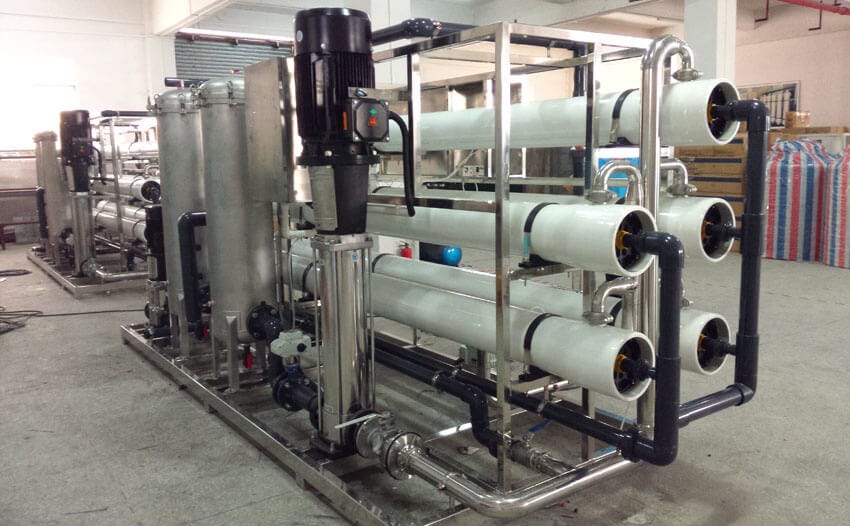
In practice this means that you can only get 40%-50% yield out of RO systems, and even this is energy intensive, though less so than boiling water for distillation. To keep costs down it's therefore crucial that we recover some of that energy from the super-pressurized brine.
This is where things get fun…
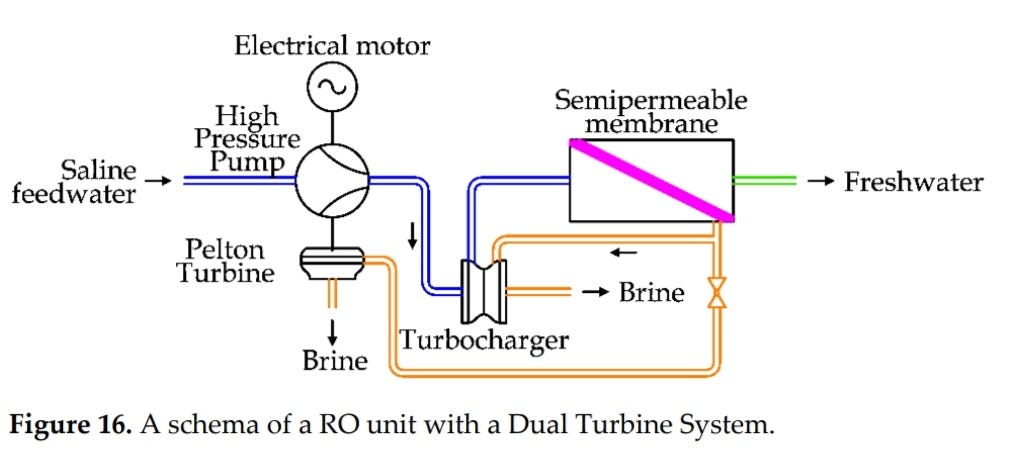
Turbines are obvious solutions: You can use Pelton turbines (bucket wheels) if the pressure is high enough, or else turbochargers, or a Francis turbine (think hydro-dam), or an arrangement of in-series turbines, or mate it with electrical motors for pressure balancing & control… endless options.
Or even better, use a pressure recovery unit.
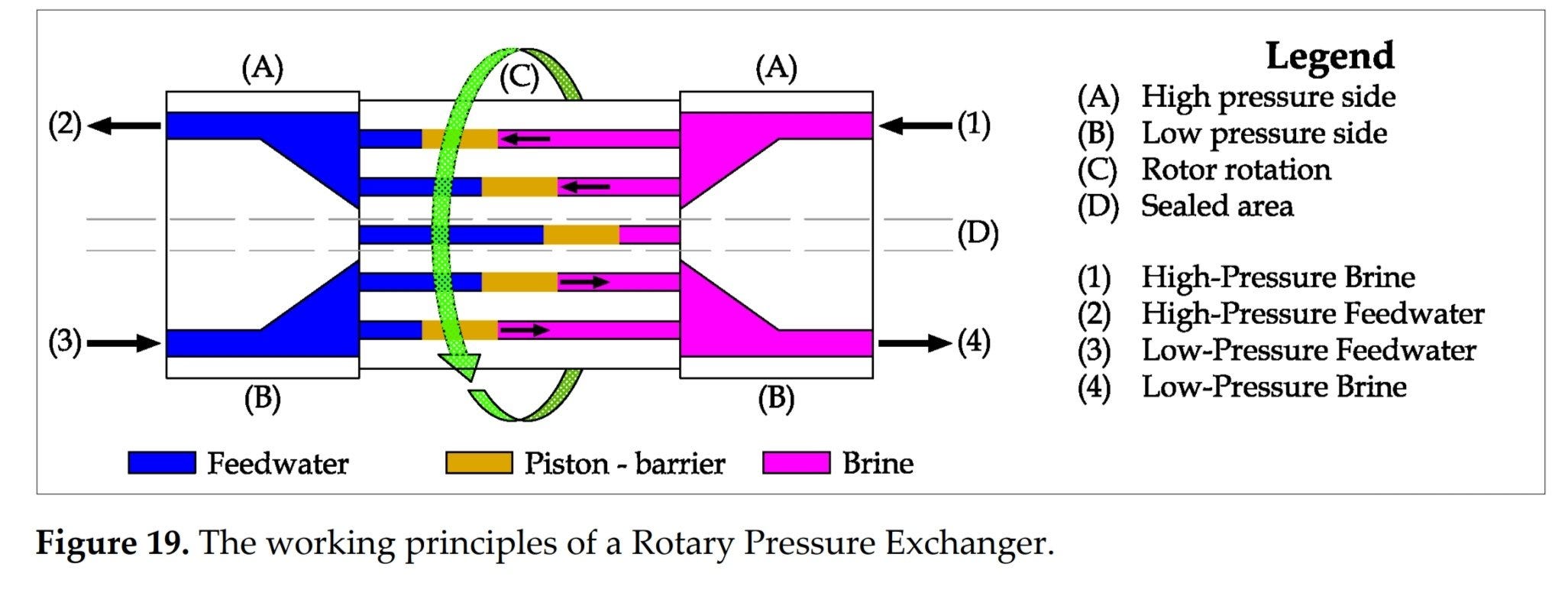
A pressure recovery unit is a deceptively simple device that can recovery a majority of this waste hydraulic energy, but is difficult to explain through words and pictures. The linked video gives you an idea, though: A spinning revolver-like cartridge containing pistons that actuate between the high and low pressure streams of outgoing brine and incoming seawater respectively, allowing energy to be effectively transferred from one stream to another while keeping them isolated from each other.
With this and other methods, globally desalination has reached prices equivalent to just 50 cents per cubic metre, while the majority of desalination capacity has moved from thermal distillation to Reverse Osmosis. By Pushing Salt, over 100 million cubic metres per day of installed capacity exists now and this is growing rapidly, with fully half of this in the middle East. Natural geography combined with expanding young populations demand technological solutions to water scarcity.
And this is where desalination tech is a story of hope. It's a story of abundance taken from the endless ocean, of energy transmuted into life through a crucible of salt. It's providence grows with the abundance, and cheapness, of energy.
Make it cheap enough and you can irrigate entire deserts.

This is where our focus should be as a civilization: We float on a sea of abundant energy and we should fight those who would see its use as a dirty word. We can't move forwards by holding ourselves back so let's make the future an energy abundant one. Make it run, make it flow, make it fountain ever higher until we have the power to make all the hungers and petty recriminations of the world disappear amidst the plenty.
Take out the salt, and we can make paradise out of arid lands.
Energy becomes life.
Post-script:
Because this article used way more images than usual, and many of them are annotated diagrams from existing papers, it's fair to point out the papers I used. Here they are, and full credit to the authors: