
Our Steampunk World
The story of the steam engine.

We live in a world of steam.
The first click of your kettle in the morning is prelude to a symphony that's been rising to a crescendo for three centuries now. We may no longer travel on puffing, roaring steam locomotives, but the power behind our entire society, hidden from view, is that of boiling water. All our pretension and our software sorcery is owed to simple steam.
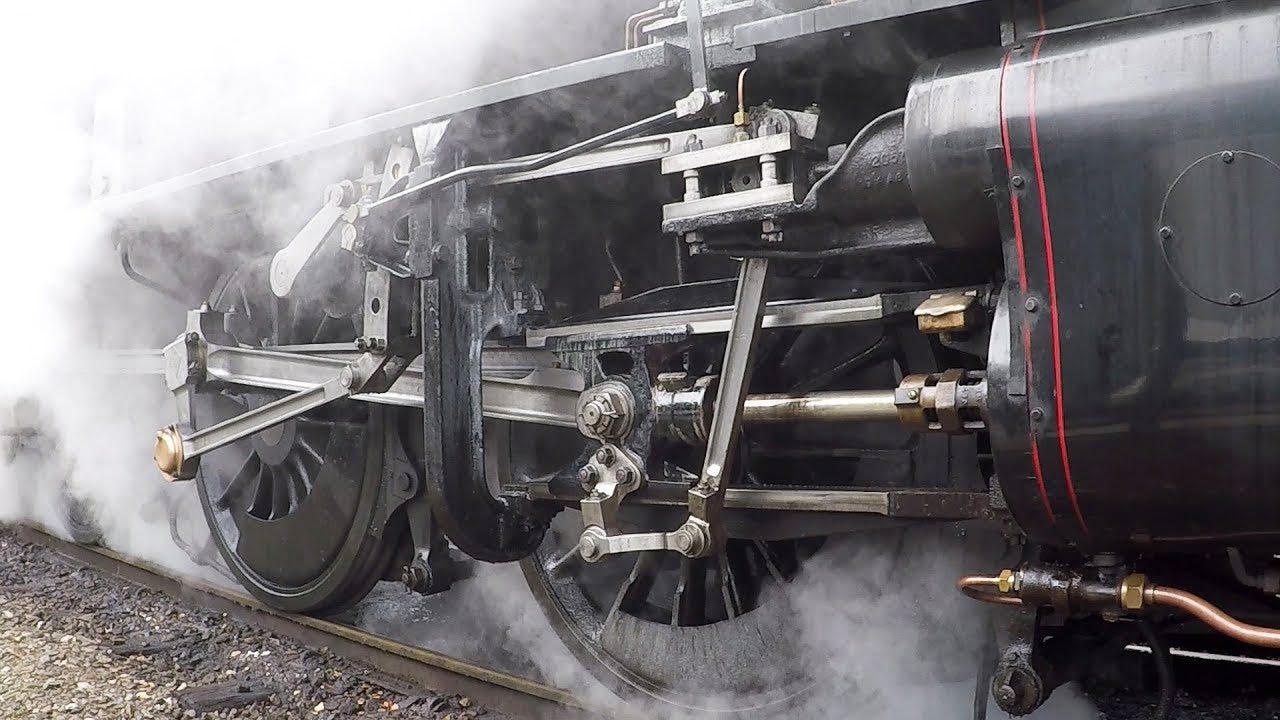
It wasn't always this way. The steam engine changed society, dragged people from a rural world of pony & trap to cities and humming factories. It creates our power, moved our trains and ships and changed our world. The industrial revolution and all of modernity was delivered this way.
But capturing it wasn't easy and our present-day mastery stands on centuries of ingenuity and lost lives.
And it starts with a pump.
1: The Miner's Friend.
The deepest mine in the world today plunges more than four kilometres beneath the surface of the earth. For much of history this would have been impossible magic, and most mines were limited to thirty or sixty metres deep.
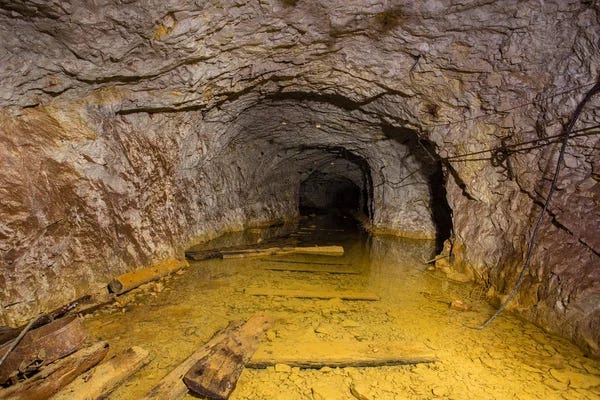
The reason was simple: Flooding. Reach below the local water table and it will seep in and drown your excavations, and unless you're digging sideways into a hill you can't rely on gravity to drain it, so you have to pull it out.
Before the steam engine, bucket chains, human labour, simple hydraulics and animals were used: Literal horsepower. But animals tire and ropes break, so this still limited the mine owner to shallow reaches.
All of this started to change in 1698 when Englishman Thomas Savery patented the first commercial steam powered pump.
We'll get into the Savery pump in a second, but first let's talk about steam and why it's useful. Basically if you can get water to evaporate, it wants to expand about a thousand times as it turns to vapour. The work done by the fluid during this expansion can be tapped, and in the earliest steam engines that was done by cylinders or pressure vessels. Reverse the process and condense in an enclosed space and you can get a partial vacuum too, so you can power machinery both ways.
But why water specifically? Why not run a heat engine with oil, air or ammonia?
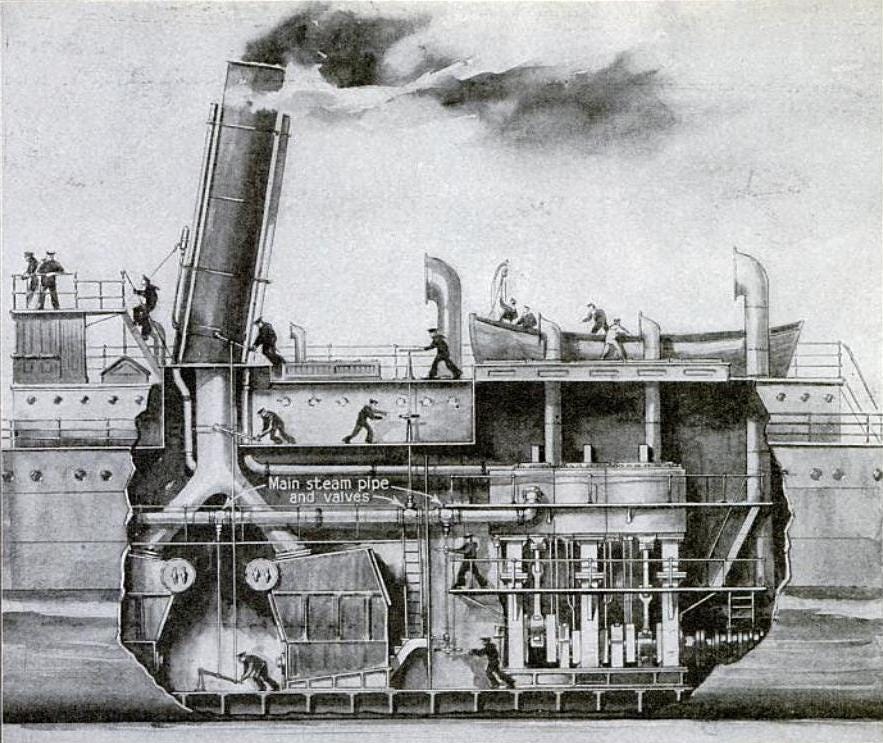
Well for one thing water is cheap and falls from the sky, giving a cost advantage no other fluid can beat. It's also easy to manage, non-toxic and boils in a range that, when pressurised, is useful for most industrial heat sources, meaning that you can fine-tune its behaviour through pressure (the boiling point goes up with pressure). But there are other fundamental benefits of using water steam…
The huge increase in volume of unconstrained water when it becomes steam is much higher than most other fluids, which is useful if you want to tap into this expansion with pistons or turbines, which we do.
Water also has an unusually high specific heat capacity, or the energy required to increase the temperature of 1kg of water by 1 degree, and this means that even a small amount of water can store and transport an awful lot of energy.
And it has a very high condensation enthalpy, which takes some explaining…
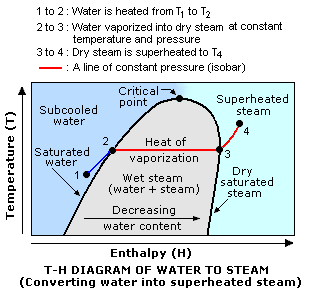
Condensation enthalpy refers to the amount of energy you need to shove into liquid to turn it into vapour when its temperature is already right at the boiling point. For liquid water at 100 degrees at sea level, you need to blast 2,257 kiloJoules per kg to make it into steam, which is five times the energy needed to take liquid water at zero degrees Celsius all the way to liquid water at a hundred degree!
It's uniquely enormous.
Now, since a heat engine can't recover all this energy back, you'd think that this is very inconvenient and wasteful. It is, except for two saving graces.
Firstly, as you increase pressure the condensation enthalpy goes down, and most steam raising power systems run at high pressure for reasons we'll get into. And secondly, this huge energy chasm means that it's safe to run boilers at high power with water, because the high condensation enthalpy means there's no chance of it all boiling at once and breaking things.
So: Compact, high power, controlled by pressurisation, chemically safe and super cheap. Water is perfect to fuel an industrial revolution! So it's handy that the Lord saw fit to cover our planet with it. That was considerate.
But anyway, back to the revolution, flooded mines and the Thomas Savery steam pump!
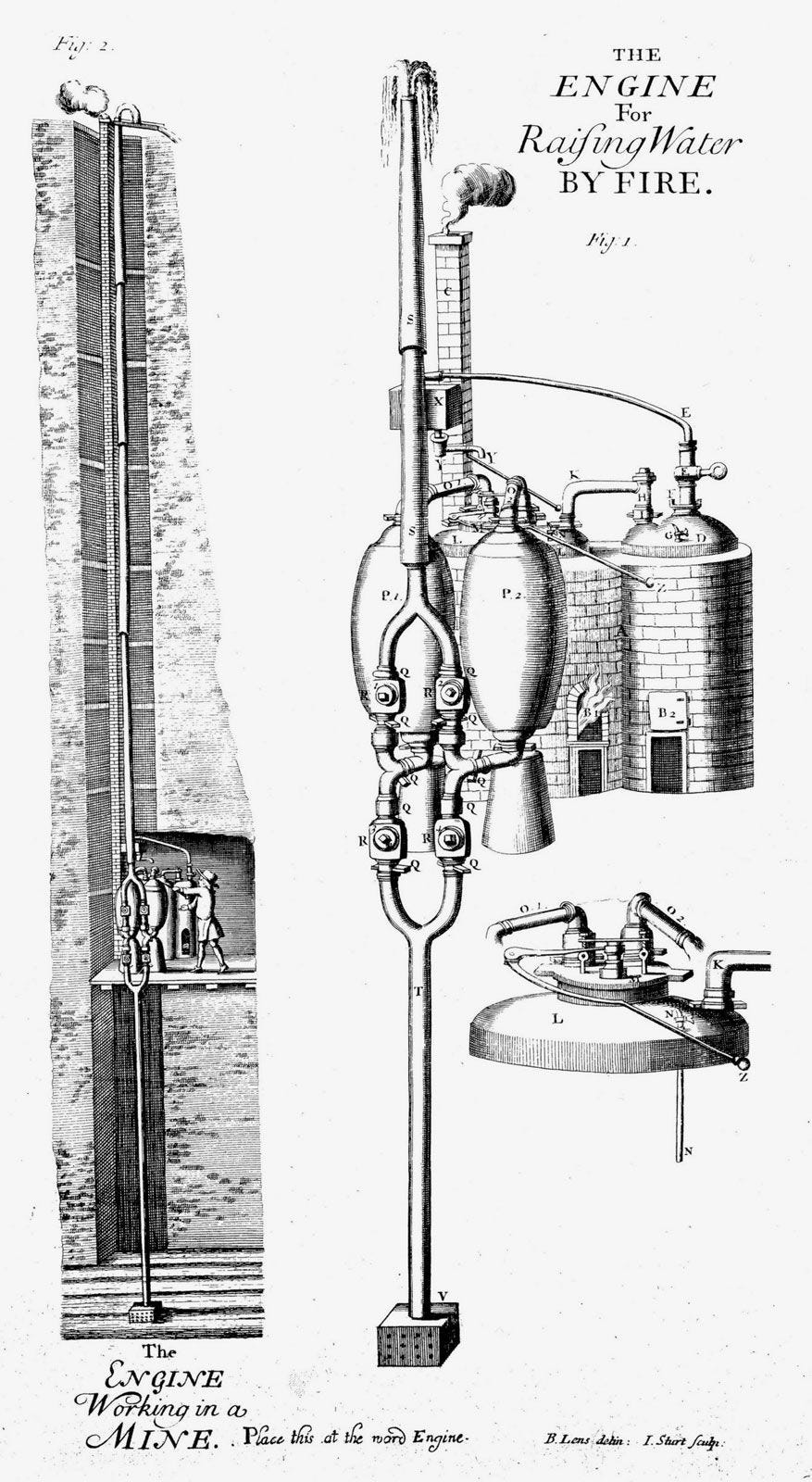
Savery’s steam pump was the first significant use of a steam engine in a commercial context, and was patented in 1698. Its goal was, simply, to be the miner’s friend: It had to pump floodwater out of mines, so they could be dug a little deeper.
Savery’s design was a piston-less pump that used both positive and negative pressure to draw water up from a mine and then expel it. In this so-called Fire Engine, a coal-fired boiler heated water to boiling, sending steam into a pressure vessel, partly-filled with drawn-out mine water which would gradually increase in pressure. This would then push out the mine water from the pressure vessel, through a non-return valve and up through a water delivery pipe, expelling the water from the mine.
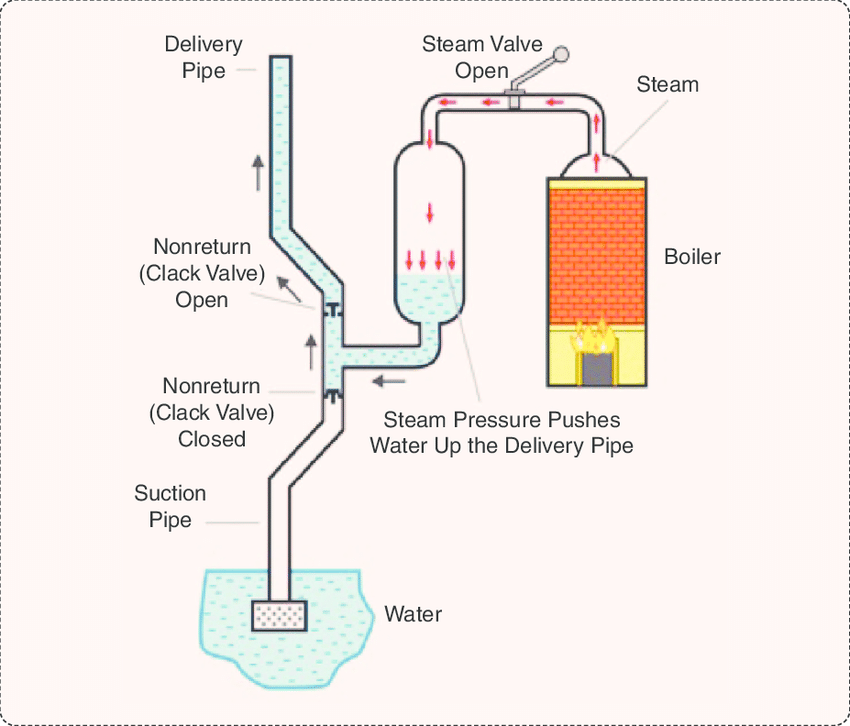
This done, the Fire Engine would then go into reverse, as the steam valve connecting the boiler to the pressure vessel was closed and the non-return valves were opened & closed. Cold water would be poured over the pressure vessel to cool the high pressure steam held inside, forcing it to cool and condense. Because water vapour is hundreds of times less dense than liquid water, the condensation of the steam in the closed vessel would create a partial vacuum. Once created this would then be exposed to the well going down into the mine, and would suck mine water up twenty to thirty feet into the Engine, which would then close the valves to the lower mine, open the manual steam valve and start pressurizing once more.
In this way, by manipulating steam and pressure, Savery’s Engine could be built inside a mine to continually pull water from beneath and push it out above. Chain these together and ‘deep’ mines became possible in wet ground for the first time in our history. This was particularly useful in Southern England at the time, where over-exploitation of easy resources close to the surface was driving miners ever down into the drowned earth.
Thomas Savery’s harnessing of steam gave impetus, but a small one, to the budding industrial revolution. It was extremely inefficient, but useful, and by 1733 it was used in around fifty mining installations, pushing men deeper into the underworld and increasing coal production; a vital ingredient in the industrial transformation of society that was to follow.
But Savery’s design was not without its drawbacks. It was a heavily manual process, reliant on sequential opening & closing of valves for effective operation, and operated at a steam pressure of up to eight or ten atmospheres in a time when pressure vessels were neither reliable nor safe. Steam explosions were a risk, and the spectre of a skin-peeling steam blast deep underground gives pause to the most ardent technological optimist. This was underlined by an explosion of one of his units in 1705, bringing a swift end to the short-lived era of the ‘Miner’s Friend’.
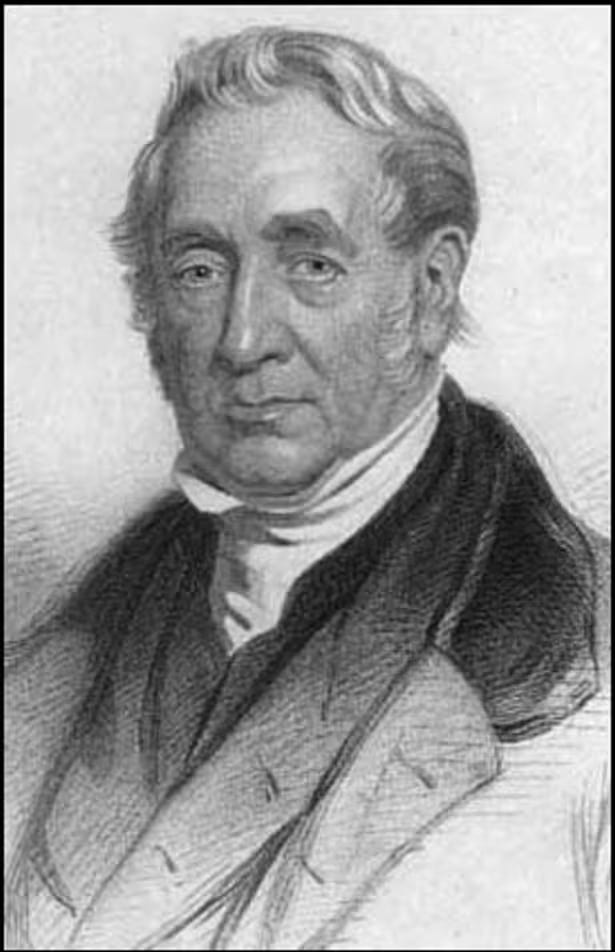
And so, in the fullness of time, Savery’s engine was replaced with something better. Another Thomas, Thomas Newcomen developed the Atmospheric Engine in 1712, the first commercial steam pump to use pistons, and this was the killer app that caused the exploitation of steam to explode, by… um, not exploding.
2: Piston Power.
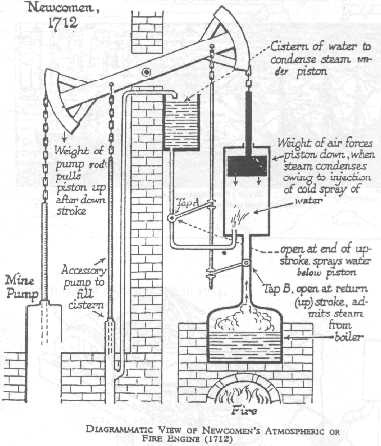
Newcomen’s Atmospheric Engine was a different kind of creature. It used a travelling cylinder to pump water from mines, which meant that the pressure wouldn’t rise much above one atmosphere, rendering it a safe design… particularly since it worked through negative pressure!
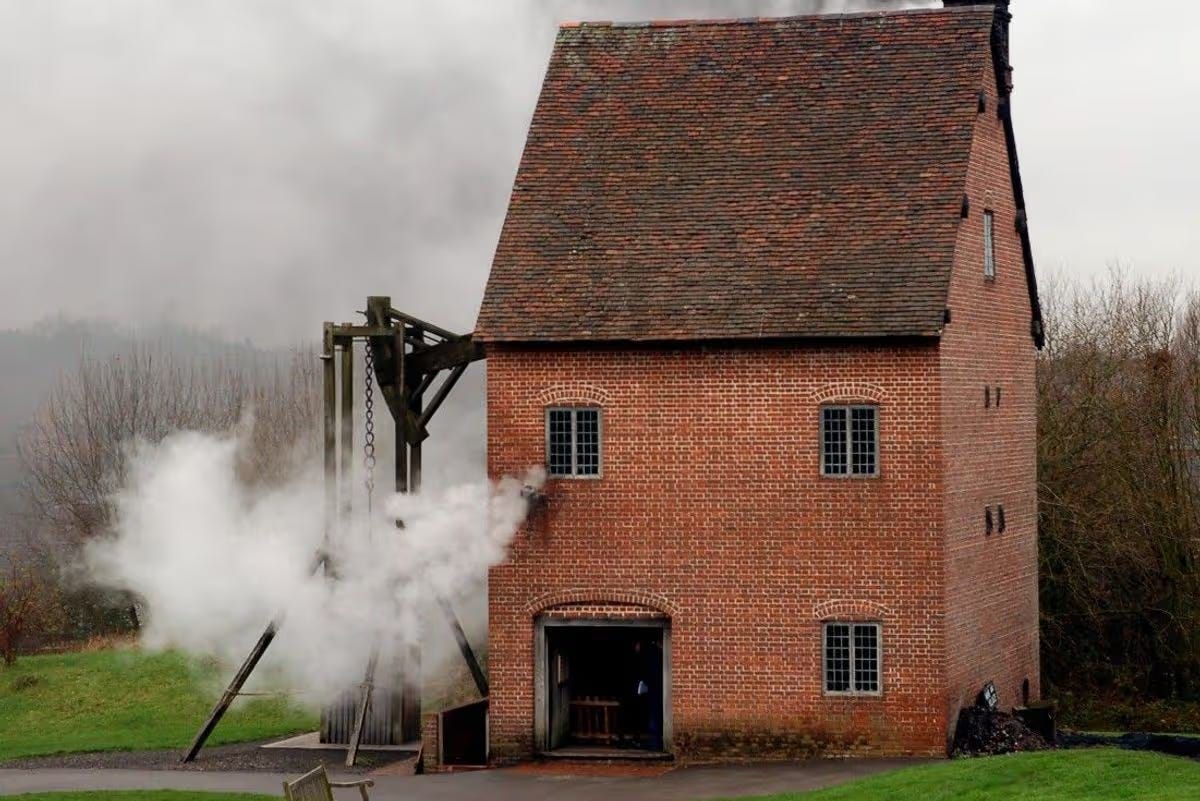
The Atmospheric Engine comprised a large cylinder mounted atop a coal-fired boiler, with valves at its entrance and exit. During the initial powered stroke, expanding steam from the boiler would pass through an open valve into the cylinder, pulled by the negative pressure of the opening cylinder which is weighed down by the pumping rod, connected to a balance arm. When the piston was fully extended, the entry valve was closed, preventing the entrance of further steam, and an injection of cold water was applied from a cold water cistern to the cylinder to prompt cooling & condensation. The resulting contraction of the steam into water creates a partial vacuum which pulls on the balance arm, raises the pumping rod at the other end up and begins the cycle again.
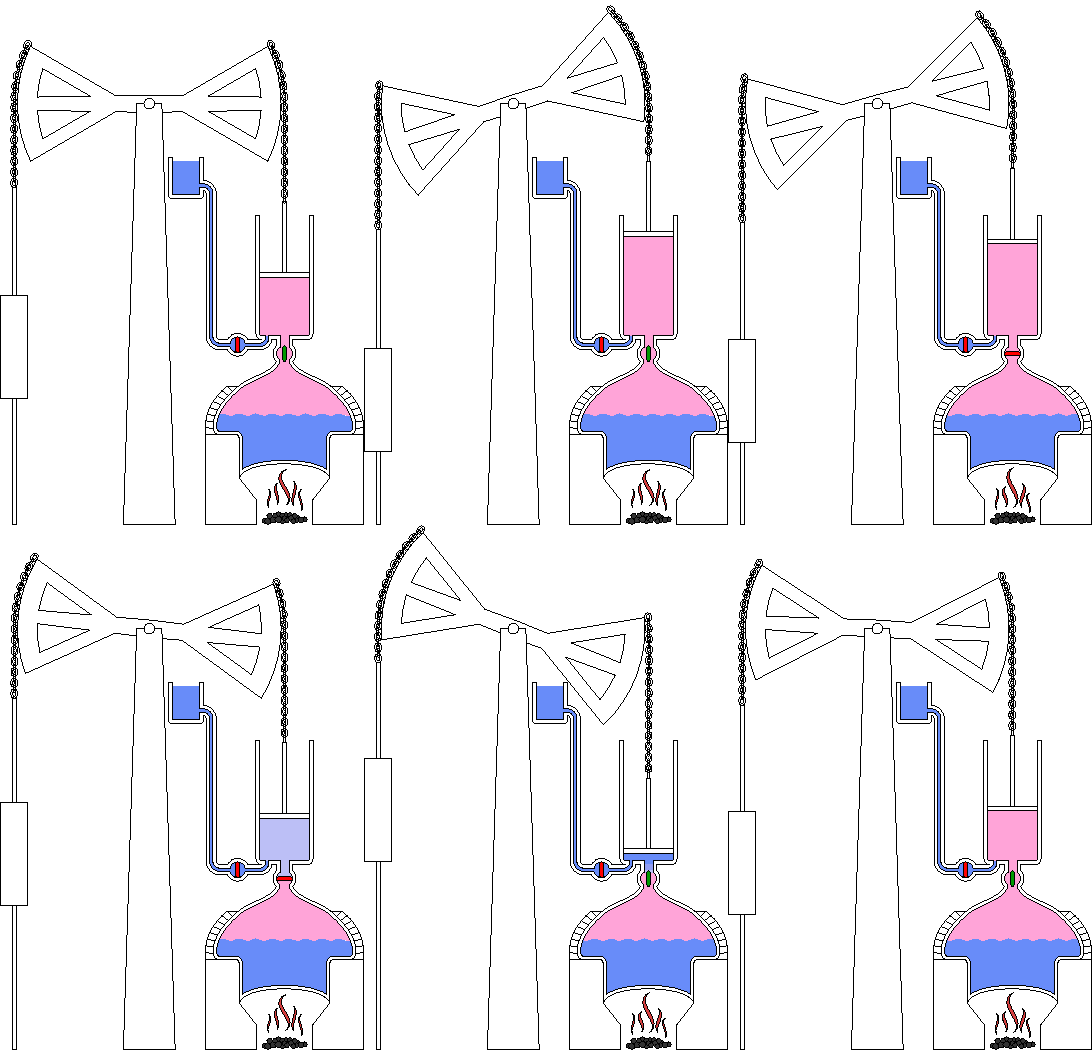
At the end of the pumping rod, way down in the depths of the mine, are conventional pumping handles which the Engine connects to, drying and opening up the subterranean retreat. As for the Engine's cylinder itself, it was water lubricated and sealed by the very same cistern used for cooling.
By 1735, Newcomen’s Engine was installed in over a hundred mines, and by the end of the century variants of the engine would be in over 2,000 mines across the globe. Men dug deeper and British coal production tripled, deepening the well of energy from which our civilization drank and setting off an industrial revolution that would spread worldwide, changing every aspect of society. The globe would come to be dominated by a handful of swelling cities in the British Isles, risen by workshop and loom, choked by smoke, alive with energy from the ground.
All of this from a steam piston over a mine.
But the story of steam was only just beginning, for the mid 18th century saw the arrival of James Watt…
3: Power from Scotland.
James Watt comes from the fine old Scottish tradition of inventing practically the entire modern world, and you know this to be true of someone when their surname is literally an international measure of power. He first came across the Newcomen engine while servicing one in Glasgow in 1765, and quickly became aware of both its shortcomings and potential routes of improvement.
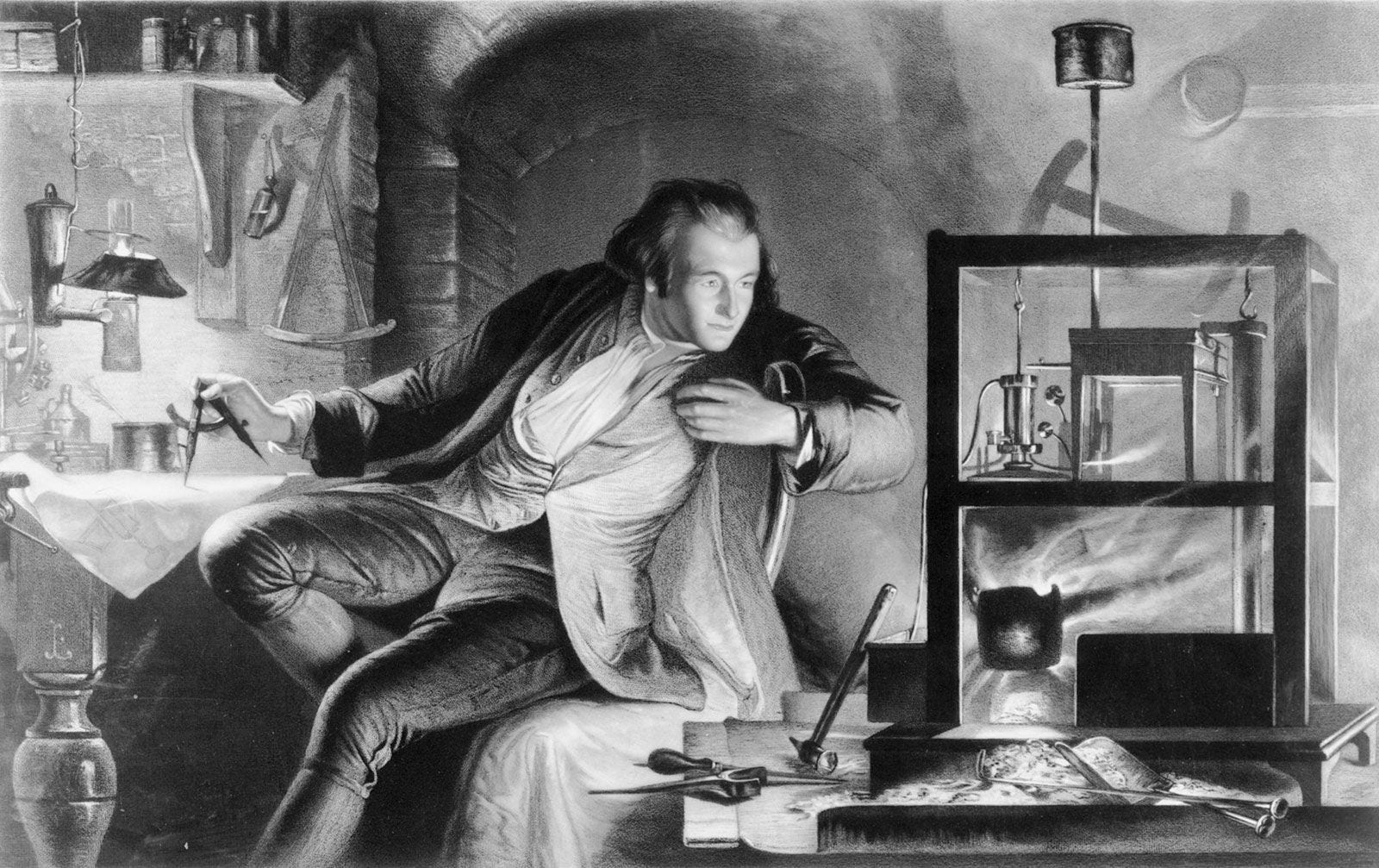
Put simply, the Newcomen engines were appallingly inefficient. They could only power stroke in a single direction, through the partial vacuum created by condensing steam (not the introduction of high pressure steam as you’d think), the cylinders leaked, the cooling water carried away and wasted most of the heat energy and it combined the heating and cooling cycle into a single cylinder.
It’s not obvious why this should be a shortcoming, but there is power in purity, and the Newcomen engine’s main cylinder was a compromise; spending half of its time heating and half of its time cooling, it was constantly fighting its own thermal inertia and could not specialize at a single role. -Make it a better insulator (to reduce energy wastage) and you’d impede the cooling portion of the stroke. Make it a better transmitter of heat and you impede the heating portion of operation.
No purity, no purpose.
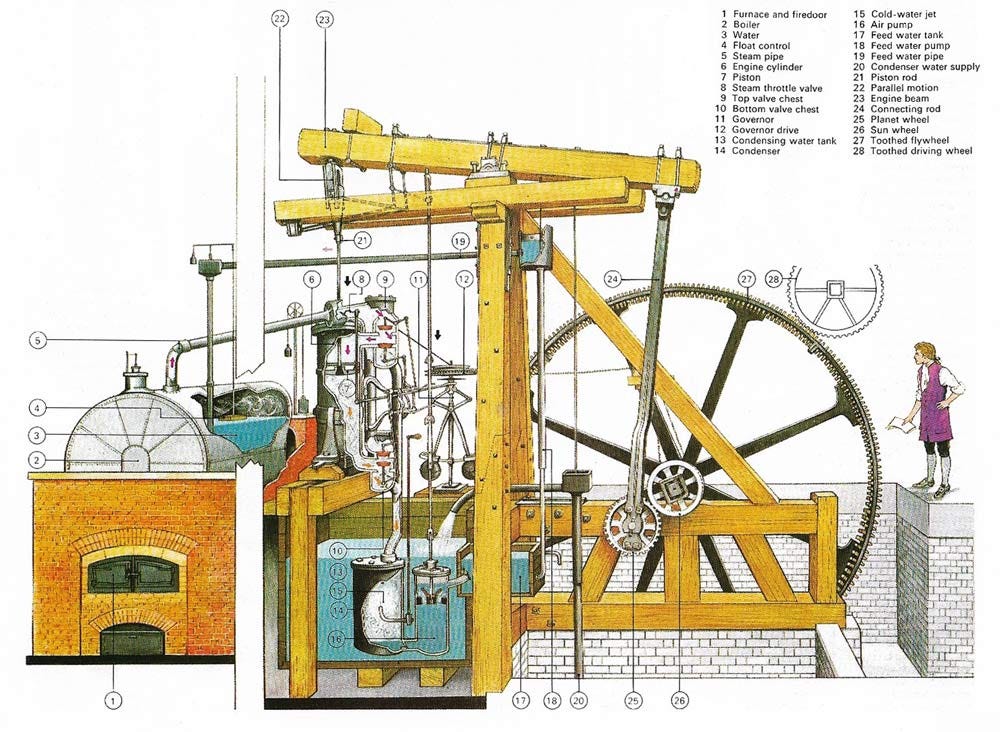
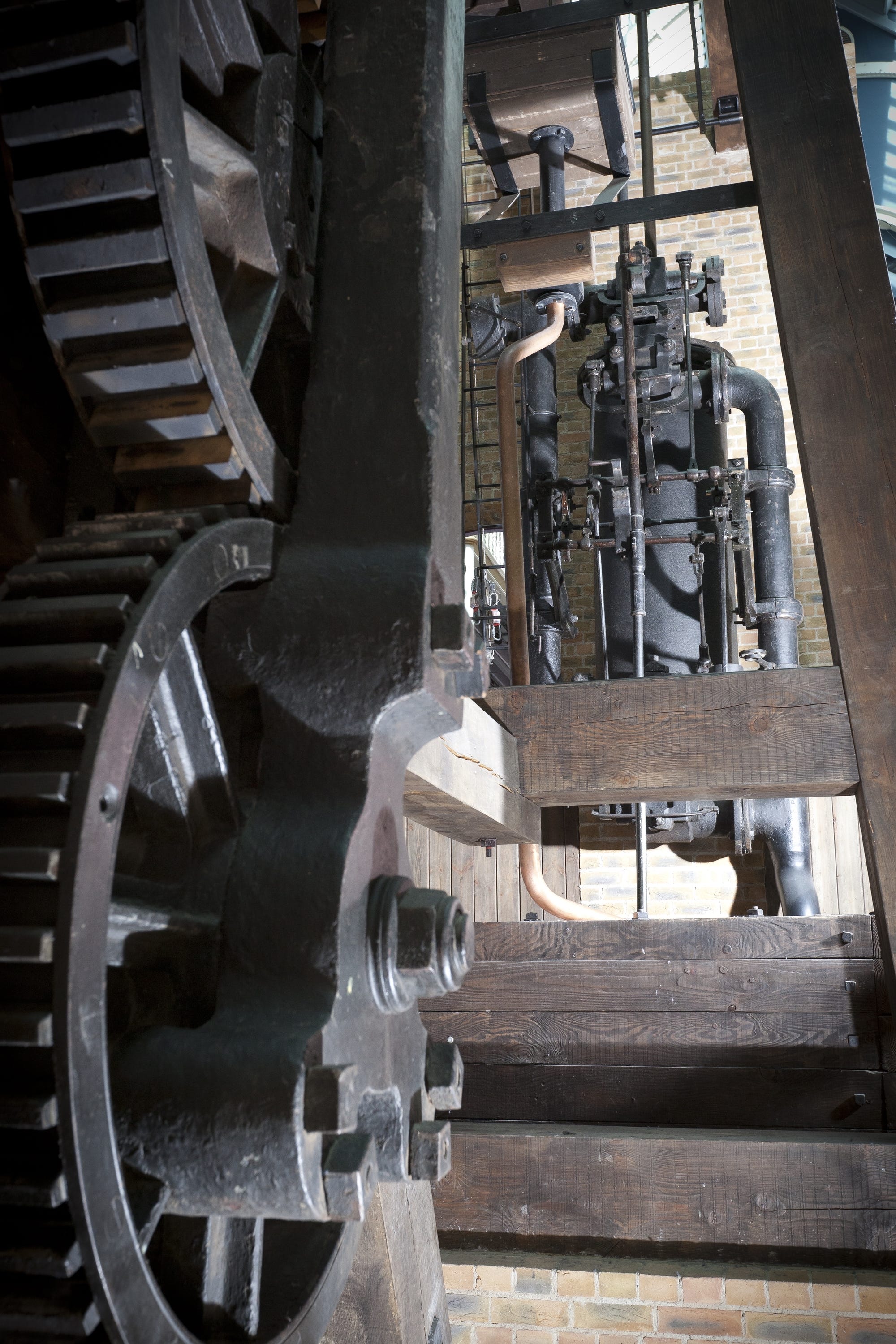
Watt introduced many improvements to the steam engine during his time, and one of the first, in 1769, was to isolate the condensing portion of the stroke in a separate vessel away from the cylinder. This allowed the condenser to be a dedicated water-jacketed heat sink, while the cylinder could be kept insulated from thermal wastage. The separation of the condenser, meanwhile, allowed the condensate and remaining air (not boiling, but still hot) to be pumped out of the condenser to a hot well and then recycled to the boiler. This was the first use of heat recuperation in a steam engine, and it was crucial to the efficiency gains from the Watt engine, which consumed 75% less fuel than its Newcomen engine predecessor.
The new Watt engine ran faster, cooler and far more efficiently, and this in turn allowed their reach to expand further than the Savery and Newcomen engines ever had, powering the burgeoning industrialization of Great Britain. With each efficiency improvement, more avenues opened up for using the new technology, bringing in money, investment and talent, with which to make even more efficient engines, which allowed even more widespread use, and so-forth…
For a modern analogy, look at the explosion in air travel since the 1970s driven by improved fuel efficiency, or the motorcar before that, or space rockets right now, driven by the inherent efficiency of re-using your rocket booster. Each rests on a powerful industrial feedback mechanism that, once started, is hard to stop before it changes the world.
Anyway, because of the Watt engine, the industrial flywheel for steam had finally started. It would keep spinning for centuries, and Watt wasn’t finished yet!
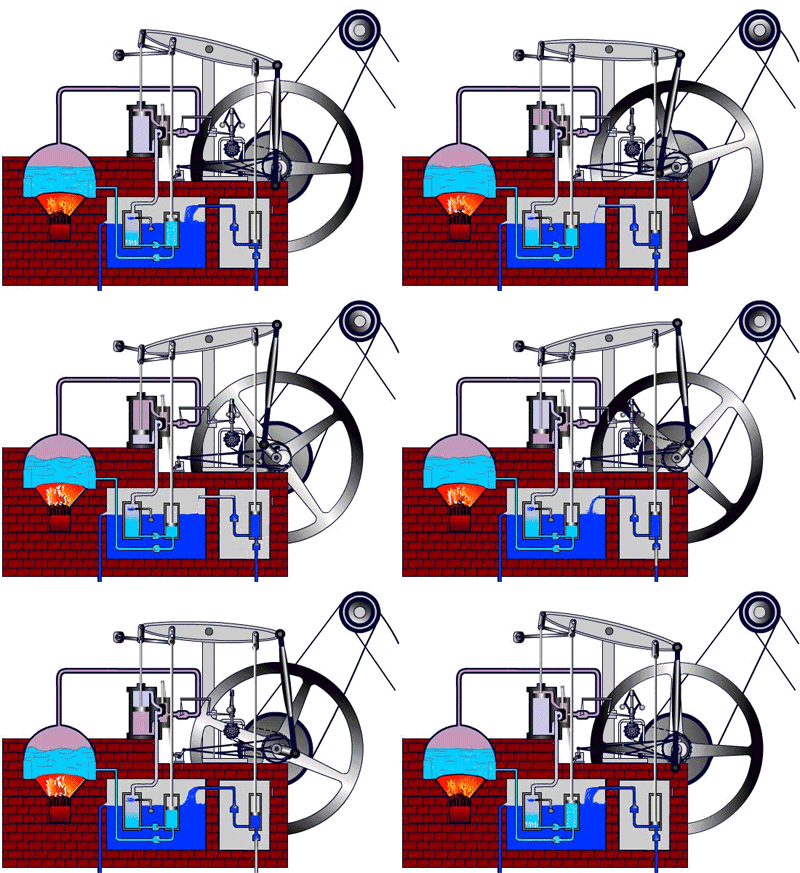
In 1781, invented by William Murdoch and patented by James Watt was the sun-&-planet gear, an obvious-only-in-hindsight development that used a piston-driven beam connected to planetary gear attached in turn to a ‘sun’ gear that would transform oscillating in-out motion into useful rotary motion for operating heavy machinery and factories. It used a flywheel to smooth the output and was the first development that allowed a functional steam engine to drive complex factory machinery directly. This moved the steam engine out of the mines & water pumps and into the heart of our new industrial world; the cotton mills and workhouses that turbocharged industry for Britain and then the globe. James Watt gave his name to power, and he’d given his power to the industrial revolution. Our Steampunk World had arrived!
But he still wasn’t done…
