
Forgotten Atlas
Heat Exchangers: Designing the titans that hold up our world.

Our technological world is not a wireless wonder and owes its existence to ugly machines from a gnarled, ancient family tree. This was first posted when I had a mere two hundred subscribers, so hopefully it’s new to a lot of you. Enjoy!
We live in an age obsessed with digital bling, but beyond the siren call of your pocket demon is a world of aged technology, of water and steam.
And we owe it our entire existence.
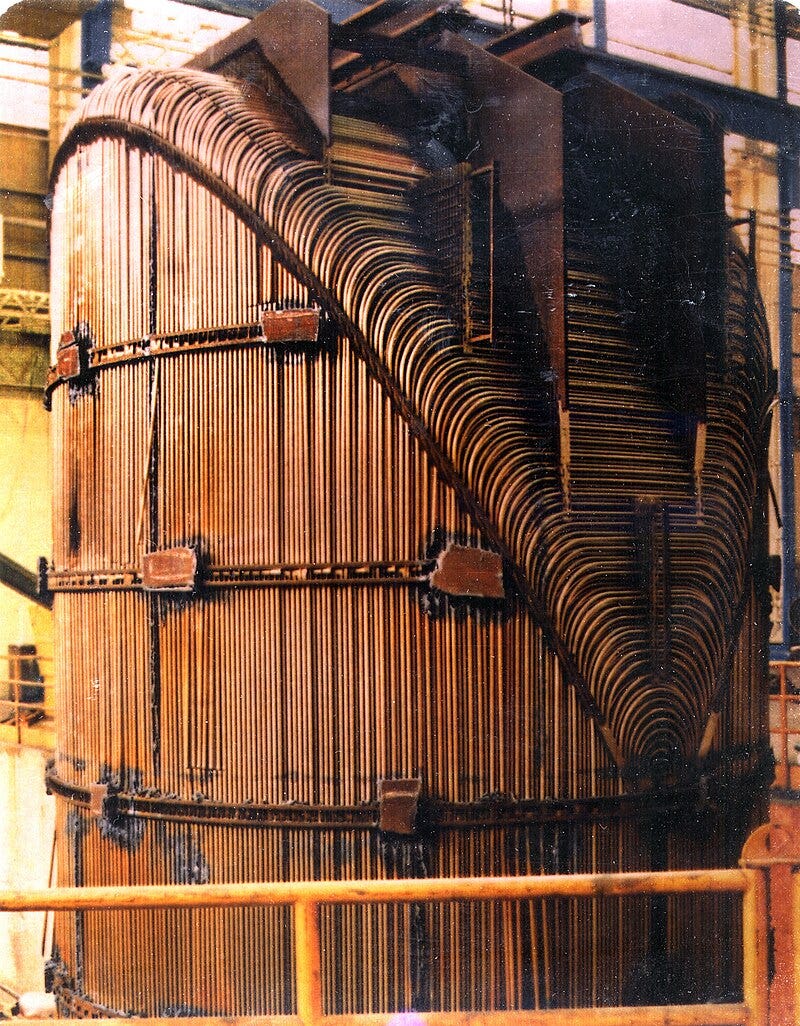
In a real way our world is built on heat exchangers, and it's kind of a relief: It’s good that we rely on a beast of honest blue collar welded metal. They are of all sizes, from as big as buildings to small enough to disappear in a cupped hand, but there are a number of tried & tested designs that we keep on returning to.
Let's go through them.
Hang in there: This starts simple, but is Weird by the finish.
1: The basics.
We are all, metaphorically, passengers in a train at night. We sit placidly, jostled by forces we’re only vaguely aware of, mindful of our destination but unsure of the passage and unaware of the mechanisms of travel. The shudders, vibrations and dull roars are as much a mystery to us as the blurred constellations we rush past, half-glimpsed in the night.
But the train keeps moving. It is a forgotten mule, unthought of. Heat exchangers are the same, and they power our entire civilization.
Though their uses, from refining to data centres, may be grandiose, the heat exchanger is a simple creature at heart. In essence, two fluids must pass each other, separated by an impermeable boundary, preventing the fluids from mixing but allowing thermal energy to transfer, from the hotter fluid to the colder one.
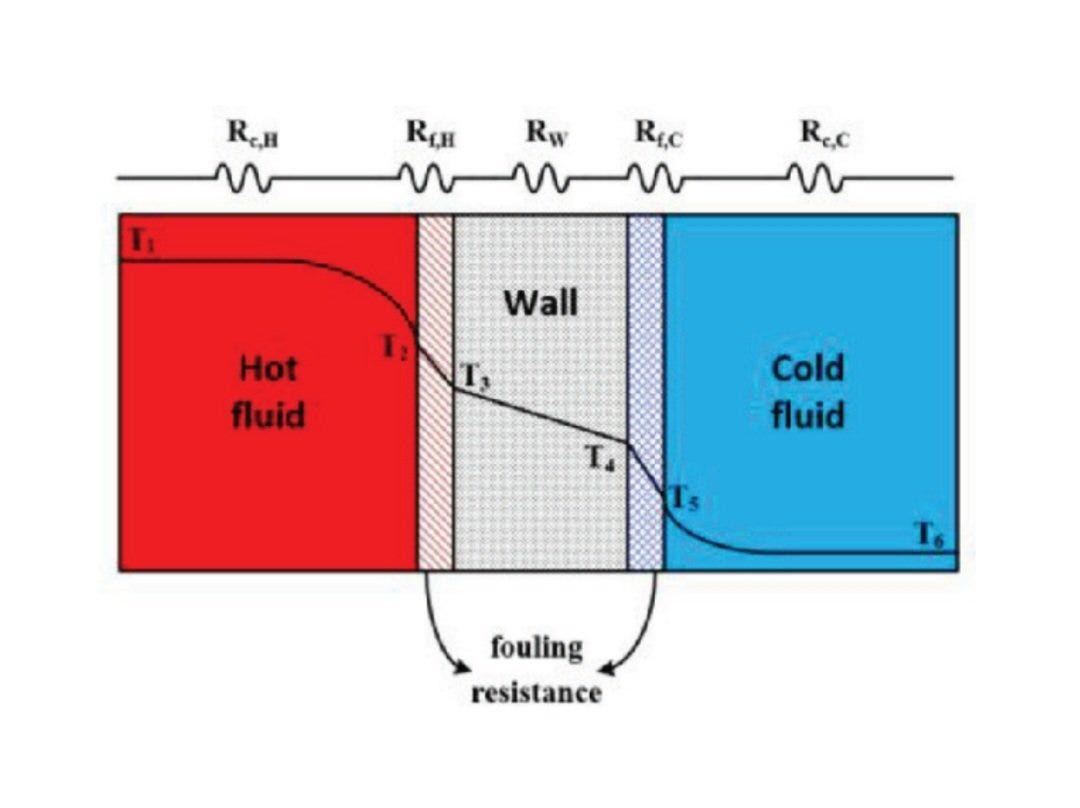
Simples, no?
Sort of. Thin walls are good for heat transfer, but thick walls may be needed to resist loads caused by thermal expansion or different pressures between the two fluids. The choice of materials also needs to be appropriate: Corrosion is a factor, particularly with aggressive liquids or vapours. Then there’s channel width, power transfer, turbulence, size, flow, pumping losses… lots of things.
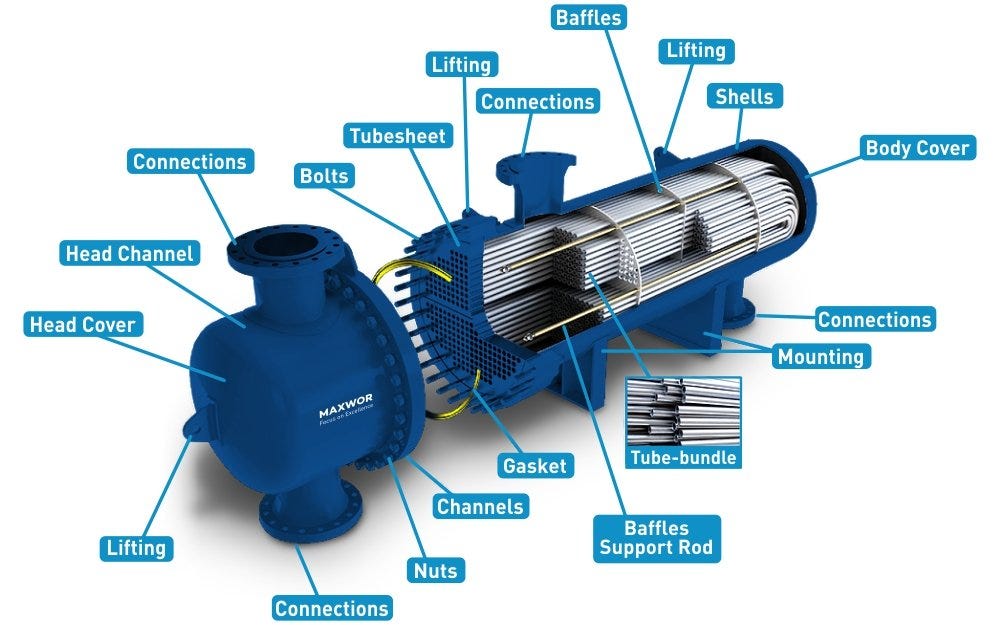
So there might be a teeny bit more to it than meets the eye.
Let's go deeper…
2: Simple things. A tube inside a tube…
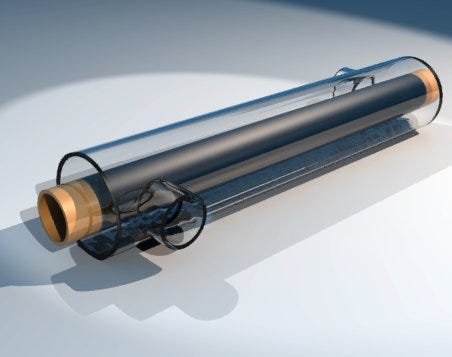
A double pipe or monotube heat exchanger is probably the simplest device you can think of: Literally a tube inside a tube, with different fluids in each. It's lack of sophistication may cost it efficiency, but what it loses in performance it gains in robustness: Uses of these heat exchangers include chemical heat exchange where large grains may be carried in the fluid flow, or fibres or similar solids prone to clogging. Simple straight geometries are clog-resistant after all.
But tube geometries aside, there is a more fundamental design fork to navigate: The flow directions of the different fluids in the heat exchanger. Because sometimes it's better to move against the traffic…
3: Traffic management. Cross flow, counterflow or co-flow?
Direction of flow matters. The rate of heat transfer across a barrier between two fluids is proportional to the temperature difference between the fluids, so the theoretical best heat transfer efficiency is achieved with a counter-flow setup, where both fluids travel in opposite directions. Why..?
Remember that one fluid will start cold and end up hot, while the other starts hot and ends cold. As a result, if they're taking journeys in opposite directions then there is a much larger average difference in temperature between them at a given point.


Contrast a co-flow arrangement, where the fluids travel in the same direction, in-parallel. Here, the rate heat transfer starts aggressive & high, but slows down as the two fluids start to get closer and closer in temperature. Keep this up for long enough and eventually the two fluids leave the heat exchanger at the same temperature.
Who knows? Maybe this is what you want.
A cross-flow or multi-pass cross-flow is a sort of compromise, and one you may need to visit to enable certain designs: Most shell & tube heat exchangers, for example, work this way to some extent.
Let's talk about them now…
4: The Big Boys. Shell & tube heat exchangers.


Take a gander for a moment at this steam raising plant for a French nuclear power station: This formidable unit is 21 metres long, as long as a tennis court. It also weighs 300 tons and circulates nuclear primary cycle distilled water at 150 atmospheres and hundreds of degrees through 4,460 tubes inside that vast shell.
That's a spicy meatball! And it's not even the biggest…
Things like this run in the hundreds of megawatts to gigawatt range, and are the heart and lungs of our industrial society.
It is, of course, a shell & tube heat exchanger: A thick walled shell which contains many, many fluid carrying tubes in a tubesheet array that take straight paths and, usually, loop back again. Meanwhile the second fluid runs inside the shell between the tubes, and often takes a wavy zigzag path through emplaced baffles to maximise mixing and even-out the heat transfer.
They can be absolutely bloody enormous! Big enough to make that French steam raiser look piddly.
These are the bad boys you'll see in power plants and refineries, where extremes of heat and pressure are encountered, and that initially seems strange: Sure, a thick-walled shell is pretty robust, but surely thousands of little narrow tubes are delicate and prone to damage?
Not so. A shell & tube heat exchanger has the advantage of ease of quality control, and heavy duty torqued and welded joins: The shell construction is obviously as robust as you want to make it, but so are the tubes, because tube-to-tubesheet welding is a highly automatable process and so is easy to control on an industrial scale. Weld inspection is also well understood for high pressure applications, and the system doesn't need perishable gaskets.
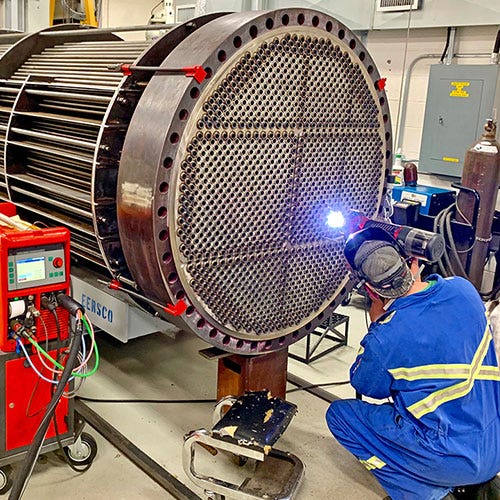
In short: An old technique, but one that is so well understood and straightforward to semi-automate that it's ideal for highly quality critical and demanding industrial processes like power generation or nuclear energy.
There's even more subtlety to it than that if you look closely: Not only can you vary tube direction, thickness, baffles and shell flow path, but you can also optimize the tubesheet array itself: A ‘square’ pattern is low resistance but allows fluids to shortcut between tubes. A ‘triangular’ pattern forces shell crossflow to zigzag and slalom it's way around the tubes, evening-out heat transfer and promoting turbulence and mixing.


Then there's material selection, fatigue design, corrosion, weld management etc etc…
More than meets the eye. But for an even better example of hidden complexity we'll go to our next heat exchanger design, where all detail is hidden from the outside: The black box itself.
The Plate Heat Exchanger…
5: Ordering the perfect sandwich: The Plate Heat Exchanger (PHE).
The PHE is a compact, space-efficient heat exchanger that uses a sandwich of many, many exchange plates, each with openings and shaped gaskets to ensure that fluid flow only passes between every second pair of plates.
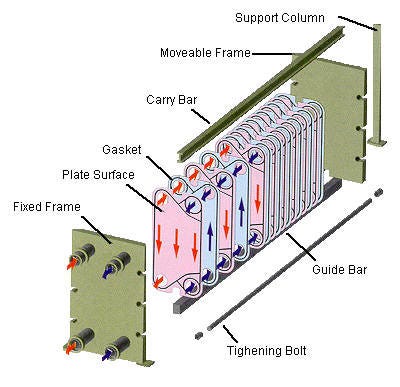
OK, that's a little hard to describe. Try studying the diagram shown and it'll make sense. Fluid A starts at one end of the sandwich, fluid B at the other. The design ensures that when fluid A is running in between two given plates, fluid B is on the opposite side of both: One side co-flow, the other counter-flow.
A little confusing, but there you go.
Because everything in a PHE is a heat exchange surface, and there's a generally counter-flow design, it's very good at cramming lots of heat exchange power into a small volume. The individual plates are often ribbed or channelled to improve mixing and surface area even more.
And because it's a simple, layered construction put together & tightened on a carry bar, it's easy to take apart and maintain too (but remember which plate is which!)
So why isn't it everywhere? What's the drawback?
The primary drawback of PHEs, despite their terrific utility, is the gasket: A gasket is needed to seal the gap between each heat exchanger plate, and in situations of extreme pressure or temperature it’s the humble gasket that, alas, becomes the limiting design factor.
An EPDM rubber gasket in a PHE, for example, is generally limited to a gauge pressure of up to 25 atmospheres, and a temperature range of -45C to 150C. This sounds like plenty, and indeed it’s perfect for a huge range of commercial and residential uses: Want to use a heat exchanger to manage temperature in a swimming pool? A plate heat exchanger will do you proud, as well as being smaller, more maintenance accessible and a lot less expensive than a shell & tube exchanger. You’re quids-in!
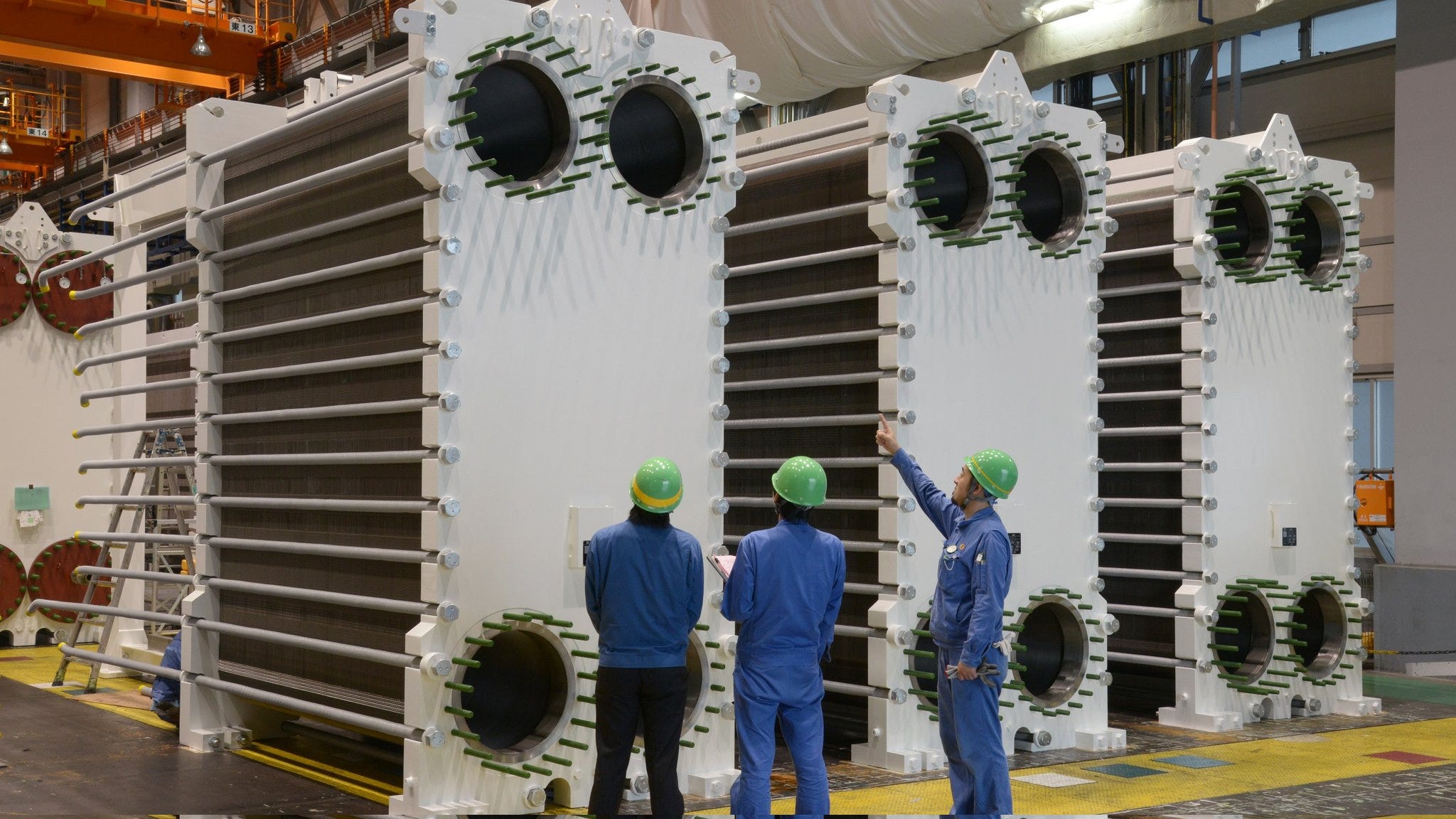
But that pressure and temperature range isn’t enough for the Big Boy applications: A nuclear pressurised water reactor, for example, will shove out water at up to 300C and 150 atmospheres of pressure, which would overwhelm an EPDM rubber gasket.
And a rubber gasket, let’s not forget, is perishable: Not ideal for a long life asset with corrosive, radioactive or just dangerously energetic contents.
So why not replace the rubber gasket with something else?
You could use a brazed plate heat exchanger: Brazing is a process superficially similar to welding in that it uses the addition of a filler material between two joined parts, and the filler material melts to create the join. Unlike in traditional welding, however, the joined materials do not themselves melt, as the filler material has a lower melting point than the joins. This avoids the material distortion issues that would affect thin plates welded around the edges, but the drawback is less structural integrity than a traditional weld.
What does a brazed PHE get you? 30 bar and up to 225C. Still not enough for power generation or refining, but good for a wide variety of other industrial processes, plus brewing.
Beer is good.
6: Ordering the Perfect Pint: Uses of Heat Exchangers.
It’s all very well & good showcasing the methods, but what about the uses? We’ll start with an old favourite: Brewing.
Brewing is a process that operates at generally mild pressures and isn’t too hot or cold either, but the sheer quantity of fluids processed mean that there’s a big costly energy loss in brewing, and this is where heat exchangers can help.
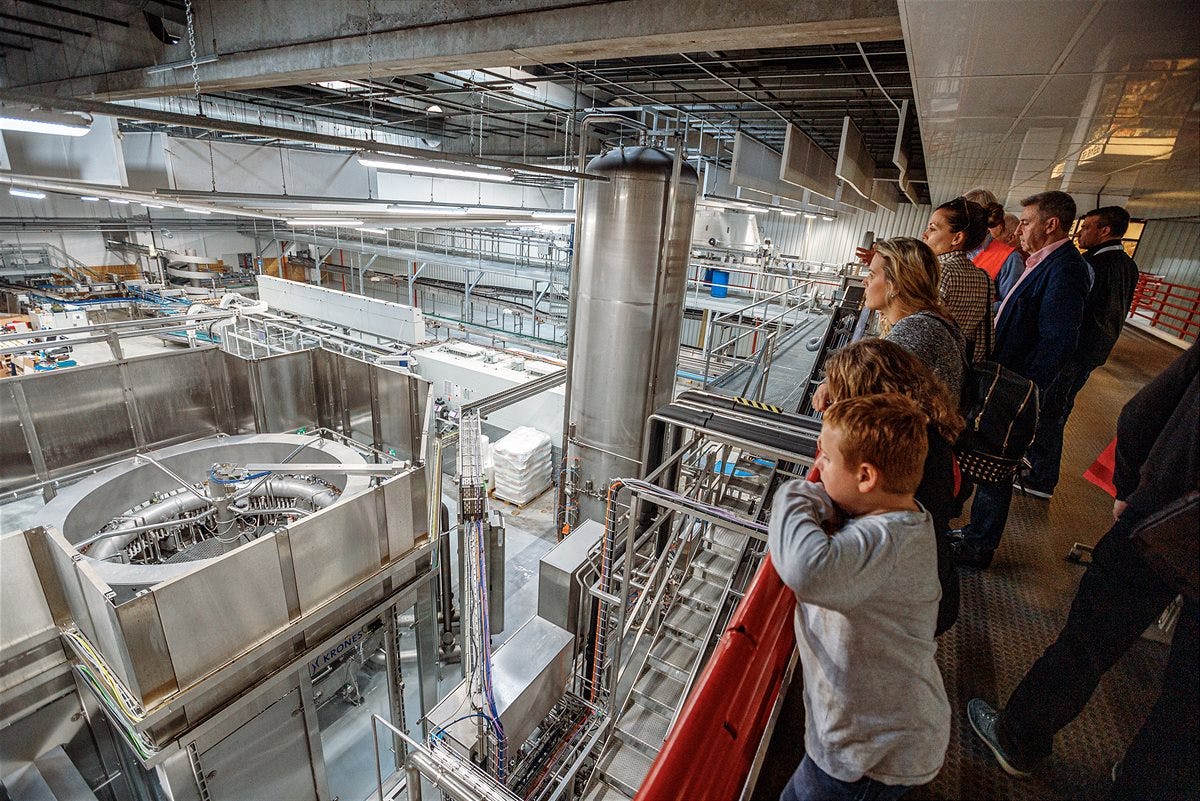
By ‘pumping’ heat from hot processes that need cooling, to cool feeds that need heating, you can affect big reductions in local energy use which is perfect for a low margin industry like brewing beer: You can, for example, pump heat between wort cooling and the feed water boiler.
Or, better still: The Schwechat brewery in Austria even reclaims relatively mild fermentation heat and pumps it to local apartments in the area, thereby heating 900 apartments with delicious beer fermentation heat. Now that’s a loyal customer base!
You wouldn’t necessarily use PHEs or shell & tube exchangers for such a task though: More likely might be a pillow-plate heat exchanger, but we’ll get to that in a minute.
Another, more generic use of heat exchanging is your car’s radiator: Almost every internal combustion engined car has one, and it’s function is to exchange heat from engine coolant with the atmosphere (and potentially your air conditioning). This intelligent system keeps the engine within a manageable temperature range, which not only prevents dangerous overheating of a larger chunk of metal with a limited surface area, but also allows tighter tolerances to be used within the engine’s moving parts, as thermal expansion is being managed through the cooling system. Small, high power engines would be impossible without heat exchanging.
And it gets more grandiose: A heat exchanger that you are, even now, contributing to while reading this is located in a server farm somewhere as your precious bits & bites are converted, through inarguable entropy, into waste heat that must be managed. This can be massive: In my home of Ireland, for example, a completely ridiculous 21 percent of the nation’s electrical demand goes to data centres, all of which ends up as waste heat. You can thank us the next time you ask ChatGPT something silly, and we’ll thank you for making Ireland that little bit warmer. Maybe.
Heat exchanging can be impossibly macho as well: Take, for example, the concept of a supercritical CO2 power cycle plant, a novel, high energy density and super-efficient form of power generation with the promise to miniaturize and clean up a lot of electricity. It relies on carbon dioxide in a recirculating loop, operating in a supercritical phase, extremely high temperature & pressure and possessing qualities of both liquid and gas.
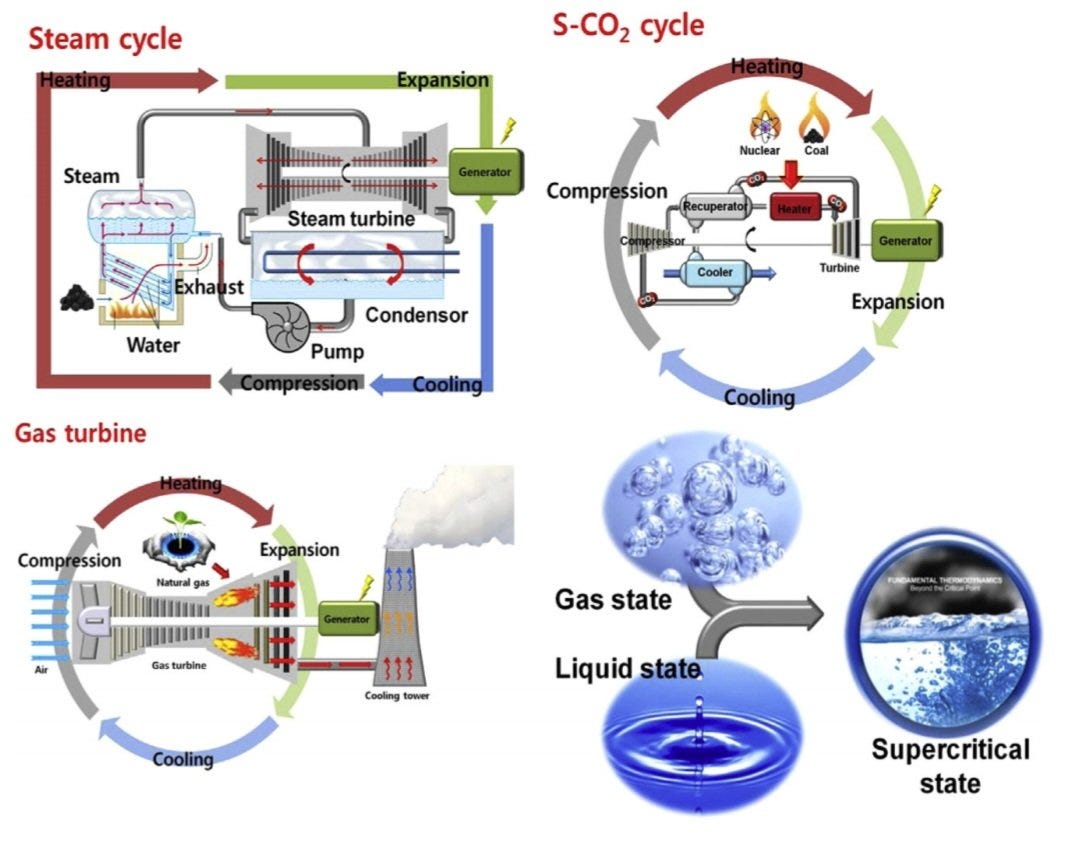
This weird and sophisticated form of science-fiction power generation, which could be revolutionary for us all, can only exist if it is copiously recuperated through heat exchangers, and it is a process that demands a special form of heat exchanging for its high energy density 500 Celsius, 200 bar CO2 flows…
… Just above we have examples of two processes, fermentation tank heat pumping and supercritical CO2 power cycles, that each need something different from the PHEs and shell-&-tube heat exchangers we’ve already talked about.
Let's get into them: Pillow-plate heat exchangers, and printed circuit heat exchangers.
7: Wrapping tanks: The Pillow-Plate Heat Exchanger.
What if you need to retrofit a tank farm or fermentation vessel, like in a brewery or chemical plant, in order to reclaim precious, precious heat, but you don’t want to build everything up from scratch?
You can use a pillow-plate heat exchanger.
These subtle but curiously omnipresent heat exchange systems are perfect for brewing, chemicals and light industrial plant, because they can be retrofitted to existing gear.
The characteristic flowing lines of the pillow-plate heat exchanger, reminiscent of a pillow or bed mattress, are down to the manufacturing process: If you want to retrofit a smooth-walled tank, such as a fermentation tank, with a heat exchanging outer film, what you do is overlay it with thin plates, close to its curvature, that are then resistance spot welded in place. Once this are done, the seams of the thin new outer shell are welded shut, with the exception of the input & output ports for the coolant fluid. A pressurised hydraulic fluid is the pumped into the gap between tank & plates and the pressure increased, distorting one or both plates into the distinctive ‘pillow’ architecture around the spot welds, giving it both its name and function.


These common systems are proliferating now due to the benefits of energy recycling in thermally intensive liquid processing. The recent high energy costs in some parts of the world only add to the drive to retrofit these systems, for thermal energy recycling and heat pumping.
Naturally, due to their means of construction, they are hard, if not impossible, to clean, so coolant liquids used must be of the non-fouling variety, unless chemical solvents can be used in cleaning.
8: Pushing The Limits: Printed Circuit Heat Exchangers
Sometimes you find a process whose heat exchange demands reach dizzying extremes: Tiny size, high pressures, brutal temperatures and a need for very high energy exchange efficiency. Perhaps a shell & tube heat exchanger could handle the pressures & temperatures, but it’s just too big and you need more power concentrated into a smaller space.
What do you do?
An example of this would be closed supercritical CO2 Brayton power cycles, mentioned earlier: This uses extreme pressure & temperature supercritical CO2 to drive a miniaturised turbine, enabled by supercritical CO2’s high density and excellent heat transmission properties.
Brilliant! So what?
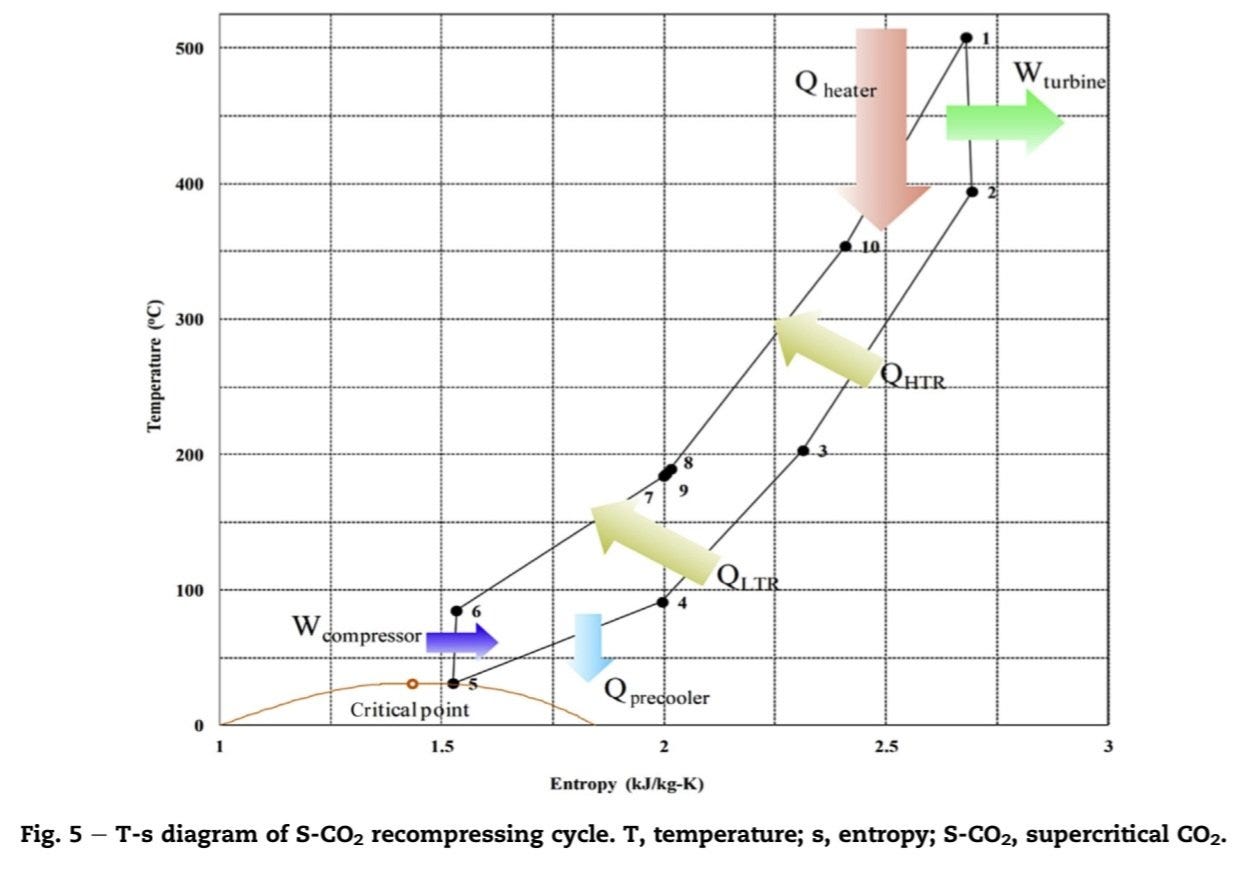
The ‘so what’ is that, in order to close the cycle and cool the SCO2 cycle back to a usable state before it is heated again, but without wastefully dumping the energy, it needs very aggressive heat recuperation: See the T-S (temperature-entropy) diagram shown, which indicates that the energy removed by the turbine simply isn’t all that much, and to take advantage of SCO2’s less compressible lower temperature state at the compressor the exhaust gas must be cooled. High performance heat exchangers are needed to re-use that heat at the opposite end of the cycle, for efficiency.
Got that? It’s OK, you don’t need to. The important thing is that we need tiny, high efficiency heat exchangers that can operate at crazy temperatures and pressures.
Enter printed circuit heat exchangers!


A series of layered heat exchange plates are photochemically etched to provide elaborate mixing surfaces (waves, zigzags etc) to improve boundary layer mixing, maximize surface area and maximise heat transmission. We saw the same thing in plate heat exchangers (PHEs), but unlike the rubber or brazed joins of the PHE, the printed circuit heat exchanger (PCHE) has plates that are robustly diffusion-bonded together, to make a monolithic whole, capable of withstanding extreme forces.
This is, of course, almost impossible to clean, so any proposed use in SCO2 cycles would need to be with clean burning fuels or SCO2 coolant only, but otherwise it ticks every box at once: A superpowered heat exchanger for superpowered applications.
Except… can we go one better?
Maybe we can.
9: 3D printed heat exchangers.
Use selective laser sintering (SLS) on Titanium alloy powder and your imagination becomes the limit. Here is a gyroid heat exchanger, with a complex 3-dimensional internal geometry inspired by the microscopic structure of butterfly wings. It’s dizzyingly complex, but with its high rates of mixing, and vast internal surface area, it beats almost everything else in terms of power density, and variants of this bizarre heat exchanger are being put forward for qualification on helicopters as gearbox heat exchangers.


It makes sense: Weight and size are important in aerospace. We may yet see more of these impossible creations.
10: Forgotten Mules
We're all riding a train in the night. We know where we've come from and we have an idea where we're going but all the little bumps and shudders are a mystery.
Occasionally a distant town or motorway shines brightly enough to catch our eye and we watch it, entranced, until it falls behind us in the murk.
There lays some small glamour, here and gone again.
The seats under us are mucky, disguised with patterns. The floor is stained in spots. Scratches in the paint of walls & seats are key-edged messages, scrawled crudely by those long gone.
“Baz + Sara 4eva”
Maybe they were.
Still we move, juddering and clanking, into the night.
Eventually we shall arrive, stretching and blinking into the fluorescent-stained streets of somewhere new and distracting, and we will forget the train with its growls, hums and shudders.
It is a forgotten mule.
Heat Exchangers are the same, from the small to the massive: An unglamorous keystone of our civilization. Remember these forgotten mules, for you will need them again tomorrow.
You’d love the spiral or coil wound heat exchangers used in applications like the multi-component refrigerant cycles common in large LNG plants.
High pressures, ridiculous temperature ranges, phase changes, very low temperature approaches and efficient heat transfer in a bafflingly compact design.
Marvels of heat exchanger mechanical engineering.